


More news on this day
Thousands of air travelers were left in limbo this week as Dubai International and Zurich Airport registered more than 40 flight cancellations across key Europe–Asia routes, triggering missed connections, overnight stays and a fresh wave of itinerary reshuffles at the start of the peak summer travel period.
Get the latest news straight to your inbox!
Disruptions Hit Two of the World’s Busiest Hubs
Publicly available flight tracking data and airport status boards on June 9 and 10 indicate that dozens of services through Dubai and Zurich were cancelled or heavily disrupted, affecting long haul links between Europe, the Middle East and Asia. Aviation monitoring platforms show cancellations affecting a mix of Gulf superconnectors and European network carriers that rely on the two hubs to funnel transfer traffic across continents.
In Dubai, regional reports and operational snapshots from early June follow a pattern that has emerged since late spring, when waves of schedule cuts and rolling disruptions in the Middle East left thousands of passengers stuck at major hubs. Earlier data from late April and early May documented clusters of 50 or more cancellations and hundreds of delays across Dubai and other Gulf airports in a single day, underscoring how quickly disruption at one node can strand large numbers of connecting passengers.
Zurich, meanwhile, has seen mounting pressure from a combination of capacity constraints, weather related flow restrictions and operational incidents. Network reports for recent months highlight Zurich among European airports experiencing elevated air traffic management delays, while local coverage points to isolated technical issues and aircraft turnbacks that forced cancellations on key long haul sectors.
Although the precise tally fluctuates across the day, combined cancellations at Dubai and Zurich since Sunday are estimated to exceed 40 flights, with a disproportionate impact on routes linking Europe with India, Southeast Asia and other Gulf points.
Key Routes Affected Between Europe, the Gulf and Asia
Early indications suggest that the most affected passengers are those traveling on itineraries that use Dubai or Zurich as a transfer point between Europe and Asia. Long haul services to and from India, Southeast Asia and select African destinations appear particularly exposed, because many operate once daily or a few times per week, leaving limited immediate alternatives when a rotation is cancelled.
In Zurich, recent incidents involving widebody aircraft on routes to Delhi and other long haul destinations have led to same day cancellations and rebookings. Aviation incident summaries from June 7 describe a Zurich to Delhi service that turned back over the Black Sea due to a technical indication, with the onward rotation cancelled and passengers pushed onto later flights. Such events can wipe out an entire day’s capacity on an intercontinental route and force travelers into long layovers or overnight stays.
For Dubai, regional travel coverage during April and May showed concentrated disruption on services linking the hub to major cities in Europe, South Asia and the wider Gulf. A combination of temporary airspace restrictions, precautionary route diversions and airline capacity adjustments has left some city pairs with fewer frequencies than scheduled, heightening the impact when a flight is pulled at short notice.
Travel forums and airline advisories over recent weeks also point to temporary suspensions on certain Manila–Dubai and other Middle East routes for security and operational reasons. When such suspensions overlap with unplanned day of operations cancellations at hub airports, the pool of available seats for rebooking quickly tightens.
Why Dubai and Zurich Are So Vulnerable to Knock-on Effects
The disruption is magnified by the role Dubai and Zurich play in the global air transport network. Dubai International is one of the world’s largest transit hubs, stitching together city pairs across Asia, Europe, Africa and Oceania that would otherwise see little or no nonstop service. Any spike in cancellations there ripples outward across multiple continents as missed connections accumulate.
Zurich, while smaller in absolute scale, is a critical gateway for Switzerland and a key transfer point for traffic to and from central and eastern Europe. Industry data shows that more than three quarters of Zurich’s passengers are traveling on European routes, many feeding onward to intercontinental flights. Network performance reports for early 2026 note that weather and capacity constraints at Zurich contributed thousands of minutes of air traffic flow management delay, leaving little margin when additional issues arise.
Analysts note that both hubs are also contending with broader structural pressures. Since late February, a series of regional security concerns and shifting overflight patterns has forced airlines to reconfigure routes between Europe and Asia, increasing flight times and complicating crew and aircraft scheduling. Trade publications for spring 2026 detail how some Asian and Gulf carriers temporarily suspended Dubai or Riyadh services, reallocated capacity and reworked flight paths to avoid conflict zones, adding stress to already tight summer schedules.
At the same time, higher fuel costs and staffing constraints have left airlines with less spare capacity to absorb shocks. When an aircraft goes out of rotation in Zurich or a bank of departures is curtailed in Dubai, there are fewer standby aircraft and crews available to restore normal operations quickly.
What Stranded Passengers Are Experiencing on the Ground
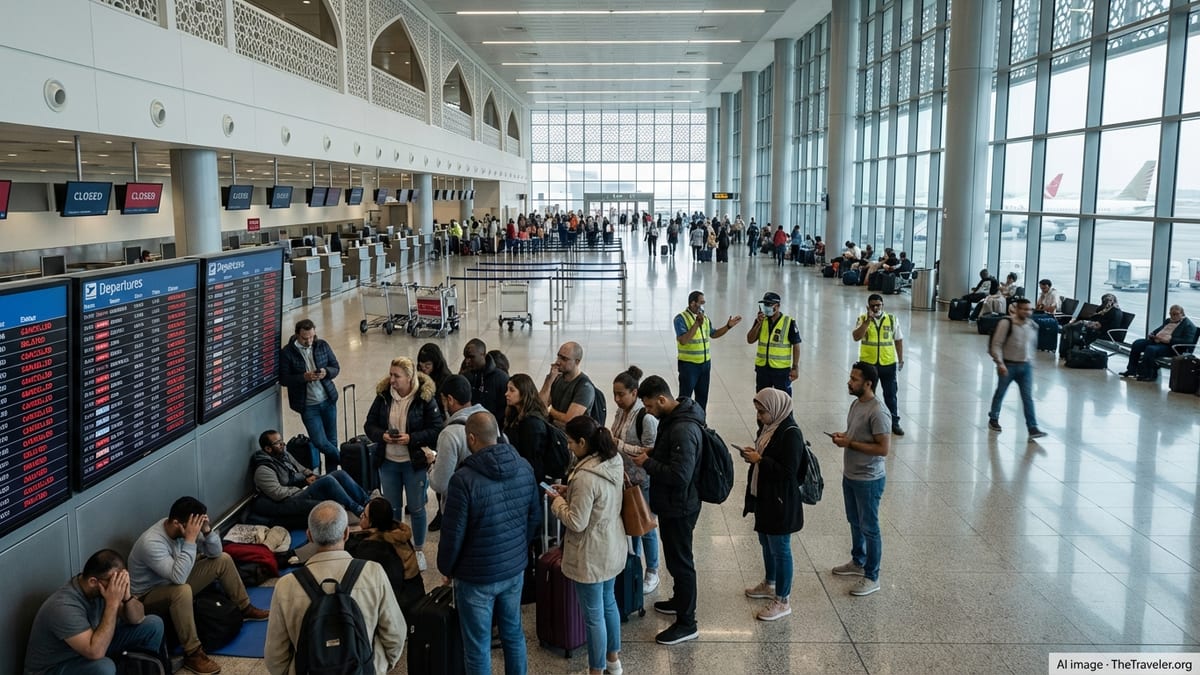
Images shared on social channels and descriptions from travel forums over the past 48 hours depict crowded departure halls, long lines at service desks and passengers camping near power outlets as they wait for new itineraries. Some travelers report being automatically rebooked via alternative hubs such as Frankfurt, Istanbul or Doha, while others describe waiting hours for confirmed onward seats as flights on popular routes fill up.
At Zurich, airport documentation on winter and disruption planning outlines designated rest areas and procedures for accommodating stranded passengers when large numbers of cancellations occur. However, the current wave of disruptions has occurred in the shoulder between spring and high summer, when hotel capacity in the surrounding region can already be tight due to events and tourism, complicating efforts to place travelers overnight.
In Dubai, recent regional disruption days have shown how quickly terminal infrastructure can be overwhelmed when banks of long haul departures are cancelled at short notice. Observers describe scenes of departure boards dominated by delayed and cancelled statuses, with queues forming not only at airline counters but also at immigration, food outlets and airport hotels as passengers attempt to salvage their trips.
Travel advocates note that the knock on impact is especially severe for those with complex itineraries, separate tickets or time sensitive commitments such as visa expiry dates, work obligations or onward cruises and tours. For these travelers, a cancelled flight in Dubai or Zurich can cascade into multiple missed connections and substantial extra costs.
Essential Guidance for Travelers Caught in the Disruption
Publicly available guidance from regulators and consumer organizations stresses that passengers affected by cancellations should first verify the exact status of their booking through airline apps or websites before heading to the airport. In several recent Middle East and European disruption events, airlines have advised customers not to travel to the airport if their flight is already marked as cancelled, in order to reduce congestion at terminals.
Travel law resources highlight that many journeys touching Dubai or Zurich may fall under different compensation regimes depending on the airline and the origin or destination of the flight. European Union rules and Switzerland’s equivalent ordinance can, in certain circumstances, provide compensation, meals and accommodation when flights departing from or arriving in Europe are cancelled or severely delayed, unless the airline can demonstrate extraordinary circumstances. For flights starting and ending outside Europe, policies vary by carrier and jurisdiction.
Consumer advocates recommend that passengers keep boarding passes, booking confirmations and any written communication from the airline about the reason for a cancellation, as this documentation can be important when seeking refunds, compensation or insurance claims. Where rebooking options are limited, some advisers also suggest asking about rerouting via alternative hubs, even if it means an extra stop, to avoid being stranded for several days awaiting the next direct service.
With schedules in flux, frequent travelers are urging others to build additional margin into itineraries that rely on Dubai or Zurich in the coming weeks, including longer connection times and flexible hotel and ground transport bookings. Given the combination of regional tensions, tight capacity and the onset of peak season, aviation analysts warn that further disruption across key Europe–Asia corridors remains possible even after the current wave of cancellations eases.