


More news on this day
Europe’s river cruise boom is colliding with climate stress and local backlash, forcing industry leaders to rethink how they sail, where they dock and how much growth rivers can really bear.
Get the latest news straight to your inbox!
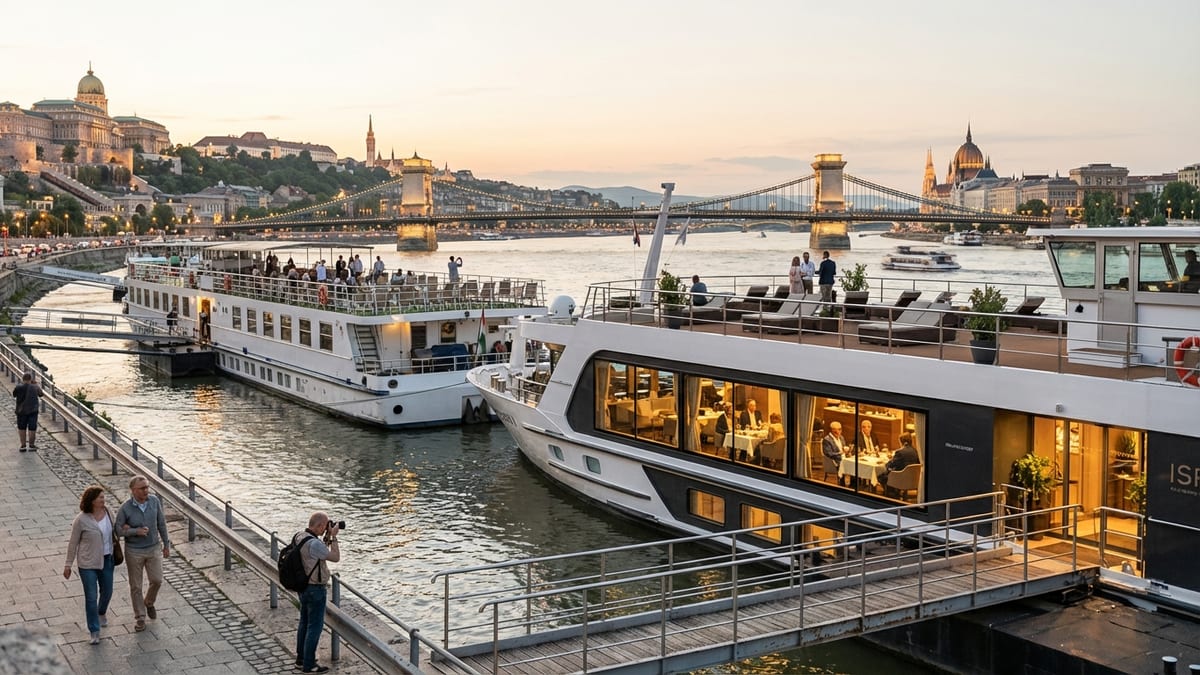
Low water turns climate risk into day-to-day operations
Recent heatwaves and scant rainfall across Central Europe have again pushed parts of the Danube and Rhine toward unnavigable levels, disrupting itineraries and sharpening focus on how exposed river cruising has become to climate volatility. Reports from cruise trackers and passenger forums in June and July 2026 describe groundings, last-minute ship swaps and extended coach transfers where vessels cannot safely pass shallow stretches.
These incidents build on several years of erratic conditions. Industry coverage has documented repeated low water episodes on both the Rhine and Danube since 2018, with 2022 singled out as a particularly difficult season for inland shipping and tourism. Market observation reports from Rhine navigation authorities point to a growing number of “critical low water days,” turning what was once considered an occasional anomaly into a recurring operational risk.
Executives have responded by normalising contingency planning. Larger fleets are increasingly deployed as flexible networks, allowing lines to switch guests between identical sister ships on different river segments rather than cancel entire voyages. Older vessels are being complemented with boats designed to sit lower in the water, and itineraries are more frequently written with built-in buffers for delays, alternate ports and coach-based excursions when a section of river becomes impassable.
For travellers, this means European river cruises remain viable but less predictable. Itineraries marketed around an uninterrupted journey from Amsterdam to Budapest, for example, now often carry prominent disclaimers that segments may be operated partly by road if water levels fall. Executives frame this as a trade-off between maintaining capacity on popular routes and acknowledging that climate risk can no longer be treated as a rare exception.
Overtourism shifts from coastal flashpoints to inland cities
While ocean-going megaships continue to dominate headlines about overtourism in cities such as Barcelona and Venice, the rapid growth of river cruising is beginning to test the tolerance of smaller inland destinations. River cruise market studies for 2024 and 2025 show passenger numbers and overnight stays rising steadily on the Rhine, Danube and Douro, turning once-niche itineraries into mass-market products.
Public debate has so far focused on air pollution and crowding from large cruise ships, but some of the same concerns are emerging along rivers. Historic centres that sit only a short walk from quaysides can experience sharp spikes in visitor numbers when several vessels dock simultaneously, particularly during peak summer weeks. Residents’ groups in popular stops along the Middle Rhine and upper Danube have begun to question whether narrow streets, housing stock and local services can absorb continued growth without new rules.
In response, port authorities and municipalities are experimenting with tools long used in major seaports. These include caps on the number of ships allowed to dock at one time, requirements to berth further from city centres, and higher port fees tied to emissions performance. Some cities are also adjusting coach access and parking near riverfronts in an attempt to spread groups more evenly across the day and toward lesser-known quarters.
Executives argue that river ships, which typically carry 150 to 200 guests, distribute visitors more gently than ocean vessels that can deliver thousands at once. Yet the cumulative effect of longer seasons, more ships and denser scheduling means even modest vessels contribute to the same pressure points seen elsewhere in Europe: crowded viewpoints, rising short-term rentals and friction between daily life and visitor expectations.
Building resilience: fleet design, data and diversified routes
Conversations around resilience in the river sector now extend well beyond emergency response. Industry analyses presented in 2024 and 2025 highlight three main fronts for adaptation: hardware, data and product design. On the hardware side, newer vessels are being commissioned with shallower drafts and more efficient hull shapes to increase their operability at lower water levels. Some operators are also investing in hybrid propulsion and improved wastewater systems to align with tightening environmental rules and local expectations.
Data has become another critical pillar. Navigation authorities along the Rhine and Danube publish increasingly detailed hydrological information, while private weather and river-level forecasting tools are being integrated into cruise planning. Executives emphasise the need to move from reactive schedule changes to proactive routing decisions that anticipate low or high water several days in advance, minimising disruption for both guests and local partners.
Product design is shifting in parallel. Lines are diversifying beyond the most water-stressed chokepoints, promoting itineraries on tributaries and other European rivers where conditions are historically less volatile. Shoulder-season sailings in spring and autumn are being marketed more aggressively to relieve peak summer bottlenecks. Some brands are blending river segments with rail or land components, treating the ship as one part of a broader journey rather than the sole focus.
Collectively, these measures signal that resilience is becoming a competitive metric. Operators that can maintain service through a volatile summer, while keeping disruption and emissions in check, position themselves more strongly with both travellers and regulators in a tightening climate policy landscape.
Balancing growth ambitions with local acceptance
The underlying tension for river cruise executives is how to reconcile robust demand with finite river capacity and community patience. Market research commissioned by industry groups points to strong interest from North American and European travellers, particularly older guests seeking slower-paced trips through cultural landscapes. At the same time, surveys and protests in popular European destinations reveal a public increasingly wary of tourism’s side effects, from housing pressure to congestion and environmental stress.
River cruising often presents itself as a more sustainable alternative to both long-haul flying and large ocean ships, citing lower passenger counts and closer integration with rail networks. However, local acceptance is likely to depend on how visibly operators contribute to solutions, whether through onshore power use, stricter noise controls at night, or financial participation in riverfront infrastructure and conservation projects.
Several destinations are beginning to tie docking rights more explicitly to these factors. Pilot schemes in parts of Western and Central Europe link access to environmental performance scores, while regional planning documents reference the need to align river tourism with water management strategies and climate adaptation plans. These developments suggest that future growth will be less about adding capacity wherever demand appears and more about negotiating social and ecological thresholds on a river-by-river basis.
For now, the European river cruise sector remains on an upward trajectory, with new ships on order and booking data for 2026 and 2027 reported as strong. The challenge for executives is to steer that momentum through shallow waters, crowded quays and rising expectations that the industry not only weather climate shocks, but actively help rivers and river communities become more resilient.