


More news on this day
Dubai has drawn an estimated 7 million international visitors so far this year even as the Iran war disrupts Gulf airspace, curbs airline schedules and dampens wider Middle East travel demand, according to publicly available tourism and aviation data.
Get the latest news straight to your inbox!
Visitor numbers hold up amid regional conflict
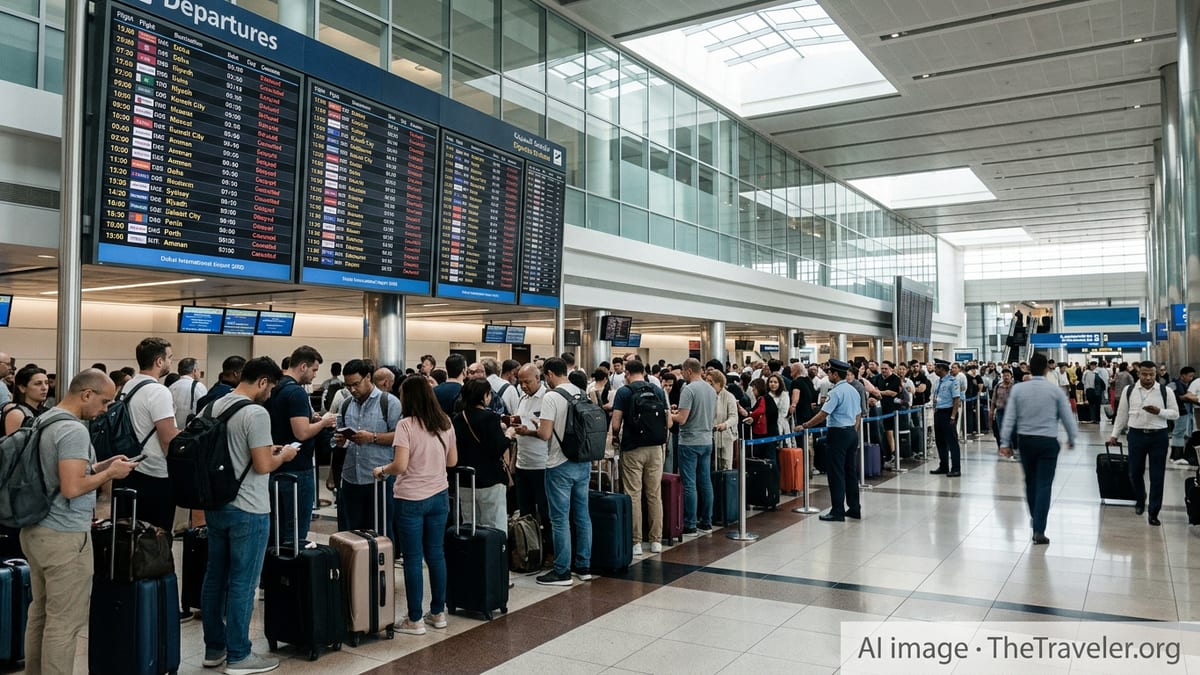
Travel and tourism indicators suggest that Dubai has continued to welcome millions of international travellers in 2026, with visitor arrivals and airport throughput remaining far above the lows seen in the immediate aftermath of the February start of the Iran war. Passenger traffic at Dubai International Airport fell sharply in March as missile strikes and precautionary closures rippled across Gulf airspace, but volumes began to recover from April onward as restrictions eased and more routes were restored.
Publicly available statistics for the first half of the year point to more than 30 million passengers moving through Dubai’s two airports and a gradual return of leisure visitors, even as flight schedules remain below earlier projections. Tourism officials have highlighted that Dubai finished 2025 with 19.6 million international overnight visitors, and industry forecasts now suggest that roughly 7 million people have already visited the city in 2026 despite months of disruption.
Travel analysts note that this level of demand contrasts with steeper drops reported in several neighboring destinations that are closer to front-line tensions or more dependent on charter traffic. While Dubai’s hotel occupancy and room rates have softened compared with a year earlier, sector data indicates that the city is still outperforming many regional competitors as airlines and tour operators prioritize routes that can reliably feed its hub.
Airspace closures reshape Dubai’s global hub role
The Iran war led to repeated closures and restrictions across Gulf airspace, forcing wide detours or full suspensions on some of the busiest east–west corridors. Dubai’s aviation system, anchored by its main international airport and the emirate’s flagship carrier, saw passenger traffic fall more than 30 percent year-on-year in the first half of 2026 as a direct consequence of rerouting and cautious scheduling by international airlines.
Airport management has revised its full-year traffic projection to around 70 million passengers, down from an earlier goal close to 100 million. Reports indicate that targets near pre-war records are now being pushed out to 2027 as the region waits for a more durable easing of hostilities and insurance restrictions. Several European low-cost and long-haul carriers continue to operate reduced frequencies or seasonal pauses into Dubai while they assess risk and demand.
Despite that, the city’s main airport is still operating near full capacity at peak times. Emirates and other Gulf-based airlines have restored the vast majority of their pre-war network, shifting capacity to resilient origin markets in Asia, Europe and the Middle East and North Africa. The ability to re-time flights, use alternative routings and rely on a large connecting passenger base has helped Dubai maintain a steady stream of visitors even as detours add flying time and cost.
Key source markets and shifting travel patterns
Available data from airport and tourism authorities shows that India, Saudi Arabia and the United Kingdom remain among the top source markets for travel to and through Dubai in 2026, echoing patterns that were already visible before the conflict. Passenger volumes from these countries have softened but remain substantial, supported by large expatriate communities, strong trade links and enduring interest in Dubai as a short- to medium-haul getaway.
At the same time, there are signs that travel patterns are shifting in response to war-related advisories and higher airfares. Industry coverage points to shorter booking windows, a stronger focus on last-minute deals and a greater reliance on regional visitors who can reach the emirate on relatively short flights that avoid the most affected airspace. Hotels and resorts have been targeting residents and Gulf neighbors with discounted staycation offers to cushion the impact of weaker long-haul demand.
Travel platforms are also reporting a pivot toward destinations perceived as lower risk or more affordable, which has created new competition for Dubai in Europe and parts of Asia. Even so, the city’s extensive air links, diverse accommodation base and established reputation as a stopover point on long-haul journeys are helping it retain a significant share of global traffic, keeping visitor numbers in the millions rather than the steep declines seen in some nearby markets.
Tourism industry adjusts to a new risk landscape
The war in Iran has created a new risk calculus for the wider Middle East travel industry, with the World Travel and Tourism Council estimating substantial losses in international visitor spending across the region. For Dubai, this has meant weighing short-term safety measures and operational disruptions against the need to preserve its status as a year-round travel hub and leisure destination.
Airlines, hotels and tourism operators are reworking their plans accordingly. Aviation strategies now place greater emphasis on flexible routing, rapid schedule changes and the ability to redeploy capacity if specific corridors become constrained. On the ground, hospitality groups are focusing on enhancing experiences that keep visitors within the city for longer stays, from new attractions and cultural offerings to bundled packages that encourage repeat travel once conditions stabilize.
Travel industry events hosted in Dubai, including this year’s major trade shows, are being used as platforms to reassure partners, showcase resilience measures and signal that the emirate remains open for business. Participants are closely monitoring how quickly demand from corporate, meetings and incentive segments can return, given that travel insurance and corporate risk policies still limit some international business trips.
Resilience tested as Dubai looks beyond 2026
Dubai’s ability to attract around 7 million visitors during a year marked by conflict underscores the depth of its tourism and aviation ecosystem, but the outlook remains tightly linked to geopolitical developments. Forecasts suggest that overall passenger volumes will continue to recover in the second half of 2026, though at a slower pace than originally expected before the war reshaped regional travel flows.
Large-scale infrastructure projects at the emirate’s airports and tourism districts are proceeding, signaling confidence in long-term growth even as near-term metrics fluctuate. Investments in terminal upgrades, digital border processes and new attractions are framed as preparation for a future in which Dubai aims not only to regain but to surpass its pre-war visitor benchmarks.
For now, the city’s tourism narrative is one of cautious resilience. Strong performance in core source markets, the capacity of its airlines to adapt to airspace disruptions and proactive efforts by the hospitality sector have helped Dubai draw millions of visitors in a volatile year. How quickly that momentum can accelerate will depend on the trajectory of the Iran war, the pace at which travel advisories are relaxed and the willingness of long-haul travelers to return to the Gulf in large numbers.