


More news on this day
Nine Schengen countries, including major gateways such as France, Germany and Italy, have secured a further delay to enforcing full biometric checks under the European Union’s new Entry/Exit System, easing immediate pressure on airports but extending uncertainty for millions of non-EU travelers planning trips this autumn and winter.
Get the latest news straight to your inbox!
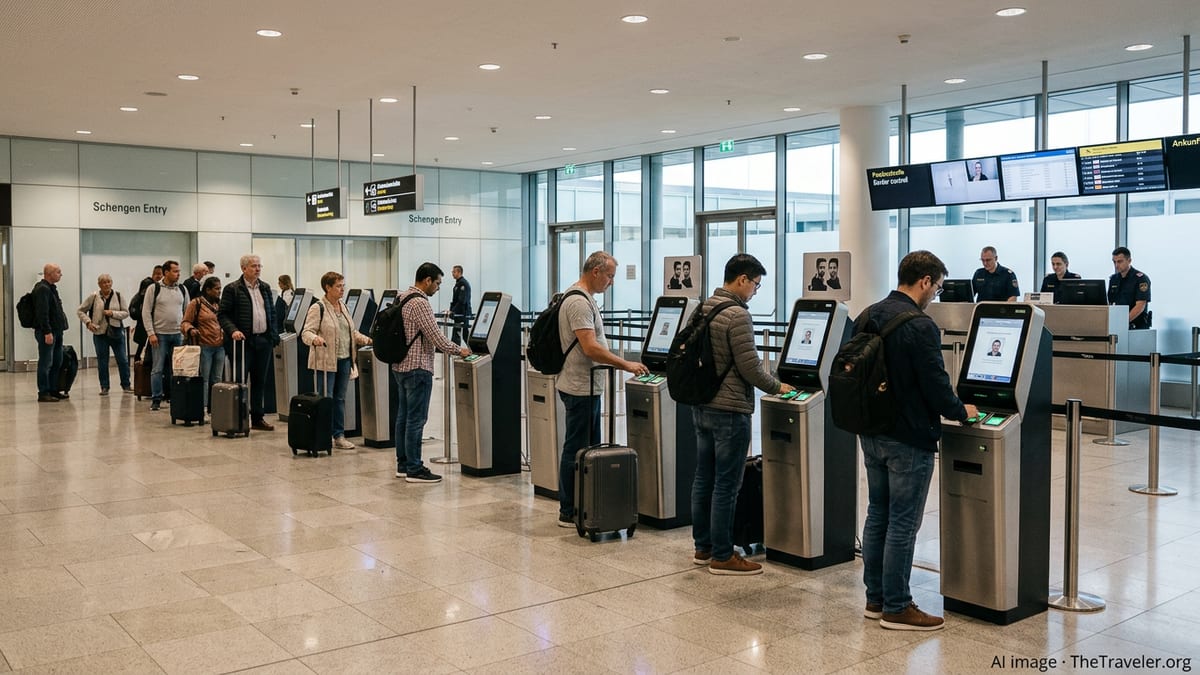
Informal reprieve after official EES flexibilities expire
Published coverage indicates that the latest delay follows the expiry of the EU’s formal summer derogation on 6 September 2026, which had allowed border posts to suspend biometric checks temporarily when queues became unmanageable. That waiver was designed as a short-term safety valve during the first peak season under the new Entry/Exit System, known as EES.
Reports from European travel and business media describe an informal understanding now in place for at least nine Schengen states, including France, Belgium, the Netherlands, Germany, Greece, Italy, Malta, Portugal and Switzerland. These countries are reportedly being allowed to hold off on strict, across-the-board biometric processing while they work through software problems, capacity issues and local bottlenecks at busy air and sea gateways.
The move represents a notable shift from earlier European Commission messaging that the system could not be applied unevenly across member states. Recent reporting suggests that, in practice, Brussels is accepting a more flexible rollout as long as countries continue to capture data where technically feasible and keep the core system live.
For travelers, the result is a patchwork of experiences at the border, with some crossings running near-normal passport checks and others still testing or partially applying the new fingerprint and facial-scan procedures introduced under EES.
Why nine countries sought more time
The nine countries pushing for an extension are among the Schengen area’s busiest entry points for non-EU visitors, handling large volumes of British, American and other long-haul travelers. According to recent reports, these governments argued that full enforcement of biometric checks at every booth risked recreating scenes of airport gridlock seen earlier in the summer.
During peak holiday weeks, travelers at several European hubs faced queues stretching for hours as the new system struggled to keep pace with demand. Coverage from European and international outlets has highlighted cases of long waits at airports such as Brussels and at key ferry and land-border crossings, with some travelers reportedly missing flights or onward connections after repeated attempts to capture biometric data.
Technical teething problems have been another major concern. Reports describe instances of duplicate EES profiles, failed data transfers and repeated biometric registrations for the same traveler, undermining the system’s promise of faster processing on subsequent trips. Border forces in high-traffic countries have also warned that they lack sufficient trained staff to manage both manual checks and the expanded biometric workload during peak times.
By seeking extra time, the nine countries aim to stabilize their national systems, refine passenger flows and train additional staff, while avoiding a return to extreme queues that could damage Europe’s reputation with long-haul leisure and business visitors.
What the EES system changes for non-EU travelers
The Entry/Exit System is the EU’s flagship biometric border database for recording movements of non-EU nationals entering and leaving the Schengen area. According to publicly available information, it became fully operational at external Schengen borders in April 2026 after a phased deployment that began in late 2025.
Under EES, travelers from countries such as the United Kingdom, United States, Canada and many others must provide fingerprints and a facial image on their first entry after the system goes live, replacing traditional passport stamps. The system stores biometric and biographic data, along with details of entry and exit, with the stated goals of tightening overstayer controls and improving security.
In theory, once a traveler is registered, later crossings should be faster, as automated gates and kiosks can verify their identity against stored records. However, early experience has not always matched that promise. Reports from passenger groups and travel forums describe repeated biometric capture, inconsistent use of e-gates and, in some locations, a continued reliance on manual booths due to technical or staffing constraints.
The nine-country delay does not suspend EES entirely. Instead, it effectively slows the transition to strict, universal biometric processing at all times, with border officers in those states making wider use of existing flexibilities to prioritize flow and safety when systems struggle or queues spike.
Impact on autumn and winter travel plans
For travelers planning trips to Europe in late 2026, the latest postponement offers short-term relief but also adds complexity. Business-travel specialists note that, in the nine countries benefitting from the delay, many passengers may continue to encounter a lighter-touch regime, particularly at airports that have struggled most with early EES implementation.
This could mean shorter queues at some entry points compared with a strict, fully enforced biometric rollout. At the same time, travelers are being advised in published guidance to allow extra time at the border, especially when connecting flights or cruises are involved, because local conditions can still change quickly as systems are adjusted or stress-tested.
The uneven application of EES across Schengen may also influence route planning. Some carriers and travel advisers are already highlighting airports and land crossings that appear to be coping better with the new processes, while warning that others remain prone to sudden delays when volumes surge or technical issues arise.
For frequent non-EU visitors, the continuing transition period means that experiences can vary widely even within the same journey. A traveler might pass quickly through one country’s border using a kiosk and e-gate, then encounter long manual queues on departure from another, despite both being part of the same Schengen area.
What comes next for Europe’s border overhaul
Despite the fresh delay for nine countries, EU institutions and member states remain on a path toward a fully biometric external border regime. Commission policy papers and recent Schengen reports continue to frame EES as a cornerstone of wider migration and security reforms, with future integration planned alongside the forthcoming European Travel Information and Authorisation System for visa-exempt visitors.
Industry groups, including airline and airport associations, are pressing for a more realistic timetable and clearer communication, urging that IT upgrades, staff recruitment and passenger education keep pace with regulatory deadlines. Some have publicly argued for additional grace periods into 2027 to avoid repeating the scenes of congestion seen during the first post-rollout summer.
Travelers, meanwhile, are being encouraged by consumer advocates and travel organizations to monitor official government and airport advisories before departure, check recommended arrival times for border control and be prepared for either a streamlined automated process or a slower manual one. As long as the nine-country delay remains in effect and other states continue to fine-tune their systems, predictability at the EU’s external borders is likely to remain limited.
For now, the informal reprieve granted to France, Germany, Italy and their peers buys time for technical fixes and operational adjustments. How effectively that time is used will determine whether the 2027 peak seasons unfold under a confident, fully functioning biometric border system or with renewed calls for yet another round of delays.