


More news on this day
Flight schedules across Dubai and the wider Middle East remain under strain as airlines extend route suspensions and diversions, even as reports indicate that recent US strikes on Iran have come to a halt.
Get the latest news straight to your inbox!
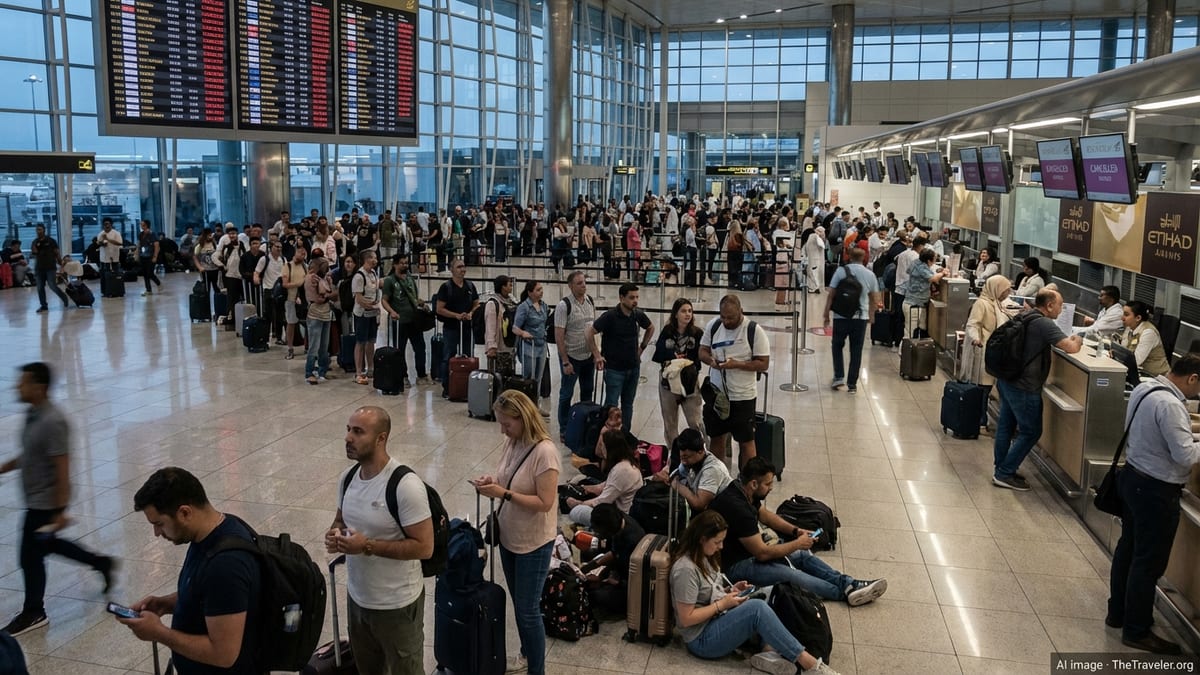
Pause in US attacks fails to reset regional aviation
Publicly available information on recent military developments in the Gulf suggests that the United States has paused direct strikes on Iranian targets after months of heightened confrontation. However, this shift has not immediately restored confidence in the air corridors that connect Europe, Asia and Africa through the Gulf’s big hubs.
Analysis of open flight-tracking data and airline advisories indicates that carriers are continuing to avoid the most sensitive airspace following missile and drone activity earlier this year that temporarily shut or curtailed operations at airports in the United Arab Emirates, Kuwait and other states. Dubai International, one of the world’s busiest intercontinental hubs, has gradually rebuilt services, but the regional network that feeds it is still heavily disrupted.
Industry briefings on the conflict’s wider economic impact describe a structural reset rather than a short interruption, with airlines locking in longer routings to skirt closed or higher-risk airspace. That pattern helps to explain why, despite the halt in US attacks, many airlines are in no rush to reinstate suspended routes through the northern Gulf and Levant, where airspace rules and risk assessments remain fluid.
Specialist security and logistics updates also point to continued congestion on remaining open corridors, as carriers crowd into narrower bands of approved routes. The resulting bottlenecks are adding both time and cost to journeys that would normally pass efficiently over Iran and neighboring states.
Dubai hub open, but selective suspensions persist
Dubai International Airport and other UAE gateways are fully operational, but schedules show that a number of foreign airlines have still not returned to their pre-crisis timetables. Travel-industry summaries compiled in June and July highlight multiple Asian and European carriers that extended suspensions of Dubai services into August and beyond, citing regional risk assessments and aircraft deployment constraints.
In parallel, network updates from cargo and logistics providers describe Dubai and Abu Dhabi as open yet constrained, with some routings still unavailable and others operating at reduced frequencies. These reports note that limited capacity into certain neighboring markets, such as Kuwait and Iraq, continues to spill over into Dubai itineraries, creating knock-on effects for passengers using the city as a transfer point.
Local traveler accounts shared on public forums depict a mixed picture on the ground. Core routes operated by Gulf carriers are largely running, although often with retimed departures and occasional rolling cancellations. At the same time, travelers booked on specific European or Asia Pacific airlines are finding that their Dubai legs remain suspended, forcing rerouting through alternative hubs such as Istanbul, Athens or South Asian gateways.
This patchwork recovery means that Dubai’s role as a global connector is intact but less predictable. While the airport is no longer in the near-standstill phase seen during the height of the strikes, the persistence of selective airline suspensions continues to limit choice and complicate long-haul planning.
Regional route map reshaped across the Middle East
The disruption is not confined to the UAE. Regional aviation updates gathered since March show that several Middle Eastern airports continue to face reduced connectivity, particularly where airspace closures have been slower to ease. Published analyses of the 2026 Iran war and its aftermath note that Iran, Iraq, Israel and parts of the eastern Mediterranean experienced particularly sharp cuts in overflights and direct services.
Some national and regional carriers have announced prolonged suspensions on routes into conflict-adjacent markets such as Tel Aviv, Beirut, Amman and certain Iraqi cities. In several cases, these pauses stretch well into the summer season or are listed as “until further notice,” reflecting both security concerns and uncertainty over demand.
Broader economic assessments of the conflict describe how these closures have reshaped global air traffic patterns. With Iran and segments of neighboring airspace effectively off-limits for many operators, flights linking Europe with South and Southeast Asia, as well as Australasia, are being pushed south and west. This adds distance and fuel burn and has encouraged airlines to consolidate capacity on fewer, higher-yield routes while trimming more marginal services via the Gulf.
The net effect is a regional map that still looks far from normal. Traditional Middle East stopover hubs remain central to global connectivity, but their catchment areas and feeder networks have been temporarily redrawn, with some secondary cities left with only skeletal links or none at all.
Rerouting pressures and operational costs mount
Economic studies on the conflict’s fallout highlight the mounting cost burden associated with these flight changes. Airlines have been forced to adopt longer routings that circumvent closed or high-risk airspace, significantly increasing fuel consumption. For long-haul carriers that previously relied on efficient great-circle tracks across Iran and adjacent territories, each additional hour in the air erodes margins or forces fares higher.
Industry observers note that this situation is unfolding against a backdrop of already elevated fuel prices and tight aircraft availability. Some airlines are responding by prioritizing the most profitable routes and deferring or cancelling services that no longer make commercial sense at current risk and cost levels. That approach helps explain the persistence of route suspensions even as the immediate military tempo appears to have eased.
Operational complexity has also increased. Dispatch teams must continually adjust flight plans in response to changing notices to airmen, government advisories and insurance conditions. In many cases, carriers are choosing conservative routings that remain valid even if tensions flare again, rather than repeatedly opening and closing marginally shorter paths.
This conservative stance is particularly visible in the continued avoidance of direct overflights near recent strike zones. Aviation analysts suggest that a sustained period of stability will likely be required before airlines redraw these paths, meaning the cost and schedule impact could last well beyond the formal end of active US involvement.
What travelers using Dubai and the region should expect
For passengers planning trips through Dubai or neighboring hubs, publicly available guidance from airlines and travel organizations converges on a few practical expectations. First, schedules remain more volatile than usual, with short-notice changes to routings and departure times still possible as carriers navigate airspace restrictions.
Second, travelers may find that certain city pairs involving Dubai, the Gulf and the Levant are simply unavailable on their preferred airlines for upcoming weeks. While core trunk routes are operating, some carriers have removed inventory for suspended services from booking systems, forcing customers onto alternative hubs or different travel dates.
Third, even when flights operate as planned, journey times can be longer than they were before the crisis because of extended routings. This can reduce connection buffers and raise the risk of missed onward flights, particularly on tightly timed itineraries between Europe and Asia.
Travel experts quoted in open reports advise passengers to monitor their bookings frequently, allow generous connection windows and remain flexible on carriers and routings. Until regional airspace patterns stabilize and airlines are confident enough to reverse suspensions, Dubai and the wider Middle East are expected to remain in a period of elevated, though gradually improving, disruption.