


More news on this day
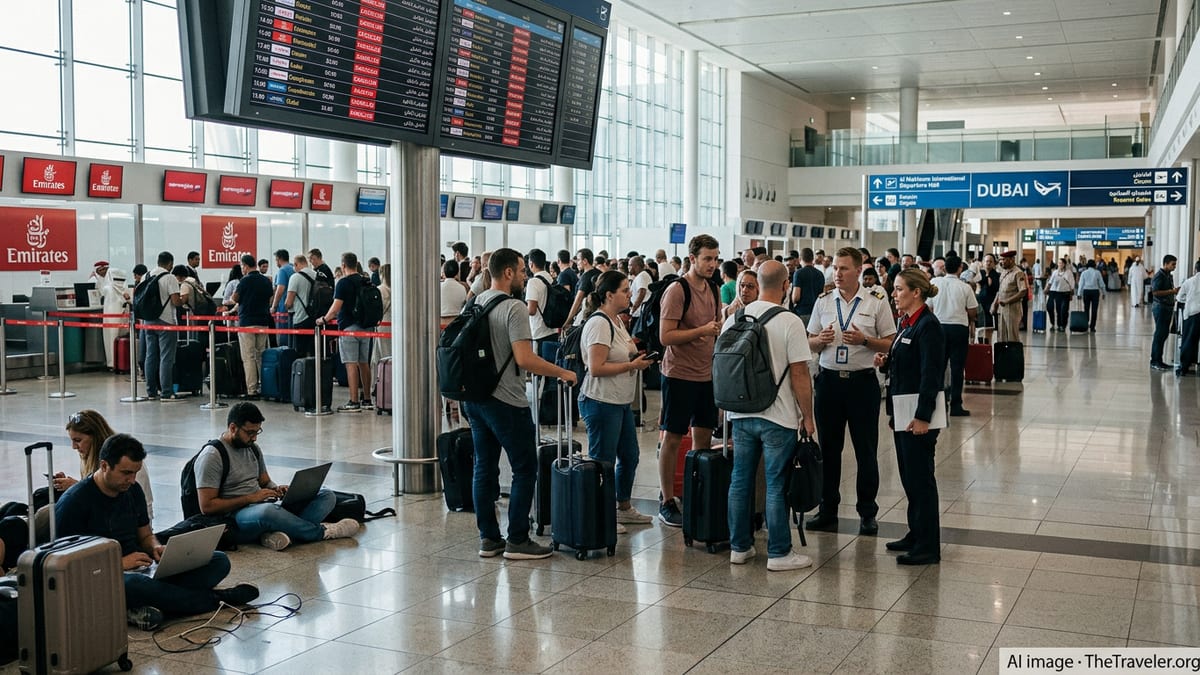
Summer travel plans for thousands of passengers connecting through Dubai are being upended as at least 16 international airlines suspend flights to the emirate, extending months of disruption triggered by regional airspace restrictions.
Get the latest news straight to your inbox!
Regional tensions keep flight schedules in flux
Published coverage indicates that Dubai’s flight disruption traces back to airspace closures that began on February 28 following military strikes involving the United States, Israel and Iran. Those restrictions forced airlines to reroute or cancel services across the Middle East, with Dubai International Airport, one of the world’s busiest hubs, experiencing a sharp reduction in operations.
After a complete shutdown of departures and arrivals for roughly 48 hours in early March, limited services gradually resumed from Dubai International and Dubai World Central. However, travel advisories from aviation trackers and passenger-rights platforms note that schedules have remained constrained, particularly for foreign carriers that rely on stable overflight corridors between Europe and Asia.
While major UAE-based airlines such as Emirates, flydubai, Etihad Airways and Air Arabia have rebuilt much of their networks under the new routing patterns, many overseas airlines continue to assess operational and insurance risks before restoring normal timetables to the UAE.
As a result, the approach of the northern summer peak has not yet brought a full return to pre-crisis connectivity, and analysts suggest that uncertainty over the regional security outlook is likely to hang over airline planning for the remainder of the season.
Which airlines are suspending Dubai flights
Lists circulating in regional media and traveller forums show at least 16 foreign airlines have either suspended Dubai flights entirely or pushed back their planned restart dates into the late summer period. The suspensions span European, Asian and Central Asian carriers, reflecting the broad geographic impact of the airspace disruption.
Hong Kong’s Cathay Pacific has paused flights to both Dubai and Riyadh until the end of August, according to a factbox summarising airline schedule changes. Singapore Airlines has extended the suspension of its Singapore to Dubai route into early August while redeploying capacity to long haul services less affected by the current restrictions.
Additional pauses affect several European flag carriers. Reports indicate that Lufthansa Group airlines and other European operators have frozen certain Dubai services until mid September, in some cases aligning Dubai suspensions with wider reductions on routes into nearby Gulf and Levant destinations.
In parallel, regional outlets in the Gulf highlight temporary suspensions from carriers such as Aegean Airlines and Air Astana, with some routes not due to return until July or later in the summer. Collectively, these withdrawals reduce the number of direct options into Dubai from smaller European and Central Asian cities, placing more pressure on remaining hubs.
Impact on passengers and summer travel demand
The timing of the suspensions is particularly sensitive for leisure travellers and expatriate residents, who traditionally rely on Dubai’s extensive connections for summer holidays and family visits. With fewer foreign airlines operating, passengers report limited choice on certain point to point routes and a greater need to connect via alternative hubs such as Doha, Istanbul or Riyadh.
Travel rights organisations note that many affected flights fall under exceptional circumstance rules because they are tied to security related airspace measures, meaning cash compensation under European regulations is often not available. Instead, passengers are being offered rebooking, refunds or vouchers, depending on the airline and fare type.
Longer journey times are another consequence. Rerouted flights that avoid restricted airspace can add significant mileage and flight time, particularly on services between Europe and South or Southeast Asia. For some travellers, that has reduced the appeal of itineraries transiting the Gulf, especially when combined with higher summer fares on remaining services.
Despite these headwinds, demand for travel through Dubai remains strong. Local media coverage points out that Emirates and flydubai have restored hundreds of daily flights and continue to carry the bulk of transfer traffic through the emirate, even as foreign airlines trim their presence.
How Dubai and Gulf carriers are responding
Publicly available schedule data suggests that Dubai based carriers have moved quickly to adjust flight paths, frequencies and aircraft deployment in response to the changing airspace picture. Emirates is operating a slightly reduced but still extensive global network, with capacity concentrated on high demand trunk routes linking Dubai to Europe, North America, Africa and Asia.
Other Gulf airlines are pursuing a similar strategy. Etihad Airways, Qatar Airways and Turkish Airlines have all advertised revised routings and schedule tweaks in recent months, aiming to preserve connectivity across their respective hubs while complying with safety guidance.
Aviation analysts say this environment favours large network carriers that can shift wide body aircraft between markets and absorb extra flying time on key routes. Smaller foreign airlines operating a limited number of services into Dubai face a tougher cost equation when airspace closures turn direct flights into longer and more complex operations.
Dubai airport operators continue to highlight that terminals are open and capable of handling more flights as conditions permit. For now, however, the balance of services tilts more heavily toward local and regional airlines than it did before the February escalation.
What travellers should watch in the coming weeks
With the situation evolving, aviation observers advise passengers holding summer tickets involving Dubai to monitor airline announcements closely. Schedules are being updated frequently as carriers reassess risk assessments and adjust capacity on routes where demand remains strong.
Industry commentary suggests several key dates to watch. Some suspensions are scheduled to lift in early to mid July, while others, including those by major Asian and European airlines, are currently set to run through late August or until the end of the summer season in late October.
If regional tensions ease and airspace restrictions are relaxed, airlines could bring forward reinstatement of flights or add extra services to capture late season demand. Conversely, any new security incidents could prompt further cancellations or extend existing suspensions, particularly among carriers that have already adopted a cautious stance toward the region.
For travellers, flexibility remains essential. Guidance from passenger advocates underscores the importance of checking flight status before leaving for the airport, keeping contact details updated in airline bookings, and considering alternative routings or travel dates where possible while Dubai works through one of the most challenging periods for its aviation network in recent years.