


For many travelers, Ellis Island is a hurried add-on to a Statue of Liberty ticket: a quick walk through the Great Hall, a glance at a few panels, and then a dash for the next ferry. Yet for more than 12 million immigrants, this small island in New York Harbor was the gateway to a new life. The most powerful parts of Ellis Island reveal themselves slowly, in the details of battered suitcases, whispered names on passenger lists, and peeling hospital walls that still seem to hold their stories. If you rush, you miss almost all of that.
Get the latest updates straight to your inbox!
Why Ellis Island Deserves More Than a Quick Stop
Ellis Island shares a ferry with the Statue of Liberty, and that accident of logistics shapes the way many people visit. It is common for travelers to book an early boat from Battery Park or Liberty State Park, focus on climbing the pedestal or crown, and treat Ellis Island as the “second stop” to squeeze in if time allows. National Park Service sample itineraries suggest that a meaningful Ellis Island visit alone can easily take 60 to 90 minutes, not counting ferry waits and security, yet many visitors give it less than half an hour between boats. In practice, that is enough only to walk through the main registry room and the gift shop, then hurry back outside.
The irony is that Ellis Island is, for many travelers, the emotional core of a visit to New York Harbor. While Liberty Island is about American ideals in bronze and stone, Ellis Island is about specific lives: the Italian teenager who arrived alone in 1910, the Jewish family who fled pogroms in 1905, the Caribbean laborer who stepped ashore after the First World War. The museum has deliberately been designed to slow you down, from the introductory exhibits in the Baggage Room to the intimate family stories upstairs. If you give the island only a rushed circuit, you are effectively skimming the surface of one of the most consequential places in United States history.
To appreciate Ellis Island fully, you need to plan for it as a destination in its own right. That usually means allocating at least half a day for the combined Statue of Liberty and Ellis Island experience, and being willing to linger at Ellis even if it means catching a later ferry back to Manhattan or New Jersey. For many visitors who do so, the memories that stay with them are not of selfies with the statue, but of quiet minutes spent standing in front of a ship’s manifest bearing a grandparent’s name or staring at abandoned hospital beds along a peeling corridor.
The Baggage Room: Where the Journey Really Begins
Most visitors enter the Ellis Island National Museum of Immigration through the historic Baggage Room on the ground floor. Today it is a bright hall filled with displays of century-old trunks and suitcases, but in the peak immigration years this was the chaotic staging area where new arrivals left their possessions before climbing to the Registry Room. The museum’s designers have left the space open so that you can imagine the crush of people, the din of multiple languages, and the smell of sea salt and damp clothing. When you pause here instead of hurrying past, the museum’s panels about global migration and the World Migration Globe take on much greater weight.
The Baggage Room exhibits are some of the most easily skipped and yet most revealing on the island. One case might display a wooden chest from Eastern Europe, another a simple canvas bag carried by a farmworker from southern Italy. Rather than generic labels, many pieces are tied to individual stories: a family from Sicily who sold their last goat to buy passage, or a tailor from Warsaw who packed his tools in the hope of finding work in New York. Visitors who stop to read a few of these narratives often find themselves immediately grounded in the human reality of immigration before they even climb the stairs.
This floor also introduces you to the broader story of migration into and out of the United States across different eras, not just the Ellis Island years. There are panels on forced migration through slavery, on Asian and Mexican labor routes, and on more recent refugee flows. Travelers who think of Ellis Island only as a European story are often surprised by this broader context. Spending ten or fifteen extra minutes here can change how you see the rest of the museum and how you understand the diversity of the people who passed through these halls.
The Registry Room: More Than a Photo Stop
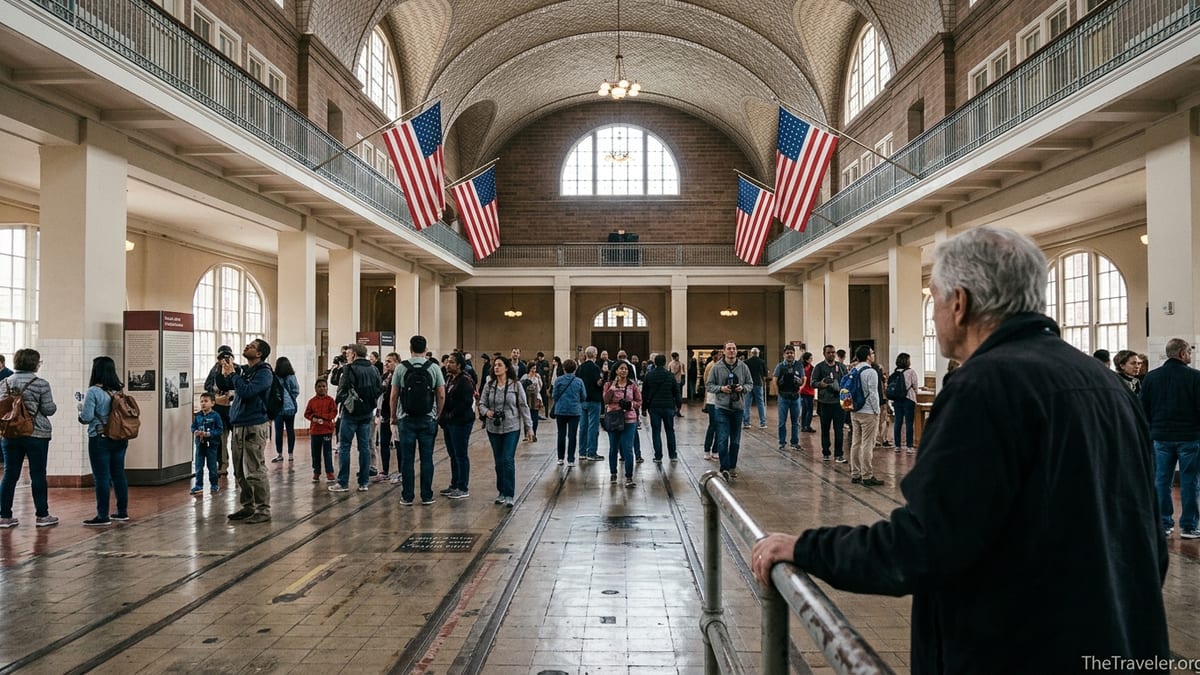
The Registry Room, also known as the Great Hall, is the iconic heart of Ellis Island. With its vaulted brick ceiling and American flags, it is the place most visitors recognize from photographs and films. It is also where the temptation to rush is strongest. Many people step into the room, take a wide-angle photo from the center aisle, glance at the information panels, and move on within five minutes. From a distance, the hall can feel almost serene, but that calm is misleading. In the early twentieth century, this room would have been packed with rows of wooden benches, inspectors in uniforms, and thousands of anxious people waiting for their turn to be questioned.
Spending time in the Registry Room changes everything. When you linger along the side galleries, you will see enlarged historic photographs of real inspection days, along with transcripts of the simple but life-defining questions inspectors asked: “How much money do you have?” “Do you have work waiting for you?” “Are you in good health?” Some panels include case studies of individuals who were detained for further medical exams or legal hearings, sometimes for weeks. Standing at the balcony and looking down, you can almost hear the echo of shoes on the tile and feel the mix of hope and fear.
Travelers who slow down here often find unexpected emotional moments. A visitor from Ireland might spot a photograph of a ship that matches the one a great-grandparent sailed on. A teenager from Texas might read about a young girl from Ukraine who crossed the Atlantic alone at fifteen, then realize they are the same age. The room also contains subtle details, such as the lines on the floor where inspection desks once stood and the old railings used to channel people into queues. These are easy to miss on a quick walk-through but powerful when you take time to look closely.
Family History Center and Wall of Honor: Turning History Personal
One of the most meaningful yet rushed-through parts of Ellis Island is the American Family Immigration History Center, located on the first floor of the museum. Here, visitors can search a database of millions of passengers who arrived at the Port of New York between the 1890s and the mid-twentieth century. The room is lined with computer terminals where you can type in a family name, approximate year of arrival, and country of origin. Within moments, many people discover scanned images of original ship manifests listing an ancestor’s name, age, last residence, and final destination in the United States.
Properly exploring this center takes time. Travelers often underestimate how long it can take to try different spellings of a surname, account for changed first names, or look through several possible matches. It is common to see families arrive, sit down “just to check quickly,” and find themselves still engrossed half an hour later as they print out records to take home. Because this research can be one of the trip’s emotional highlights, it is wise to build at least 30 to 45 minutes into your schedule if you have any suspicion that your family may have come through New York Harbor.
Outside the main building, many visitors stroll past the American Immigrant Wall of Honor without realizing what they are seeing. The stainless steel panels lining the walkway between the museum and the water hold nearly a million names inscribed by families from all eras and origins, not only those who passed directly through Ellis Island. This is one of the island’s most contemplative spaces. Standing there, with the Manhattan skyline beyond and the names at eye level, people often trace surnames with their fingers and quietly point out familiar ones. If you rush to the ferry, you may never notice that your own family name, or that of a friend back home, is etched into those panels.
The Hard Hat Tour: Ellis Island’s Hidden Emotional Core
For travelers willing to invest more time, the Hard Hat Tour of the Ellis Island hospital complex is often described as the most powerful experience of all. Operated by the nonprofit Save Ellis Island in partnership with the National Park Service, this 90-minute guided walk explores the abandoned medical buildings on the island’s south side, which were closed to the public for decades. Tour capacity is limited, tickets are paid separately from the basic ferry fare, and reservations are strongly recommended, especially in peak seasons when several departures a day can sell out.
The hospital complex once treated immigrants with illnesses ranging from measles and tuberculosis to pregnancy complications and mental health conditions. On the tour, visitors don hard hats and follow a guide through crumbling corridors, former wards, operating rooms, and an autopsy theater. The rooms are largely unrestored, with peeling paint, broken windows, and rusted equipment, yet this decay is part of the impact. Many spaces now host “Unframed,” an installation by the artist JR that overlays historic photographs of actual patients and staff onto walls and doorways. The effect is deeply moving: a child leaning against a windowsill where an image of another child once stood, or a guide’s flashlight catching the ghostly silhouettes of nurses on a cracked tile wall.
Travelers frequently describe this tour as a turning point in how they think about Ellis Island. Instead of just imagining the moment of arrival, they confront the reality that not everyone stepped easily into a new life. Some were quarantined for weeks, others were separated from family members, and a small but painful number were ultimately sent back to their countries of origin. Because the tour fee supports ongoing preservation work, participating is also a way for visitors to contribute directly to the island’s future. The experience does require extra time and energy, including planning around specific departure times from either Battery Park or Liberty State Park, but for many, it becomes the most unforgettable part of their day.
Planning Enough Time: Practical Strategies to Avoid Rushing
The simplest reason travelers rush Ellis Island is that they underestimate the combined time needed for security, ferry rides, Liberty Island, and the museum itself. From Manhattan’s Battery Park, you should expect airport-style screening, waits for boarding, and a 15 to 20 minute boat ride to Liberty Island, often followed by another short trip to Ellis Island and then back again. Even on a relatively quiet day, the full loop can easily consume four to five hours if you include a pedestal or crown visit at the Statue of Liberty. On busy spring and summer weekends, lines and security queues can stretch these times further.
To avoid turning Ellis Island into an afterthought, it helps to work backward from how much time you want to spend there. If your goal is to explore the museum exhibits at a relaxed pace, maybe search the immigration database, and walk the Wall of Honor, plan on at least 90 minutes on the island itself. Add another 30 minutes or more if you are joining a Hard Hat Tour. Once you have that number, choose a morning ferry time that places you at Ellis Island no later than midday, even if you visit Liberty Island first. Many experienced New York travelers aim for one of the earliest boats of the day to stay ahead of crowds, then deliberately budget Ellis Island for the late morning or early afternoon when they can move more freely.
Where you depart from also matters. Ferries leave from both Battery Park in Manhattan and Liberty State Park in New Jersey, and some visitors find the New Jersey side less crowded and easier for pacing a slower, more reflective visit. Whatever your starting point, resist the temptation to stack additional timed tickets, such as One World Observatory or a Broadway matinee, too close to your harbor trip. Leaving a generous buffer means you will not be checking your watch in the middle of the Registry Room or cutting short a moment of discovery in the Family History Center because you are racing for another reservation.
How to Experience Ellis Island With Intention
Once you have given yourself time, the next step is to move through Ellis Island with intention rather than as a box to tick. One effective approach is to follow the natural arc of an immigrant’s journey: begin in the Baggage Room, proceed to the medical and legal inspection exhibits around the Registry Room, then spend time with the stories of those who stayed, those who were detained, and those who were turned away. Many visitors find that listening to the included audio guide or joining a ranger talk helps structure this experience, especially if they are traveling with children or teens who respond better to storytelling than static text panels.
Another way to deepen your visit is to bring a specific question with you. It might be “When did my great-grandparents arrive?” or “What did people from my part of the world experience at Ellis Island?” or even “How is immigration handled today compared with a century ago?” As you move through the exhibits, look for answers. The museum does an excellent job of linking personal narratives to broader legal and political changes, from medical inspection procedures to restrictive immigration laws in the 1920s. Visitors who arrive with only a vague curiosity tend to skim; those who have a question in mind are more likely to stop, read, and connect the dots between galleries.
Finally, allow yourself a few unscripted moments. Step outside to the Wall of Honor and simply read names until one resonates. Stand by a window in the Registry Room and imagine seeing the Manhattan skyline for the first time after weeks at sea. If you have joined the Hard Hat Tour, linger for an extra few seconds in a particular ward or corridor that moves you. These pauses cost nothing and require no special ticket, yet they are precisely the experiences that rush-by visitors never have time to find.
The Takeaway
Ellis Island rewards slowness. Travelers who carve out real time for it come away with more than photos of a famous hall; they leave with a textured understanding of how millions of ordinary people uprooted their lives to begin again in a new country. The most powerful parts of the island are rarely the ones you can see at a glance. They are tucked into the scuffed leather of an old suitcase, the faint typeface on a ship manifest, the echoing emptiness of a hospital ward, or the long line of names etched on steel with the Hudson River glinting behind.
Approaching Ellis Island as its own destination rather than a quick add-on means planning ahead: booking an early ferry, building generous buffers around the visit, and considering experiences such as the Hard Hat Tour or a focused session in the Family History Center. It also means a willingness to be surprised and moved, to trade a little efficiency for a deeper human connection. In a city that thrives on speed, Ellis Island asks you to do the opposite: to slow down, look closely, and listen to the stories that made modern America.
FAQ
Q1. How much time should I plan specifically for Ellis Island?
Most travelers who want a meaningful visit should plan at least 60 to 90 minutes on Ellis Island itself, not including ferry time. If you intend to research family records in the American Family Immigration History Center or join a Hard Hat Tour of the hospital complex, plan for two to three hours on the island to avoid feeling rushed.
Q2. Is the Hard Hat Tour of the hospital complex worth the extra time and cost?
For many visitors, yes. The 90-minute guided tour through the abandoned hospital buildings offers rare insight into what happened to immigrants who were ill or detained. The combination of original spaces, historical interpretation, and the “Unframed” art installation creates one of the most powerful experiences on Ellis Island, and tour proceeds help fund preservation work.
Q3. Can I realistically see both the Statue of Liberty and Ellis Island in half a day?
It is possible but tight. Security screening, ferry waits, and exploration of Liberty Island can easily use several hours, leaving little time for Ellis Island. If you only have half a day, you may need to accept a shorter museum visit or skip experiences like the Hard Hat Tour. A full day in New York Harbor allows for a far more relaxed and rewarding pace.
Q4. Do I need a separate ticket for Ellis Island?
No. Standard ferry tickets from Battery Park in Manhattan or Liberty State Park in New Jersey typically include access to both Liberty Island and Ellis Island, along with the basic audio tours. However, pedestal or crown access for the Statue of Liberty and the Hard Hat Tour of the Ellis Island hospital complex require separate reservations and, in some cases, additional fees.
Q5. Is Ellis Island suitable for children, or will they be bored?
Ellis Island can be very engaging for children if you plan wisely. Many exhibits use photos, personal stories, and interactive elements, and the audio guide includes options geared to younger listeners. Framing the visit around your own family history or specific individuals’ journeys can help keep children invested, especially when balanced with outdoor time and breaks.
Q6. What is the best time of day to visit Ellis Island to avoid feeling rushed?
Morning ferries are generally the best choice. Arriving early helps you move through security and the initial boat ride before the largest crowds build. Many visitors go first to Liberty Island, then reach Ellis Island by late morning or early afternoon, giving themselves enough time in the museum and, if desired, the Hard Hat Tour before the last ferries back.
Q7. Can I visit only Ellis Island without stopping at the Statue of Liberty?
In practice, most ferries operate on a loop that includes both Liberty Island and Ellis Island, but you can choose to remain on the boat at one stop or limit your time ashore there. If your main interest is Ellis Island, you can keep your Liberty Island visit brief or skip it altogether so that you have more time for the museum, the Family History Center, and the Wall of Honor.
Q8. How accessible is Ellis Island for visitors with limited mobility?
The main museum building on Ellis Island offers elevators and ramps, and the ferry service is designed to accommodate visitors with mobility challenges. Some areas, especially in the hospital complex on the Hard Hat Tour, may involve uneven floors or stairs, so it is important to check current accessibility details and discuss any concerns with staff before booking specialized tours.
Q9. Do I need to prepare anything in advance if I want to search for my family’s records?
It helps to bring as much information as you can, such as full names, approximate years of arrival, countries or regions of origin, and any known ports or ships. Spellings often varied, so think about possible alternatives. Having these details ready makes it easier to use the databases in the American Family Immigration History Center efficiently and increases your chances of finding a meaningful match during your visit.
Q10. What should I bring to make a slower, more thoughtful visit comfortable?
Comfortable walking shoes, a light layer for indoor and outdoor temperature changes, water, and a small notebook or phone for jotting down names and details are all useful. Because you may spend longer than expected in certain exhibits or on the Hard Hat Tour, it is also wise to have a flexible schedule for the rest of your day so that you can linger when a story or space resonates with you.