


On paper, Ellis Island is a place of numbers. More than 12 million immigrants processed between 1892 and 1954, thousands of medical examinations a day, a rejection rate of only a few percent. Yet anyone who steps off the ferry and walks into the red brick arches of the Ellis Island National Museum of Immigration quickly discovers that this is not a museum about statistics. It is a museum that insists every single number had a name, a face, a family, and a story worth remembering.
Get the latest updates straight to your inbox!
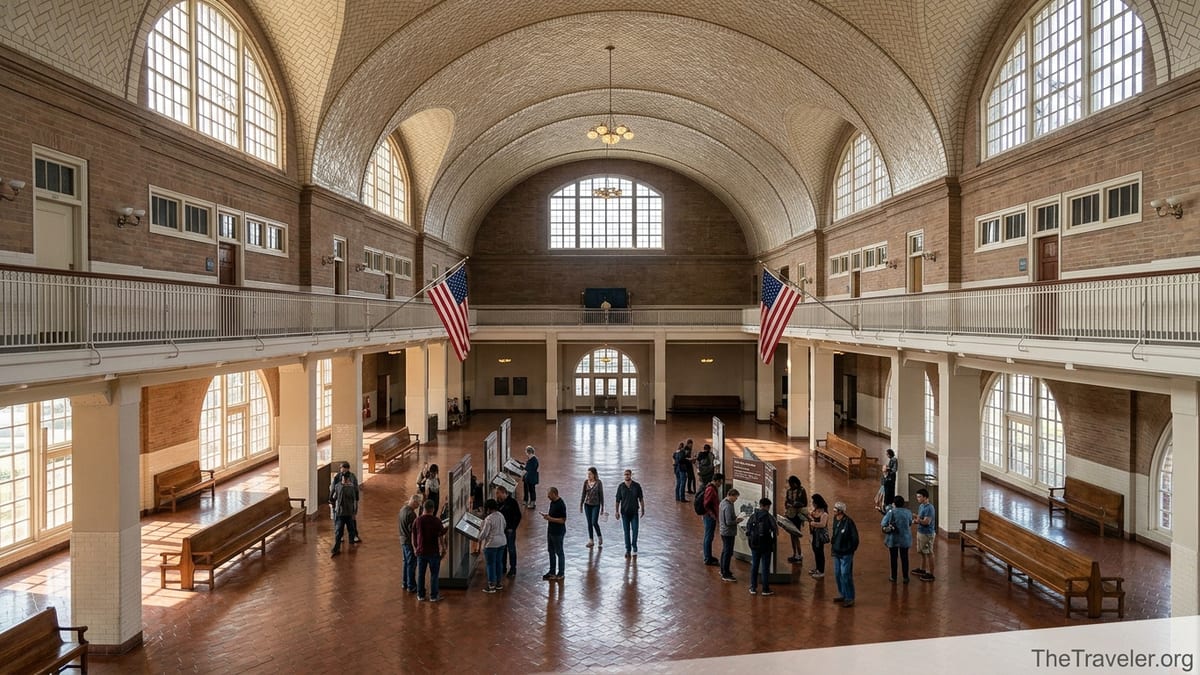
From Immigration Station To Storytelling Museum
Today’s visitors arrive at Ellis Island on a Statue City Cruises ferry that departs from either Battery Park in Manhattan or Liberty State Park in New Jersey. As the boat pulls into the slip, the main building’s French Renaissance turrets come into view, the same silhouette that greeted anxious arrivals a century ago. Inside, however, the space has been carefully transformed into the Ellis Island National Museum of Immigration, a place that uses archival records, family artifacts, audio testimony, and interactive media to connect modern travelers with the people behind the statistics.
The national park rangers who greet visitors like to quote the broad figures: roughly 12 million immigrants were processed here between 1892 and 1954, and at the station’s peak more than 1 million people a year passed through. But almost immediately, those numbers are grounded in specific journeys. Exhibit panels introduce individual travelers, from a 17 year old Irish girl named Annie Moore, the first person processed at the new station on January 1, 1892, to a Norwegian merchant seaman recorded as the final immigrant in November 1954.
The building itself participates in the storytelling. Standing on the worn stone steps and looking up at the vaulted ceiling of the Great Hall, visitors can see grooves in the floor and original wooden benches that hint at the long days people spent waiting to be inspected. Rather than simply listing how many people were processed, the museum places you where they once stood, surrounded by the same windows, the same sound of footsteps echoing off tile, and the same view back across the harbor toward the skyline they hoped would mark a new beginning.
This combination of architecture and narrative is deliberate. When the museum opened in 1990, and later expanded with the Peopling of America galleries, the National Park Service and exhibition designers reimagined Ellis Island not as an abandoned checkpoint but as a storytelling engine, turning bureaucratic procedures and archival data into a vivid human drama that visitors can absorb at their own pace.
Walking Through The Numbers In The Great Hall
Most travelers begin their visit on the first floor, where interpretive panels describe the basic process: medical inspection, legal questioning, and final decisions that determined whether someone could enter the United States or would be detained or sent back. Here the museum presents essential statistics in approachable terms. Roughly four out of five people were processed within a few hours. Only a small minority were held for closer medical evaluation or legal review, and only a fraction were ultimately excluded.
Instead of leaving those figures abstract, the exhibits invite visitors to walk the same route an arriving immigrant would have taken. You move from the baggage room, where piles of old trunks and wicker baskets illustrate the idea that many people carried all they owned, up to the Registry Room, where lines of life sized cutouts and faded inspection tags give an immediate sense of scale. One panel describes how, on record breaking days, more than 10,000 people might pass through this space. Another focuses on the cards that inspectors marked with chalk to flag suspected illnesses, a small letter scrawled on a coat that could change a family’s future.
A particularly effective display pairs a wall of statistics with a single family’s paperwork. One case might show a passenger manifest listing dozens of names, ages, and occupations in nearly illegible cursive. Next to it, an audio station plays an interview with a woman describing how she remembered her father clutching that same manifest as they stepped into the hall, terrified of being turned away. For many visitors, this is the moment when distant numbers like “12 million” shrink into a child worried about whether her parents will pass the eye exam.
The museum encourages you to imagine yourself in those lines. Kids on school trips often copy the posture of the cardboard silhouettes, standing with their backs straight and their eyes fixed ahead. Adults pause at the railings, reading the stories of people from Italy, Russia, Syria, and Scandinavia who once filled the hall. Statistics about peak immigration years become tangible when you realize that, on a day not unlike your visit, thousands of people from dozens of countries were crammed into the same room, all listening for their names.
“Through America’s Gate” And The Power Of Individual Journeys
One of the museum’s signature exhibits, “Through America’s Gate,” takes visitors step by step through the inspection process. Here, the power of the storytelling lies in the accumulation of small details. Panels explain that inspectors might ask each person around 30 questions about their health, work prospects, and relatives. Rather than simply reporting that fact, the exhibit presents real transcripts of interviews, complete with hesitations, misunderstandings, and the occasional joke.
For example, a transcript displayed under glass records the confusion of a young boy from Eastern Europe who did not understand an interpreter’s question about his occupation. The record shows how the inspector rephrased the question, noted the boy’s work in a textile mill, and ultimately approved him for entry. Next to this dry bureaucratic record, a family photograph shows an elderly man, that same boy decades later, surrounded by grandchildren at a picnic in New Jersey. The pairing makes the stakes of every interview suddenly clear.
Another case focuses on medical examinations. We read that eye disease and contagious illnesses were particular concerns, and that anyone suspected of being unable to work might be detained. But it is the individual stories that stay with visitors. One panel shares the story of a young Italian woman separated from her family for further tests, spending weeks in the hospital wards on an adjacent part of the island. Her son, interviewed in old age, recalls his grandmother’s story that she learned English by listening to the nurses and eventually became a seamstress in Brooklyn.
Throughout “Through America’s Gate,” the exhibits underline that immigration policy is not just a set of rules but a series of choices made by individuals. Inspectors, doctors, and translators appear as characters in the story, sometimes compassionate, sometimes strict, and always operating under intense pressure. Travelers walking through the exhibit often find themselves comparing these historical encounters with contemporary debates about borders and belonging, recognizing that behind every statistic about arrivals or detentions lie complicated personal histories.
The Peopling of America Galleries: Before And After Ellis Island
While many visitors come to Ellis Island expecting only stories from the early twentieth century, the museum now deliberately widens the lens. The Peopling of America galleries trace migration to and from the continent from the colonial era to the present day. This expansion makes the statistics of Ellis Island itself feel like one chapter in a much longer story of people on the move.
In one gallery focused on the period before 1892, maps and timelines show waves of newcomers from Europe, Africa, Asia, and the Americas. Rather than simply listing numbers, the exhibits focus on particular individuals. A reproduction of a ship’s manifest from the 1700s, for instance, is accompanied by the story of a German artisan who brought carpentry tools and a prayer book, merging hard data with personal narrative. Nearby, visitors can see artifacts associated with Indigenous displacement and forced migration, reminding travelers that not all movement to and within the United States was voluntary.
Later sections look at immigration after Ellis Island’s heyday, when airports and land borders replaced New York Harbor as primary points of entry. Here, video interviews with recent arrivals from places such as Vietnam, Somalia, and Central America echo the voices of earlier immigrants. A visitor might listen to a contemporary nurse from West Africa describing the challenges of passing a professional licensing exam while standing just a few meters away from exhibits about a century old health inspections. The parallel stories underline how current statistics about visas and refugee admissions continue to translate into individual struggles and successes.
For travelers, this broader context reshapes the meaning of a visit. Instead of treating Ellis Island as a sealed chapter of history, the Peopling of America galleries frame it as a powerful symbol within an ongoing global movement of people. The numbers on government charts are still changing, but the basic questions asked in the Great Hall about work, family, and health remain familiar, linking today’s headlines to the stories etched into the museum’s walls.
Listening To Voices: Oral Histories And Interactive Media
One of the most striking ways the museum transforms data into lived experience is through its collection of oral histories. Throughout the building, listening stations allow visitors to hear former immigrants and their descendants describe their journeys in their own words. The content ranges from joyful memories of seeing the Statue of Liberty for the first time to painful recollections of family members turned away.
In a small theater off the main hall, for example, a looping audio program features a Greek shopkeeper recalling the taste of the bread served in the Ellis Island cafeteria, a Polish seamstress describing the fear of medical inspections, and a Jewish teenager explaining how he clutched the address of an uncle in the Bronx. None of these stories would appear in a statistical report, yet taken together they make those reports feel suddenly intimate. A chart might tell you that most people passed through in a day, but a recorded voice explaining how long that day felt gives emotional weight to the timeline.
Interactive exhibits deepen this sense of connection. Touchscreen stations invite visitors to explore immigration trends by decade, but each graph can be opened to reveal personal stories and photographs. Choose a year such as 1907, one of the busiest on record, and the screen might highlight a family from Sicily, a teacher from Sweden, and a laborer from the Ottoman Empire. Each one is represented by a passenger list entry, a family snapshot, and a brief narrative describing what happened after arrival.
Even young travelers find ways to engage. School groups cluster around kiosks where they can create a mock inspection card by entering their age, occupation, and reason for travel. The system then generates a fictionalized outcome based on period rules, showing whether they would likely have been admitted or detained. By transforming faceless statistics into a kind of role play, the museum allows visitors to feel, if only briefly, the uncertainty that defined so many journeys.
Finding Yourself In The Records
For many travelers, the most moving part of Ellis Island is not an exhibit but a database. On the first floor, the Family History Center offers access to digitized passenger lists and other records. Visitors can search for surnames, ship names, or country of origin, trying to locate relatives who may have passed through the island. Staff and volunteers often help people navigate the period handwriting and abbreviations that can make these searches challenging.
It is here that the transformation of statistics into human stories becomes most personal. A family from Ohio, for example, might come in knowing only that a great grandfather “came through New York from Italy.” Within minutes, they can be looking at a scanned manifest showing his name, age, and the amount of money he carried. Some discover signatures they recognize from old letters at home, or realize that spelling variations in their last name date back to the original paperwork rather than any change at the inspection desk.
Even visitors with no known Ellis Island connection often find themselves absorbed in the process. Searching at random among ship lists, they see how varied the flows of people were: a group of teenage sisters from the Austro Hungarian Empire traveling alone, a widowed mother with five children from Ireland, a single man from Syria listing his occupation as “peddler.” Taken together, these fragmentary records give texture to the broad claim, often repeated in the museum, that a large share of Americans today can trace ancestry to at least one person who passed through this island.
Outside, near the water’s edge, the American Immigrant Wall of Honor extends the personal connection into the present. Families can sponsor the engraving of names and hometowns, creating a physical record that stretches along the promenade. Travelers walking the wall might pause when they spot a familiar surname, realizing that behind every line of text is a story that begins somewhere far from New York Harbor and continues into the present.
Planning Your Visit: Practical Tips For Travelers
Experiencing Ellis Island fully requires some planning. Most visitors purchase combined ferry tickets that include both the Statue of Liberty and Ellis Island. Given the security screening at departure points and the ferry travel time, it is wise to set aside at least half a day, and preferably longer, if you want to absorb more than the highlights. Arriving on one of the first morning boats often means cooler temperatures in summer and slightly smaller crowds in the Great Hall.
The museum itself does not charge an entrance fee, but the ferry service is ticketed, with dynamic pricing that reflects season and demand. Travelers visiting in peak months such as July or August should book ahead, particularly if they are interested in pedestal or crown access at the Statue of Liberty before or after their Ellis Island stop. Families with children often break up the day by having a picnic on the lawn outside the main building or grabbing a simple cafeteria style lunch on the island.
Those keen to dive into the stories behind the statistics should plan for at least two to three hours inside the museum. Audio guides, available in multiple languages, can help orient first time visitors and provide added context for key exhibits. Travelers interested in the hospital complex, where many immigrants were treated and quarantined, can join specialty tours offered by partner organizations; these excursions, usually booked separately, take visitors into partially restored wards and isolation rooms, adding another layer to the story of how health data and human lives intersected here.
Comfortable shoes are essential. Much of the experience involves walking, sometimes on uneven brick or stone surfaces, and stairs connect several exhibit levels. Photography is welcome in most areas, so many travelers bring a camera or smartphone to capture the light flooding through the arched windows of the Great Hall or the view back toward Lower Manhattan, a skyline that anchors the dreams described in so many of the museum’s stories.
The Takeaway
Ellis Island National Museum of Immigration stands as a rare place where travelers can feel national history narrowing down to a single human voice. It begins with stark figures about millions of arrivals and the machinery of federal immigration control, but it consistently refuses to let those figures remain abstract. Every exhibit, from the chalk marks on inspection cards to the worn handles of old suitcases, insists that each entry in the ledger belonged to a person with hopes, fears, and plans.
For modern visitors navigating a world still shaped by migration, the museum offers perspective. It reveals how earlier generations wrestled with many of the same questions that fill today’s headlines: Who should be allowed in, under what conditions, and according to which values. Yet instead of framing these dilemmas purely in terms of policy or politics, Ellis Island invites travelers to listen closely to the individuals whose lives were altered on its tiled floors. In doing so, it transforms an island of numbers into a landscape of stories that linger long after the ferry pulls away.
FAQ
Q1. How long does it take to visit the Ellis Island Museum?
Most travelers spend between two and three hours exploring the museum itself, not including ferry travel and security screening time on either end.
Q2. Is entry to the Ellis Island Museum free?
The museum does not charge an admission fee, but you must purchase a ticket for the ferry service that transports visitors to Ellis Island and the Statue of Liberty.
Q3. Can I visit Ellis Island without visiting the Statue of Liberty?
Ferry tickets typically cover both sites on the same route. Once on board, you can choose to disembark at Ellis Island only, but most visitors combine both stops.
Q4. Do I need to book tickets in advance?
Advance booking is strongly recommended, especially during weekends, holidays, and peak summer months, when early departure times can sell out quickly.
Q5. Are guided tours available inside the museum?
Yes. National park rangers offer regular talks, and audio guides are available. Special access tours of the hospital complex are also offered through partner organizations.
Q6. Can I research my family history at Ellis Island?
Yes. The Family History Center on the first floor provides access to digitized passenger records, and staff or volunteers can help you search for family names.
Q7. Is the Ellis Island Museum suitable for children?
The museum is family friendly, with interactive exhibits, audio stories, and role playing activities that help children understand what immigration was like a century ago.
Q8. What should I wear for a visit to Ellis Island?
Wear comfortable walking shoes and dress for the weather. You will spend time outdoors on the ferry and grounds, as well as walking and standing inside the museum.
Q9. Are food and drinks available on Ellis Island?
Yes. There is a cafeteria style dining area on the island, and many visitors bring snacks or simple picnic lunches to enjoy on the outdoor lawns.
Q10. Is Ellis Island accessible for visitors with limited mobility?
The main museum building is accessible by elevator and ramps, and ferries are equipped to assist visitors with mobility challenges, though some historic areas remain uneven.