


For millions of American families, Ellis Island is more than a stop in New York Harbor. It is a symbol of hardship, hope, and the moment an ancestor first set foot in the United States. If you have ever wondered whether your great-grandparents were among the 12 million immigrants processed there between 1892 and 1954, the answer is often hidden in ship manifests, government databases, and family stories. With a bit of preparation and realistic expectations, you can usually discover how, when, and where your relatives arrived, and whether Ellis Island really was part of their journey.
Get the latest updates straight to your inbox!
What Ellis Island Records Can and Cannot Tell You
Ellis Island served as the main federal immigration station in New York Harbor from 1892 to 1954, handling the majority of steerage and third-class passengers who arrived by ship at the Port of New York. In practical terms, that means if your European ancestors came to the United States by steamship in the late 19th or early 20th century and traveled in the cheaper sections of the ship, there is a reasonable chance they were processed at Ellis Island.
Passenger arrival records from this period typically include the immigrant’s name, age, sex, marital status, occupation, last place of residence, nationality, name of the ship, and date of arrival. Many manifests from the early 1900s also ask who the traveler is joining in the United States and how much money they carry. Researchers using National Archives microfilm and digital collections will see that these manifests were created for the Port of New York as a whole, not just for Ellis Island. Ellis Island was the inspection and processing site for certain classes of passengers, but the lists are organized by ship and port, not by the island itself.
It is important to understand the limits of these sources. Records were handwritten, sometimes in a language unfamiliar to the clerk, and then later transcribed. Under these conditions, names might be misspelled or misread. In some years, the same person may appear more than once, especially if they traveled back and forth. And because all pre-1897 New York immigration records stored on Ellis Island were destroyed in a fire, earlier documentation is incomplete or must be reconstructed from other collections.
Equally important is what Ellis Island records cannot tell you. They will not show a change of name performed by an immigration official at the inspection desk, despite the enduring myth. Historians and genealogists who have studied original documents note that name changes nearly always happened later, in naturalization papers, at local courthouses, or simply through gradual usage in the community. If you are hoping to watch a surname transform line by line on the manifest, you are likely to be disappointed.
Ellis Island vs Other Ports: Did They Even Land in New York?
Before diving into Ellis Island databases, confirm whether your ancestors are likely to have arrived in New York at all. The United States maintained major immigration ports in Boston, Philadelphia, Baltimore, New Orleans, and later Galveston, San Francisco, and Seattle, among others. The National Archives notes that passenger lists survive for these ports from about 1820 onward, with varying coverage. A Polish family heading to Chicago might have come through Baltimore or Philadelphia, while someone bound for a lumber town in Washington State may appear in Seattle rather than New York.
Time period matters. Ellis Island did not open until 1892, and it temporarily closed after the 1897 fire, reopening with new fireproof buildings in 1900. Before federal processing at Ellis Island, the main reception center for New York was Castle Garden at the southern tip of Manhattan, which operated as an immigrant depot from 1855 to 1890. A German ancestor who reportedly “came through New York in the 1870s” would never appear in Ellis Island records but may be documented in surviving Castle Garden or customs passenger lists preserved by the National Archives and state archives.
There are also class distinctions. First- and second-class passengers arriving in New York during the Ellis Island era were usually inspected quickly on board ship or at the pier and may never have set foot on the island itself. Their names still appear on the same ship manifests as third-class passengers, but their personal experience did not include the long lines and medical inspections depicted in museum exhibits. A wealthy British merchant traveling in first class in 1910 and a Sicilian laborer in steerage on the same ship will be found on the same list, even though only one passed through the great hall of Ellis Island.
One practical way to narrow down the likely port is to study where your family settled. A family that appears in the 1910 census in Milwaukee, with relatives in Minnesota and the Dakotas, might have arrived via New York and then taken a train west, but they could just as easily have landed in Boston or Montreal and crossed overland. By comparing the timing of migration in census and naturalization records with historical patterns of steamship routes, researchers can make educated guesses about where to search first.
Using the Ellis Island Passenger Search Step by Step
The Statue of Liberty and Ellis Island Foundation maintains a free passenger search database that draws on ship manifests for New York and other ports across the United States. Its coverage spans portions of the 19th and 20th centuries and is updated periodically as additional data from archival partners is incorporated. For a modern traveler or family historian, it functions as the most obvious starting point to test the family story that “Grandma came through Ellis Island.”
Begin with what you know. Even a small set of details can make the difference between a successful search and dozens of false matches. A good working profile includes the ancestor’s full name or likely spelling, approximate year of birth, probable year or decade of immigration, country or region of origin, and possible traveling companions. If family stories mention that your great-grandmother, Maria Kowalska, came from “near Krakow” around 1912 with two small children and joined her husband Jan in Pittsburgh, those details give you filters to apply in the database.
When you enter a name in the Ellis Island search, expect the first results page to include many near matches. The database attempts to account for variant spellings, but it is far from perfect. It is common to see a “Kowalska” indexed as “Kowalski,” “Kowalsky,” or “Kowalskiy,” especially where handwriting is cramped or ink has faded. In practice, you may need to run multiple searches, adjusting the spelling and using flexible year ranges such as 1908 to 1915 rather than a single year.
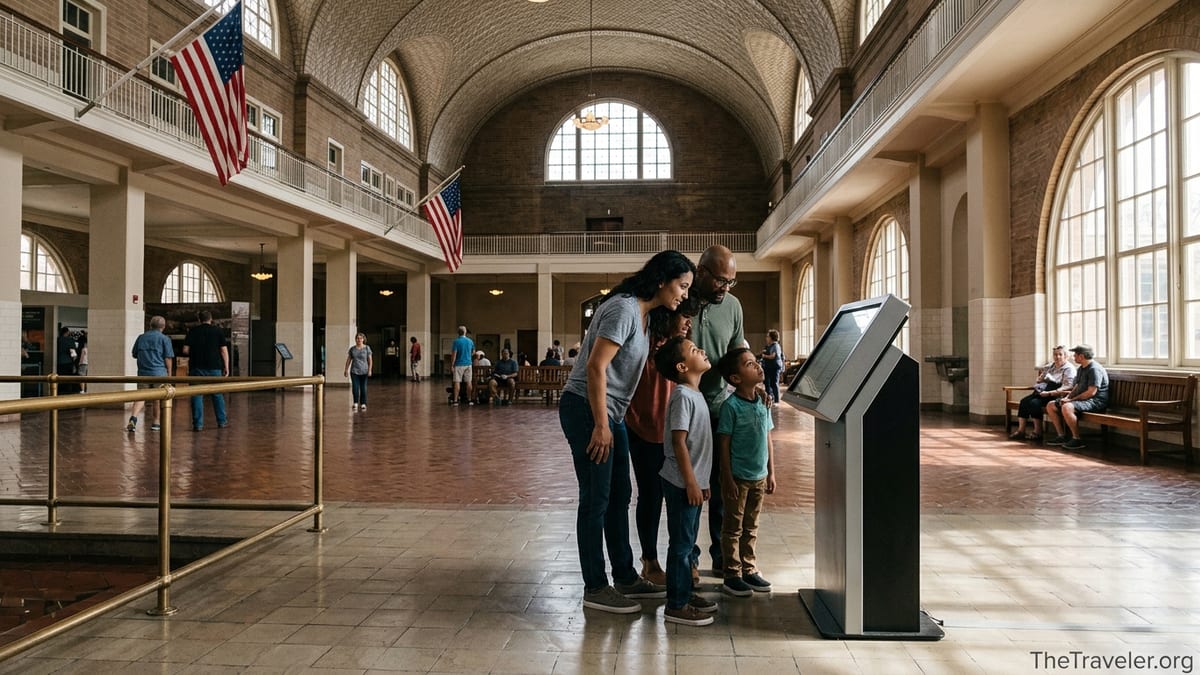
Once you think you have found a promising record, open the manifest image rather than relying solely on the typed index entry. The scanned document provides the richest clues: you might see that Maria traveled with children named Anna and Stanislaw, that their last residence was a village whose name the indexer shortened, and that they were headed to “husband Jan Kowalski, 123 Liberty Ave, Pittsburgh.” Details like these allow you to confirm you have the correct person by cross‑checking them against US census entries and later vital records. Many visitors to the Ellis Island National Museum use the on‑site Family Immigration History Center terminals to zoom in on these manifest images, but you can perform the same close reading from home if you access the digital scans on a desktop or tablet.
Going Beyond Ellis Island: National Archives and Partner Databases
Not every immigrant who used the Port of New York appears in the Ellis Island Foundation database, and the island was never the only entry point to the United States. When your search comes up empty or incomplete, the next stop is usually the US National Archives, which preserves original passenger arrival records for ports across the country, generally from about 1820 through the late 20th century. These are available as microfilm in regional archives facilities and increasingly as digital images and indexes through genealogy platforms.
A practical example illustrates how this works. Suppose you are searching for an Italian ancestor, Giovanni Russo, believed to have arrived around 1903. The Ellis Island site yields several Giovanni Russos, but none list your known hometown near Naples or the correct wife’s name. At this point, you might search a large genealogy platform that hosts National Archives microfilm collections for the Port of New York from 1897 to 1957. By filtering on nationality, estimated age, and departure port, you might uncover a manifest on a ship from Naples in 1904 where a “Gio. Russo” from your specific village is traveling to a brother already in Brooklyn. The record confirms your family story even though it did not surface easily in the original database.
When you need official proof for citizenship by descent or dual nationality applications, free indexes are usually not enough. The National Archives allows you to request copies of passenger arrival manifests for a specific person and date, often using a standard request form that asks for the traveler’s full name, date of arrival, port, and vessel. For arrivals after the 1950s, you may have to look at immigration and naturalization service microfilm, which captured passenger arrival and departure records when paper lists stopped being retained.
State archives and local institutions can also fill gaps. The New York State Archives, for example, holds related immigration and naturalization records, and historical societies in major port cities sometimes maintain copies of ship lists or published compilations. A researcher in New Orleans might consult both federal microfilm and collections in the Louisiana State Museum to document a relative who arrived through the Gulf Coast rather than New York. Taken together, these layered sources provide multiple paths to answer the same question: where and how did my family enter the country?
Common Myths and Tricky Problems in Ellis Island Research
Anyone who spends time on immigration research quickly encounters a set of persistent myths. The best known is that Ellis Island officials routinely changed surnames, inventing new identities on the spot. In reality, ship manifests were prepared at the port of departure, often by clerks or steamship agents who spoke the emigrant’s language. Inspectors in New York checked these lists but rarely altered them. When names do differ between old country records and US usage, it is usually because the immigrant simplified or anglicized the name later, or because neighbors and employers began using an easier version.
Another challenge is missing or partial records. The 1897 fire on Ellis Island destroyed the original wooden buildings and immigration records from 1855 onward that had been stored on site. Later copies of passenger lists survive because they were retained by customs offices, National Archives repositories, or shipping companies, but gaps remain. For Castle Garden era arrivals, surviving documentation may be sparser, and indexes can be patchy. This is why some families swear an ancestor came “through New York” yet no manifest turns up, even after careful searching.
Researchers also run into issues with inconsistent ages, shifting birthplaces, and spelling differences across documents. An ancestor might report their age as 25 on the ship manifest, 28 on the 1910 census, and 30 on their World War I draft registration. A Hungarian village might be listed under its historic name in the Austro‑Hungarian Empire on one record and under a modern Slovak name on another. When reading manifests, it is essential to consider historical borders and languages: a person described as “Austrian” in 1900 might later appear as “Polish” or “Ukrainian” after national boundaries changed.
Because the Ellis Island search tool has limited wildcard options and insists on a last name, it can be especially frustrating when dealing with rare or uncertain spellings. Experienced genealogists often work around this by searching first names combined with age and year range, or by browsing passenger lists for a specific ship and date once they know those details from another source such as a naturalization certificate. It can be slow and meticulous work, but it pays off when a difficult‑to‑read entry finally reveals itself on the page.
Putting the Pieces Together: A Realistic Research Strategy
Finding out whether your family passed through Ellis Island is rarely a one‑click discovery. It is more like building a case, using every record you can find to confirm that a particular passenger manifest really belongs to your ancestor. A sensible strategy starts at home. Gather family papers, such as old passports, naturalization certificates, or letters, and talk to older relatives about names, hometowns, and approximate dates. Even vague comments like “Grandpa came from a village near Trieste” can help you distinguish among similar records later.
Next, map out a timeline using US sources created after immigration. Census records for 1900, 1910, 1920, and later often list a person’s year of arrival and citizenship status. City directories, draft registrations, and death certificates may add middle names, exact birthdates, or clues about relatives. For example, if your great‑grandfather appears in the 1920 census in Cleveland, states that he arrived in 1906, and is listed with a brother who shares an unusual surname, you now have a narrow window and companion name to use in passenger list searches.
Then, search the Ellis Island database and related collections with that context in mind. Be prepared to test multiple spellings, allow for a five‑year range on arrival dates, and scrutinize every promising manifest for matching personal details. Look for patterns: do the names of relatives and hometowns repeat across records? Does the occupation align with what you know from later life? It is common to identify a likely match only after several rounds of checking, rather than in the first hour online.
A brief case example shows how this can unfold. A family story claims that an Irish great‑grandmother, Nora O’Shea, came through Ellis Island alone as a teenager. Initial database searches for “Nora O’Shea” in 1900 to 1910 turn up several possibilities. By comparing each manifest with later records, you discover one Nora, aged 18, from County Kerry, who listed her destination as an aunt in Boston and arrived in 1903. Her later marriage record in Massachusetts names the same aunt as a witness, confirming the link. Technically, Nora may have landed in New York and quickly boarded a train north, but the paper trail shows that Ellis Island was indeed the gateway through which she entered the United States.
The Takeaway
For many families, the question of whether an ancestor passed through Ellis Island is both historical and emotional. Discovering a name on a ship manifest can make a story told at the dinner table feel real. Yet the research process works best when expectations are grounded in how immigration actually functioned: Ellis Island was one piece of a larger system of ports, ships, and government records that changed over time.
If you approach the search with patience, check multiple databases, and cross‑reference every promising record with census entries, naturalization papers, and local archives, your chances of success are high. Along the way, you will likely learn not only whether your relatives walked through the great hall of Ellis Island, but also who they traveled with, where they came from, and whom they hoped to meet on the other side of the harbor. Those details, more than a single location, are what truly bring your family’s immigration story to life.
FAQ
Q1. How do I know if my ancestors actually passed through Ellis Island and not just the Port of New York?
To confirm Ellis Island specifically, look at the arrival date, class of travel, and ship. Third‑class or steerage passengers arriving between 1892 and 1954 who were bound for inspection are the most likely to have been processed on the island, even though the manifests themselves are labeled by port rather than by Ellis Island. First‑ and second‑class passengers often remained on the ship or were inspected at the pier, so they may never have set foot on the island even though New York was their port of entry.
Q2. My grandparents said their name was changed at Ellis Island. Is that true?
It is very unlikely that inspectors officially changed their surname at Ellis Island. Ship manifests were created at the port of departure, and officials in New York checked those lists rather than rewriting them. Most name changes happened later in local courts, naturalization records, or daily life when immigrants chose simpler or more English‑sounding versions of their names.
Q3. What if I cannot find my ancestor in the Ellis Island database at all?
If your searches fail, consider that your ancestor may have arrived through another port such as Boston, Baltimore, Philadelphia, New Orleans, Galveston, San Francisco, or Seattle. Check census records for the reported year of immigration and search other passenger list collections, especially those derived from National Archives microfilm. Also experiment with different spellings, reversed first and last names, or browsing by ship and date if you have that information from naturalization papers.
Q4. Did immigrants come through Ellis Island before 1892?
No. Before Ellis Island opened in 1892, the main immigrant reception center for New York City was Castle Garden in lower Manhattan, which operated from 1855 to 1890. Earlier arrivals were recorded in customs passenger lists. If your ancestor is said to have arrived in the 1860s or 1870s, you will not find them in Ellis Island records but may locate them in Castle Garden era passenger lists or later reconstructions held by the National Archives and state archives.
Q5. Can Ellis Island records help me find my ancestor’s exact hometown in Europe?
Often they can. Many manifests, especially from the early 1900s, record the last place of residence or birthplace, sometimes down to the village level. By examining the original manifest image rather than just the index, you may spot a specific town name that leads you to church registers or civil records overseas. Be aware that the place might be listed under a historical district or in a different language than today.
Q6. What information do I need before I start searching Ellis Island and other databases?
At minimum, gather a full name or likely spelling, approximate year of birth, estimated immigration year or decade, country or region of origin, and names of close relatives. Details such as traveling companions, the name of a spouse or parent already in the United States, and a probable destination city will greatly narrow your search and help you recognize the right person among similar names.
Q7. Are all Ellis Island and passenger list records online for free?
A large portion of Ellis Island era passenger lists are accessible through free databases, but coverage is not perfectly complete and image quality varies. Additional copies and indexes exist in paid genealogy platforms that license National Archives microfilm collections. For formal or legal purposes, you may still need to request certified copies of manifests directly from the National Archives or other government agencies, which can involve fees and processing time.
Q8. How accurate are the ages and dates on Ellis Island passenger lists?
Ages and dates are approximate at best. Many immigrants did not track birthdays precisely, and clerks sometimes guessed or made calculation errors. It is common to see a person’s reported age shift by a few years between the manifest, census records, and later documents. Use these details as guidelines rather than strict facts, and focus on patterns across multiple records to confirm identity.
Q9. Can I visit Ellis Island to research my family in person?
Yes. The Ellis Island National Museum of Immigration includes a Family Immigration History Center where visitors can search the arrival records database and view manifest images on site. Museum staff and volunteers can help interpret results, and seeing the great hall and historical exhibits can add emotional context to the paper trail. However, the same core records are generally available online, so an in‑person visit is not required for successful research.
Q10. What should I do if different records give conflicting information about my ancestor’s arrival?
Conflicting information is normal. When dates, ages, or spellings differ, prioritize records created closest in time to the actual event, such as original passenger lists and early naturalization papers. Build a timeline that includes every document you find and look for recurring details such as consistent hometowns, the same relatives, or repeated ship names. By weighing all the evidence together, you can usually arrive at a reasonable conclusion about when and how your ancestor entered the United States.