


More news on this day
Kinshasa’s N’Djili International Airport is entering a new growth phase as Ethiopian Airlines and several other African and Gulf carriers expand services, pair new aircraft with upgraded infrastructure, and position the Congolese capital as a more competitive hub for Central Africa.
Get the latest news straight to your inbox!
Ethiopian Airlines Deepens Its Kinshasa Footprint
Ethiopian Airlines has emerged as a central player in Kinshasa’s renewed connectivity, using its Addis Ababa hub to link the Democratic Republic of the Congo with long-haul markets in Europe, the Middle East, Asia, and the Americas. Publicly available schedule data confirms that Kinshasa remains one of Ethiopian’s key Central African destinations, with services operated from Addis Ababa Bole International Airport to N’Djili International Airport for both passengers and cargo.
In addition to the dedicated Addis Ababa to Kinshasa route, recent tracking of flight activity shows that Ethiopian has started using Kinshasa as a technical stop on certain intercontinental sectors, including selected São Paulo services. Aviation enthusiasts monitoring ET 506 have reported refueling calls at Kinshasa, a pattern that effectively injects additional widebody capacity and seats on the Addis Ababa to Kinshasa sector even when the primary market is transcontinental.([reddit.com](https://www.reddit.com/r/flightradar24/comments/1swgmia/ethiopian_airlines_flights_to_sao_paolo_stopping/?utm_source=openai))
This layered use of Kinshasa within Ethiopian’s network underscores a broader shift in African connectivity. Rather than relying solely on point-to-point services, carriers are increasingly combining hub operations, technical stops, and code-share partnerships to widen options for travelers in secondary markets such as Central Africa, while also improving aircraft utilization.
New Entrants and Gulf Carriers Expand Middle East Links
Kinshasa’s recent gains are not limited to Ethiopian. Gulf carriers have added important long-haul connections that significantly increase the city’s global reach. In June 2024, Qatar Airways inaugurated flights from Doha to Kinshasa, routing via Luanda. The four weekly services brought the airline’s African network to 29 destinations and provided N’Djili with its first direct, regular link to the Qatar Airways hub, opening one-stop options to Asia, the Indian subcontinent, and North America.([qatarairways.com](https://www.qatarairways.com/press-releases/en-WW/238099-qatar-airways-touches-down-for-the-first-time-in-kinshasa-democratic-republic-of-the-congo/?utm_source=openai))
Analysis of schedule and traffic data cited in recent Airbus market presentations indicates that, as of 2025, Qatar Airways is the only operator offering nonstop flights between Central Africa and the Middle East, with Kinshasa to Doha featuring widebody aircraft and multiple weekly frequencies. This represents a step change for the region, which historically relied on connections via Addis Ababa, Kigali, or Nairobi for most eastbound long-haul journeys.([mediaassets.airbus.com](https://mediaassets.airbus.com/pm_38_716_716268-lt72elbq5a.pdf?utm_source=openai))
These new flights, combined with Ethiopian’s expanded use of Kinshasa and continued services by regional African airlines, are translating into higher overall seat capacity and more diverse itinerary options for travelers. Industry association data show that African airlines collectively are on track to lift passenger traffic by more than 15 percent between 2024 and 2025, with capacity growth on key intercontinental corridors helping to drive the increase.([afraa.org](https://www.afraa.org/wp-content/uploads/2025/07/African-airlines-performance-updates-by-AFRAA-June-2025.pdf?utm_source=openai))
Air Congo Partnership and Domestic Feed Strengthen the Hub
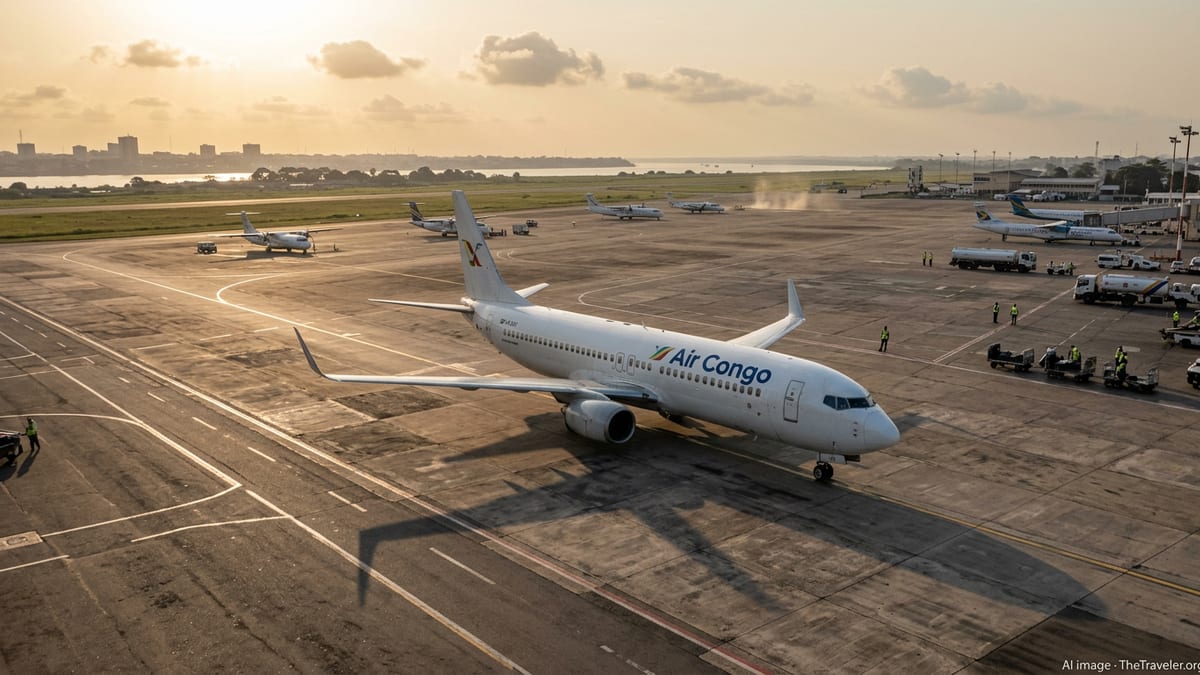
Another major development for Kinshasa’s connectivity has been the launch of Air Congo, a new flag carrier that began operations in December 2024 with N’Djili as its hub. According to publicly available corporate and media reports, the airline was created through an equity partnership with Ethiopian Airlines and has gradually added narrowbody and turboprop aircraft to serve domestic and regional routes.([en.wikipedia.org](https://en.wikipedia.org/wiki/Air_Congo_%282024-%29?utm_source=openai))
Strategic briefing documents associated with national economic forums describe Air Congo’s role as central to rebuilding the Democratic Republic of the Congo’s internal air network, with new aircraft planned for routes linking Kinshasa to major provincial cities. By feeding passengers from across the vast country into N’Djili, Air Congo is expected to improve load factors on international flights and make additional long-haul services more commercially viable.([makutano.cd](https://makutano.cd/wp-content/uploads/2025/12/NOTES-STRAGIQUES-X-MAKUTANO.pdf?utm_source=openai))
The partnership model also allows Ethiopian to leverage its experience in fleet management, maintenance, and training, while Kinshasa benefits from a home-based carrier that can coordinate schedules with long-haul partners. Industry analysis published in 2025 notes that such joint ventures are increasingly used to accelerate connectivity improvements in markets where infrastructure and regulatory frameworks are still catching up with demand.([aviationweek.com](https://aviationweek.com/sites/default/files/2025-04/AFA_2025_April-June.pdf?utm_source=openai))
Airport Upgrades and Rail Links Unlock Additional Capacity
While airlines drive most of the visible growth, Kinshasa’s capacity story is equally shaped by infrastructure developments at and around N’Djili International Airport. The airport already features one of Africa’s longest runways, at approximately 4,700 meters, allowing it to accommodate widebody aircraft under a range of operating conditions.([fr.wikipedia.org](https://fr.wikipedia.org/wiki/A%C3%A9roport_international_de_Kinshasa-Ndjili?utm_source=openai))
To address congestion and modernize facilities, Congolese authorities have pursued a multi-stage redevelopment of N’Djili. Architectural firm SOM has presented designs for a modular new terminal that would initially handle up to 5 million passengers annually by 2037, with provisions to expand capacity to more than 9 million passengers by 2050. Separate local reporting notes that the government has adjusted contracts and construction partners over time, while the transport ministry has publicly targeted a new terminal opening around 2027.([som.com](https://www.som.com/news/som-unveils-design-for-new-ndjili-international-airport-terminal-in-kinshasa/?utm_source=openai))
Recent domestic coverage also highlights incremental improvements at the existing complex, including the rehabilitation of the airport’s historic rotunda and the delivery of a new Boeing 787 aircraft for Air Congo, earmarked for international services. In parallel, a dedicated rail link between Kinshasa’s central station and N’Djili is advancing, with project documentation describing a 22 kilometer double track metro line designed to ease access and reduce road congestion on the main airport corridor.([acp.cd](https://acp.cd/nation/aeroport-de-ndjili-inauguration-de-la-rotonde-et-reception-dun-nouvel-avion-dair-congo/?utm_source=openai))
Together, these projects aim to shift N’Djili from a constrained gateway into a more efficient hub where expanded airline capacity can translate into smoother passenger flows and shorter connection times. Transport planning research focused on Kinshasa emphasizes that improved surface access to the airport is critical if airside investments are to deliver their full economic benefits.([arxiv.org](https://arxiv.org/abs/2601.00804?utm_source=openai))
Kinshasa’s Emerging Role in Central African Connectivity
The combined effect of airline expansion, new partnerships, and infrastructure projects is repositioning Kinshasa within Africa’s aviation map. Data compiled by industry associations and multilateral organizations show that Central African markets have historically been underserved compared with West and East Africa, both in seat capacity and in the variety of long-haul connections.([iata.org](https://www.iata.org/en/iata-repository/publications/economic-reports/regional-air-connectivity-in-the-democratic-republic-of-the-congo/?utm_source=openai))
As Ethiopian Airlines, Qatar Airways, Air Congo, and regional operators add frequencies, equipment, and new routings touching N’Djili, the airport is becoming a more attractive option for travelers connecting between Central Africa and destinations across the Middle East, Asia, and the Americas. The presence of long runway infrastructure, planned terminal expansions, and better ground transport links reinforces this gradual shift.
For now, growth remains a work in progress. Infrastructure projects face tight timelines, regulatory reforms continue, and competition from more established hubs in Nairobi, Addis Ababa, and Johannesburg is intense. However, current trends suggest that Kinshasa’s flight capacity is entering a sustained expansion phase in which Ethiopian and several partner airlines play an outsized role in unlocking new connectivity for one of Africa’s largest and historically most isolated markets.
Sources: Qatar Airways Kinshasa launch; SOM N’Djili terminal design; Air Congo background; AFRAA capacity data; World Bank aviation infrastructure report