


More news on this day
Etihad Airways passengers traveling from Abu Dhabi to London faced fresh disruption when a scheduled service returned to its departure airport following a reported mid-air technical problem, compounding ongoing schedule volatility across the Gulf carrier’s global network.
Get the latest news straight to your inbox!
Mid-Route Technical Issue Forces Return to Abu Dhabi
According to flight-tracking data and published coverage, Etihad Airways flight EY061 from Abu Dhabi to London Heathrow departed Zayed International Airport on 20 May but abandoned its westbound journey shortly after climb-out, instead circling and heading back to the Emirati hub. Reports indicate a technical issue on board prompted the crew to discontinue the long-haul sector and request a return to base.
Publicly available information has not detailed the exact nature of the problem. However, the sequence of events is consistent with standard safety procedures, which typically call for an immediate return when cockpit alerts, abnormal readings, or unresolved system anomalies arise early in a long overwater flight. Aviation analysts note that such decisions are designed to keep the aircraft within range of familiar maintenance facilities and emergency services.
The aircraft landed back in Abu Dhabi without reported injuries, but the unplanned diversion converted a routine overnight journey into a prolonged disruption for hundreds of passengers. Many travelers found themselves uncertain about missed connections, overnight arrangements, and onward travel to the United Kingdom and beyond.
While technical returns are not uncommon in commercial aviation, this incident has drawn heightened attention because it comes during a period of already fragile operations into and out of Abu Dhabi, where airlines have been rebuilding schedules around regional airspace constraints and rolling timetable changes.
Major Delays and Re‑Routing Hassles for Stranded Passengers
The immediate impact of the EY061 turnback was felt by passengers who suddenly faced the prospect of rebooking in an already congested market. With Etihad still operating a reshaped timetable from Abu Dhabi, alternative seats to London and onward destinations were limited, and same-day re-accommodation was not guaranteed for all travelers.
Based on passenger accounts shared through social media and travel forums, some guests were rebooked onto later Etihad flights to London, while others were offered routes via different European hubs such as Paris, Frankfurt, or Amsterdam before continuing to the United Kingdom. For those with tight onward connections in London, including same-day links to North America or regional European cities, the disruption triggered a cascade of missed flights and last-minute itinerary changes.
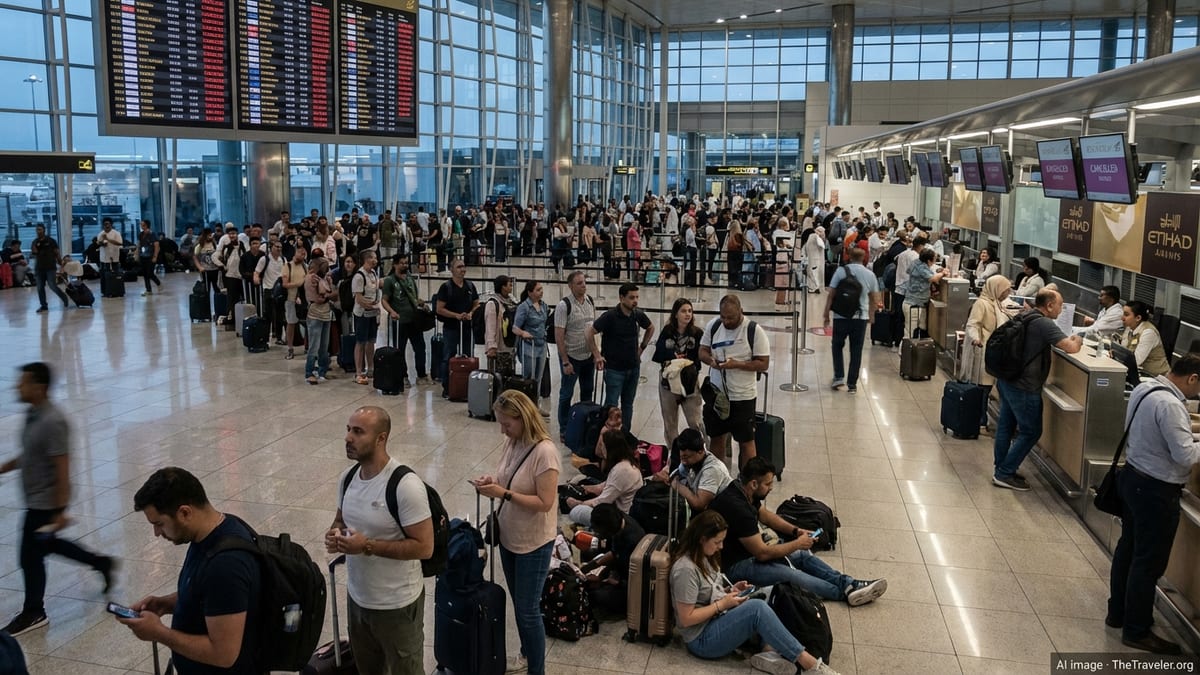
Standard airline practice in such circumstances generally includes providing meals, hotel accommodation where required, and assistance with rebooking when a technical fault renders a flight unable to complete its route. Yet multiple reports from Abu Dhabi and London in recent weeks suggest that high passenger volumes, limited staffed counters, and evolving schedules have made the process slower and more stressful, with long queues at service desks and extended waits for updated itineraries.
Travel-management companies indicate that corporate travelers have also been affected, with some firms forced to revise meeting schedules, delay project start dates, or authorize premium last-minute tickets on other carriers to keep time-sensitive trips on track. For leisure passengers, particularly families traveling at the end of school holidays or connecting to cruises and tours, the cost and complexity of rearranging plans has been significant.
Incident Hits a Network Already Under Strain
The technical return of the Abu Dhabi–London flight has landed against the backdrop of a wider realignment of Etihad’s operations. The airline has spent recent months rebuilding a limited but expanding schedule from Zayed International Airport after earlier airspace closures and security assessments prompted route suspensions and tightly controlled flight corridors across parts of the Middle East.
Publicly available airline notices and industry reports show that Etihad has been operating a reduced yet growing list of destinations, prioritizing trunk routes such as London Heathrow, New York, and key Asian and European capitals. This phased recovery has left the network more exposed to individual disruptions; when a high-demand flight like EY061 fails to complete its journey, spare capacity to absorb displaced passengers is narrower than in pre-crisis conditions.
Operational data services tracking Etihad’s Abu Dhabi–London services over recent weeks indicate a pattern of delays, occasional diversions, and schedule adjustments as the carrier adapts to changing airspace permissions and traffic flows. While on-time performance has been improving compared with the earliest days of the disruption, even small irregularities can quickly ripple across a tightly timed hub operation.
In this context, a technical event on a long-haul sector does more than delay one group of passengers. It ties up aircraft and crew, triggers maintenance checks, and can push connecting banks of flights off their planned departure times. The result is a network-wide knock-on effect that may be felt by travelers with no direct link to Abu Dhabi or London but who are relying on the same aircraft later in the day.
Broader Impact on Global Flight Operations
Analysts note that the EY061 incident illustrates how fragile long-haul connectivity remains when multiple stress factors converge: constrained airspace, rerouted flight paths, and limited spare fleet capacity. When a single aircraft operating a strategic route is forced to return to base, airlines must rearrange rotations that may stretch across several continents and time zones.
For airports such as London Heathrow, which already operate at or near capacity, the late arrival or cancellation of a Gulf service can disrupt gate allocations, baggage flows, and onward connections on partner carriers. In recent months, long-haul disruptions from the Gulf have occasionally contributed to missed minimum connection times for passengers transferring onto transatlantic flights, adding pressure to ground handling and customer-care teams.
Other airlines transiting nearby airspace have also been adjusting routings and schedules, making it more difficult for travelers to find last-minute alternatives when a planned flight fails to operate as expected. Industry coordination bodies have highlighted the growing complexity of replanning routes around active military or restricted zones while still maintaining commercially viable schedules.
As carriers, airports, and air navigation providers continue to refine flight corridors and contingency procedures, episodes like the Etihad Abu Dhabi–London technical return underscore the potential for localized technical issues to intersect with broader geopolitical and operational challenges, amplifying disruption well beyond a single aircraft or route.
What Passengers Should Do Next
With the Abu Dhabi–London corridor under close scrutiny, travel advisers recommend that passengers booked on upcoming Etihad services build extra flexibility into their plans. Publicly available guidance from airline advisories and travel portals consistently emphasizes checking flight status frequently in the 24 to 48 hours before departure and again on the day of travel.
Travelers connecting onward from London are being encouraged to allow longer layovers than usual, particularly when self-connecting between separate tickets. Where itineraries involve critical events, such as business meetings, weddings, or cruise departures, some agents are advising departures a day earlier than originally planned to create a buffer against last-minute changes.
Passenger-rights organizations also remind travelers to familiarize themselves with the conditions of carriage and applicable consumer-protection frameworks for their journey. While coverage varies by jurisdiction and ticket type, understanding entitlements to rebooking, care, and potential compensation can help passengers navigate discussions at the airport more effectively during disruption.
For now, Etihad continues to operate its core schedule from Abu Dhabi while adapting to evolving conditions. The EY061 mid-air return highlights the importance of ongoing vigilance and contingency planning for anyone relying on the Gulf hub for long-haul travel in the coming weeks.