


More news on this day
Europe’s peak summer travel season is colliding with the rollout of new EU border checks, with airport leaders warning that mounting queues and missed flights caused by the bloc’s biometric Entry/Exit System are “not bearable” over the coming months.
Get the latest news straight to your inbox!
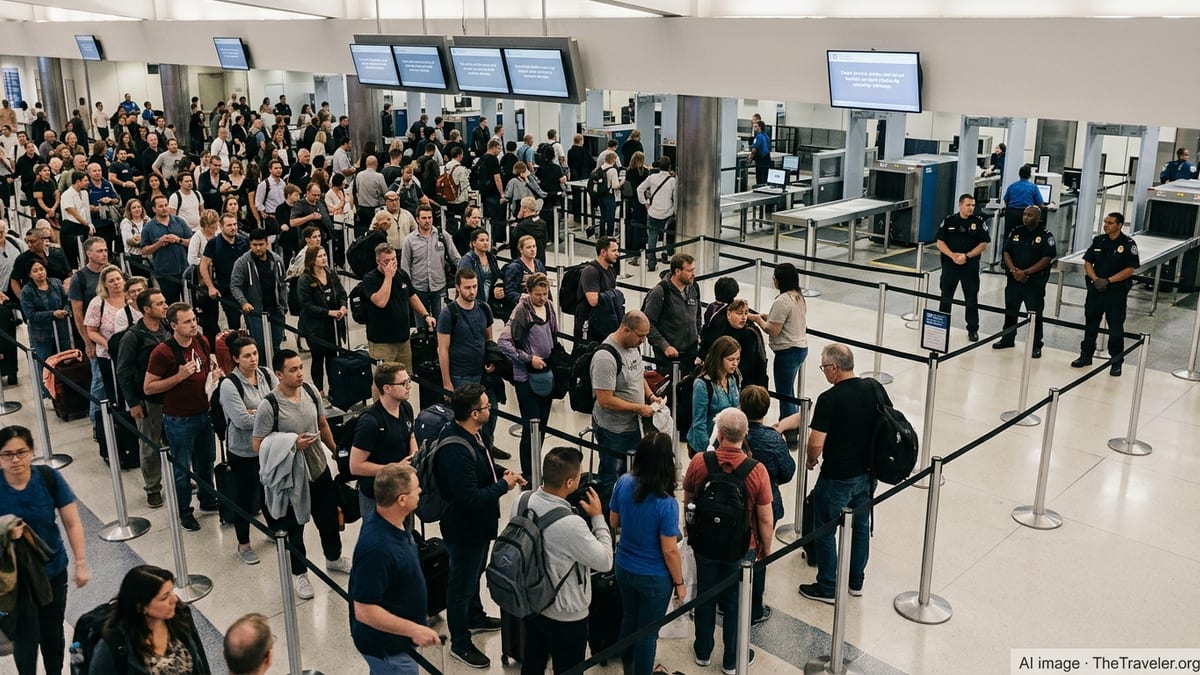
Berlin airport chief highlights strain on non-EU travellers
At Berlin Brandenburg Airport, the boss of the operating company has drawn particular attention to the pressure on border facilities handling non-EU passengers. According to recent coverage, Aletta von Massenbach described waits of up to two hours for third-country nationals and said such conditions are “not bearable over the summer”, as traffic climbs toward its annual peak.
The comments reflect the realities at a hub that has seen steady growth in long-haul and intra-European leisure traffic. With staffing and infrastructure calibrated for pre-EES procedures, the extended processing times per passenger are now rippling into check-in halls, departure boards and baggage reclaim areas, creating a visible pinch point at border control.
Industry reports suggest that Berlin is far from alone. Accounts from other major gateways indicate that even moderate disruptions at automated gates or manual booths can quickly double or triple queues when biometric checks are required for each arriving or departing traveller from outside the Schengen area.
Von Massenbach’s warning has resonated across the sector as a vivid snapshot of how the system is performing in real-world conditions, weeks before peak July and August holiday flows fully materialise.
EES rollout drives calls for emergency flexibility
The Entry/Exit System, a flagship EU project designed to register fingerprints, facial images and travel data for non-EU nationals, has been gradually activated at air, land and sea borders. Publicly available information shows that the scheme aims to tighten security and track overstays while replacing manual passport stamps with a shared digital database.
However, airline and airport associations say the early months of full operation have exposed serious bottlenecks. In an open letter to European Commission President Ursula von der Leyen, ACI Europe, Airlines for Europe and the International Air Transport Association warned that the rollout has reached a “critical point”, with some airports recording border waits of up to five hours during peak traffic. They argue that the system, in its current form, is placing “unsustainable pressure” on frontline staff and infrastructure.
The organisations are urging Brussels to allow member states far greater flexibility in suspending EES checks when passenger volumes exceed the capacity of border facilities, particularly during July and August. Their proposals include a preventive, temporary halt to full biometric enrolment at overwhelmed airports, alongside a longer-term mechanism that would let border authorities pause procedures in clearly defined exceptional circumstances.
European Commission representatives have acknowledged receiving the industry’s appeals and continue to emphasise the security benefits of the new regime. Official briefings stress that the impact is viewed as limited at most airports and that support remains available to help countries boost staffing and automation. For aviation leaders, though, the current mix of legal obligations and operational realities still falls short of what is needed to keep summer traffic flowing smoothly.
Queues, missed flights and warnings of ‘queue chaos’
Across Europe, published coverage describes a pattern of long lines, late departures and passengers stranded despite arriving early at the airport. Trade bodies and travel groups cite instances of travellers stuck in queues for several hours, forcing planes either to wait for missing passengers or to depart with empty seats while people remain trapped landside at passport control.
Low-cost carrier Ryanair has been particularly vocal about what it describes as potential “queue chaos” as more families and holidaymakers enter the system for the first time. The airline’s leadership has highlighted the extra time needed for fingerprint and facial-image collection, warning that inexperienced leisure travellers, language barriers and inconsistent procedures from one border point to another could magnify bottlenecks during school holidays.
Reports from individual airports suggest that the knock-on effects are already being felt. In some cases, airlines have had to delay pushback to wait for passengers still in border lines, while others have reported half-empty aircraft at gate closure because travellers were unable to clear control in time. Travel-industry analyses indicate that if such conditions become routine, the wider European tourism economy could face a loss of tens of millions of visitor arrivals and billions in spending over a full season.
For passengers, the experience can be unpredictable. Some flights are processed quickly when additional booths are opened or automated gates perform well; others encounter multi-hour logjams at similar times of day. This variability is adding a new layer of uncertainty for anyone connecting through a Schengen hub from a non-EU origin.
Industry pushes for staffing, tech fixes and pre-registration
Behind the urgent warnings, airport managers and airlines are also outlining potential solutions. Sector letters and interviews emphasise the need for more border police and immigration officers at critical choke points, especially at major hubs in countries such as Germany, Italy, Spain, Portugal and the Netherlands that handle large volumes of leisure traffic from the UK, North America and other non-Schengen markets.
Airports are encouraging wider use of automated border-control gates and self-service kiosks, provided that software and connectivity issues can be stabilised. Some hubs have reported cases where travellers were asked to re-enrol biometrics on subsequent trips, suggesting that data-sharing or matching problems are forcing people back through lengthy registration procedures even when they should qualify for faster verification.
Several industry proposals focus on shifting part of the process away from bottlenecked border halls. Aviation groups have renewed calls for an EU-wide pre-registration app that would allow passengers to input certain details in advance, reducing time spent at the terminal. Others are exploring whether elements of the EES process could be completed at departure airports outside the EU, although such changes would require complex legal and technical coordination.
Travel bodies also stress the importance of clear communication. Surveys referenced in recent analyses show that many prospective visitors still know little about the new checks or what is expected of them on arrival. Airports and airlines are therefore updating websites, boarding passes and pre-travel emails with basic explanations and time recommendations, even as they lobby for regulatory breathing room.
What non-EU passengers should expect this summer
For travellers from countries such as the United States, Canada and the United Kingdom, this summer’s journey through EU border controls is likely to feel different from previous years. Those entering the Schengen area for the first time since EES activation should anticipate a biometric enrolment process involving fingerprints, facial scans and additional questions at kiosks or manned booths.
Travel-industry guidance is increasingly advising passengers to arrive earlier than usual for flights involving Schengen border crossings, particularly if a short connection is required. Some airports and airlines now recommend allowing at least three hours at the first point of entry into the EU, and to be prepared for longer waits if travelling at peak holiday times or with large groups.
Analysts note that experiences will vary widely between airports. Well-resourced hubs with ample staff and mature automated-gate networks may be able to keep delays manageable, while smaller or already congested terminals could see queues stretching beyond indoor waiting areas. Weather events, local staffing shortages and technical outages may amplify the risk of disruption on certain days.
Despite the operational turbulence, the long-term goal of the Entry/Exit System remains to create a more secure and eventually more efficient external border. For now, however, Europe’s airport leaders are warning that without swift adjustments before the busiest weeks of July and August, today’s two-hour lines risk hardening into the kind of extended delays they deem simply “not bearable” for passengers or for the continent’s reputation as a welcoming, easy-to-reach destination.