


More news on this day
Europe’s new Entry/Exit System was designed to speed up border checks and tighten security, but as the scheme becomes fully operational across the Schengen area, travellers are reporting long queues, missed connections and unpredictable delays at some of the continent’s busiest airports.
Get the latest news straight to your inbox!
What the EU Entry/Exit System actually is
The European Union’s Entry/Exit System, widely referred to as EES, is a large-scale digital border database that records the movements of most non-EU nationals every time they cross the external borders of the Schengen area. In practice, it replaces the familiar ink passport stamp with an electronic file that logs when and where a traveller entered or left, as well as how long they are allowed to stay.
The scheme applies to so-called “third-country nationals” who do not hold an EU or Schengen-area passport. That group includes visitors who need short-stay visas and those, such as travellers from the United States, United Kingdom, Canada and Australia, who can enter visa-free for up to 90 days in any 180-day period. Each time these travellers cross into or out of the Schengen zone, their data is registered automatically.
At the heart of the system is a biometric profile. On a first encounter with EES, passengers are typically required to provide fingerprints and have a facial image captured, alongside basic passport details. This information is stored for several years and is intended to make subsequent crossings faster, since the system can verify identity and remaining days of stay without manual passport stamping or repeated form-filling.
The project has been in planning for more than a decade and went through repeated delays before a phased rollout began in October 2025. According to public information from EU institutions, the system became fully operational across most Schengen external border points in April 2026, marking a major shift in how the bloc manages who comes and goes.
Why EES was introduced and how it is meant to work
EU policymakers have promoted the Entry/Exit System as a way to modernise border management and reduce irregular migration linked to overstaying short-term permissions. By automatically calculating how long a non-EU visitor has been in the Schengen zone, the system is designed to flag overstays and repeat patterns more reliably than human passport stamping, which can be inconsistent and difficult to audit at scale.
The digital register is also intended to bolster security cooperation between member states. When a traveller is refused entry, deported or flagged in security databases, that information can be tied to a biometric identity and shared more rapidly across borders. Supporters argue that this makes it harder to use multiple passports or false identities to move unnoticed through the bloc and that automated checks can be carried out more consistently than manual visual inspections alone.
For legitimate travellers, the long-term promise of EES is smoother, more predictable processing. Once the initial biometric enrolment is complete, border agencies and the travel industry expect to rely more heavily on automated gates and pre-arrival data checks. The system is also intended to support the forthcoming European Travel Information and Authorisation System, or ETIAS, a separate pre-travel authorisation that is expected to come into effect in late 2026.
In principle, all of this should allow airports and land crossings to handle growing passenger numbers without proportionally increasing staffing. However, the early months of full-scale operation have exposed how challenging it can be to layer new technology on top of already stretched border infrastructure, particularly during peak holiday periods.
Queues, missed flights and suspended biometric checks
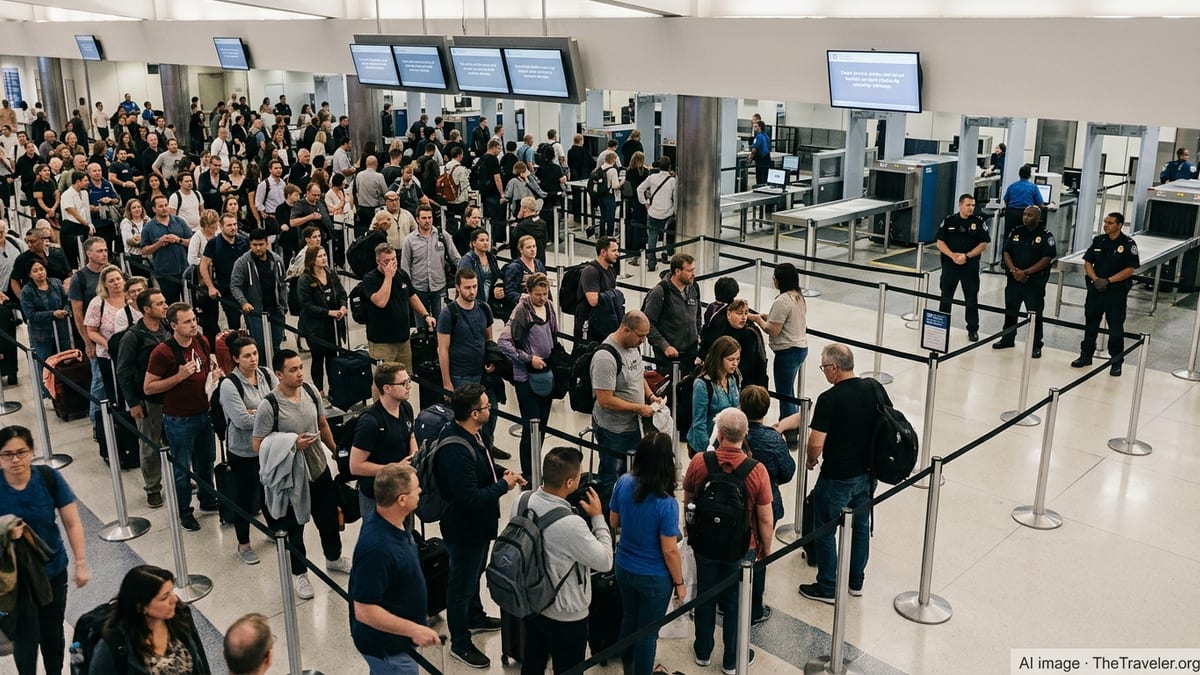
As more border posts switched fully to EES in April 2026, reports across Europe described scenes of passengers queuing for hours to provide fingerprints and facial scans. Coverage from outlets including Euronews and The Guardian described waits of up to three hours at some airports in the first days of the full launch, with some travellers missing flights after getting stuck in departure control queues.
At certain hubs, such as Brussels Airport and busy Mediterranean gateways, travel industry briefings have pointed to sustained pressure over subsequent weeks, with non-EU passengers in particular facing bottlenecks during bank holiday weekends and school holidays. Independent consumer rights platforms tracking disruptions have noted that border queues of two to four hours have not been unusual at peak times since mid-April, especially for travellers encountering the system for the first time.
In response to mounting congestion, some airports and national border agencies have temporarily reduced reliance on biometric kiosks or reverted partly to manual processing to keep queues moving. Specialist industry publications have reported instances where facial recognition gates were taken offline, with officers instead carrying out rapid visual checks and recording entries in the background to avoid severe knock-on delays to flight schedules.
While service appears to have stabilised at certain locations as staff gain experience and equipment is adjusted, disruptions continue to be reported elsewhere. Traveller accounts from hubs such as Amsterdam, Barcelona and Italian regional airports suggest that wait times can vary widely from one day to the next, with little advance visibility for passengers attempting to plan connections.
Airports and airlines push for flexibility
Europe’s aviation sector has become increasingly vocal about the operational impact of EES. In an open letter at the start of July, associations representing airports, airlines and ground handlers warned that the system had reached a “critical point,” urging EU institutions to allow more flexibility, including the option to suspend full EES checks during peak traffic surges in order to prevent five-hour queues and widespread disruption.
Industry analyses highlight the basic arithmetic behind the strain. Airport Council International Europe previously calculated that the added biometric steps at border control could increase processing times per passenger by up to 70 percent in the early stages, effectively reducing the number of people that can be handled per hour at fixed control booths. Without significant extra staffing or investment in more automated gates, long lines are a predictable outcome when traffic spikes.
Several national governments and border agencies have advised travellers to arrive much earlier than before, with some recommending at least three hours for short-haul flights and even more for long-haul departures from busy hubs. Travel trade publications report that airlines have lengthened minimum connection times at major European airports, particularly for itineraries that involve a non-EU passenger transiting from a Schengen arrival to a non-Schengen departure or vice versa.
Parliamentary briefings in countries such as the United Kingdom note that ports and rail terminals serving cross-Channel traffic are still working through technical challenges in integrating their systems with EES. Transport operators have flagged the risk that, during peak holiday getaways, even short additional processing times per person could translate into significant tailbacks for car and coach traffic heading towards continental Europe.
What travellers should expect at the border now
For non-EU visitors heading to the Schengen area this summer, the most immediate impact of EES is likely to be at the first point of entry. Travellers can typically expect to have fingerprints scanned and a facial image taken if this has not already happened on a previous trip since the system went live. The process itself is straightforward but can be slowed by unfamiliarity with the machines, difficulties capturing good-quality fingerprints and the need for staff to assist passengers who struggle with the technology.
Once the initial enrolment is complete, subsequent trips should, in theory, be faster, since border control can reuse stored biometrics and focus on verifying that the traveller has not overstayed. However, recent media coverage and passenger accounts indicate that some people have been asked to repeat the registration on multiple journeys, reportedly due to data-matching problems or duplicate profiles. When this happens at busy times, it can contribute to repeated long waits for frequent visitors.
Processing remains uneven across the continent. Larger hubs with extensive automated-gate infrastructure and additional staff on duty appear better able to absorb the extra workload, while smaller regional airports and certain land crossings have struggled more visibly. Airlines, airports and consumer advocates are encouraging passengers to build in extra time for border formalities, particularly when travelling at weekends or during school holidays.
In the background, European institutions and industry groups are debating how to fine-tune the system ahead of the introduction of ETIAS, which will add a further digital layer to travel to the bloc. For now, publicly available information suggests that travellers should not encounter new documentation requirements because of EES itself, but they can reasonably expect that crossing into or out of the Schengen area may take longer than it did before October 2025, at least until the technology and procedures bed in more fully.