


More news on this day
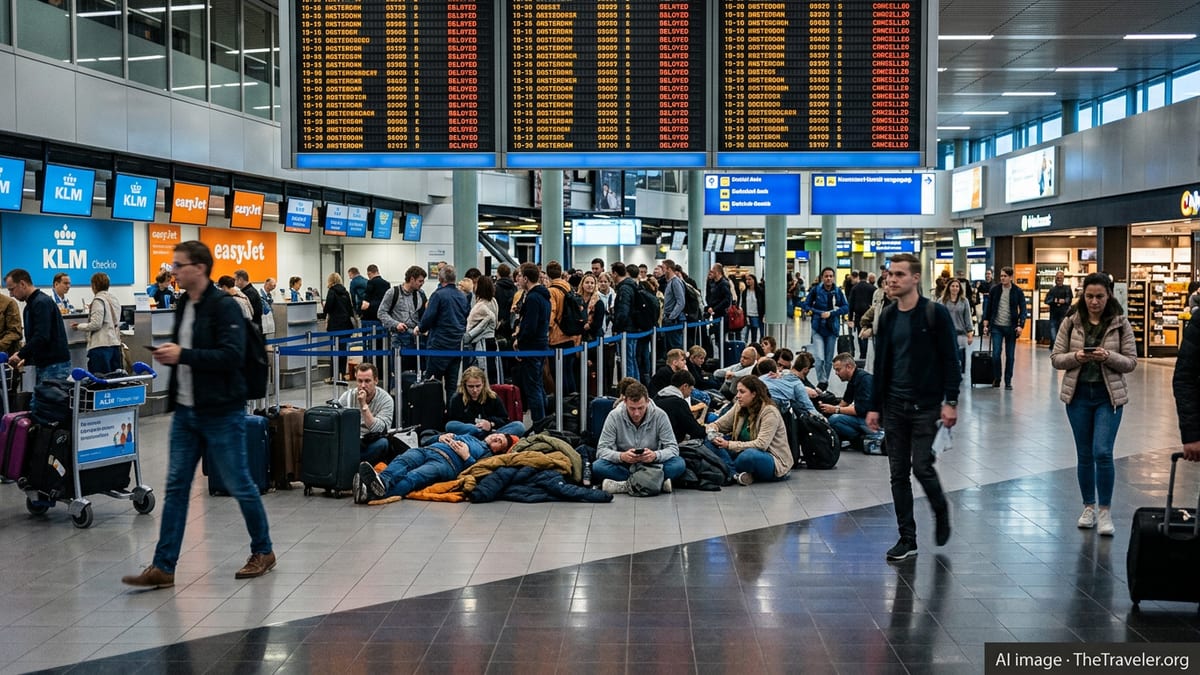
Nearly 2,000 flights have been delayed and at least 65 cancelled across key hubs in England, France and Italy, as a convergence of storms, congested airspace and operational pressures turns the 2026 summer travel season into a Europe-wide aviation crisis.
Get the latest news straight to your inbox!
Storm Systems and Congested Skies Collide
Publicly available flight-tracking data and network statistics indicate that a succession of intense storm systems over Western Europe has been a major driver of disruption. Thunderstorms and heavy rainfall have repeatedly crossed busy air corridors linking the United Kingdom, northern France and northern Italy, prompting temporary ground stops, reduced arrival rates and rerouting of traffic.
Reports from major airports in England, including London hubs, describe early morning departures being held on the ground for hours when storm cells moved across departure and arrival paths. Similar weather patterns over Paris Charles de Gaulle and Orly led to sharply reduced runway capacity, while Milan and other northern Italian airports faced rolling restrictions as convective weather built over the Alps and Po Valley.
EUROCONTROL network updates show that when storms disrupt one major hub, knock-on effects can cascade rapidly across the continent. Aircraft and crews miss their planned rotations, leading to subsequent flights departing late or being cancelled outright. The tally of 1,997 delays and 65 cancellations across England, France and Italy reflects not a single incident, but a sustained period of unstable weather interacting with already busy summer schedules.
Operational data from punctuality reports further suggest that each delayed flight is often running significantly behind schedule, with average delays stretching well beyond the 15-minute threshold commonly used in aviation statistics. Late-arriving aircraft can then push back subsequent departures into curfew or storm-affected windows, reinforcing a cycle of disruption.
Airspace Restrictions and Middle East Conflict Ripple Effects
The turmoil over Europe’s airports is being compounded by broader geopolitical and airspace constraints linked to the ongoing conflict involving Iran. Aviation trend analyses point to continued rerouting of traffic between Europe, the Middle East, Asia and parts of Africa, as airlines avoid closed or high-risk corridors and rely more heavily on alternative routes through southern and central Europe.
These longer routings and concentrated flows increase pressure on key en route sectors over France and Italy in particular. When storms or local capacity constraints arise in those same sectors, the result is a sharp rise in air traffic flow management regulations, forcing airlines to accept extended delays to departure slots or diversions to less congested routings.
In practice, that means flights which might previously have cruised on direct tracks across the eastern Mediterranean or Middle East are now sharing already crowded airspace above France and Italy. This adds another layer of vulnerability: even modest weather or staffing issues can tip a busy summer day into a significant operational crunch, driving up both the number and duration of delays.
Network forecasting from regional organisations had already warned that summer 2026 would be challenging as traffic levels continue to recover and surpass pre-pandemic volumes. The present disruption across England, France and Italy shows how quickly those forecasts are being tested in real time.
Local Pressures: Strikes, Safety Measures and Airport Constraints
Alongside weather and airspace issues, domestic factors in each of the three countries are adding friction. In Italy, recent industrial action in the aviation sector and strike notices have required the national aviation authority to publish lists of guaranteed flights and minimum service levels, while still leaving non-protected services vulnerable to cancellation or long delays when stoppages go ahead.
In France, the system remains sensitive to any disruption affecting air traffic control staffing or capacity. Past analyses of French air traffic control strikes demonstrate how significantly even short walkouts can affect flights not only to and from France, but also overflights between the United Kingdom, Spain, Italy and beyond. Although the current crisis is primarily weather and congestion driven, the network is operating with that structural fragility in the background.
In England, attention has focused on both major London hubs and smaller regional airports coping with isolated incidents and infrastructure constraints. Recent events at one southeastern airport, where a separate general aviation accident led to a temporary shutdown, illustrate how quickly capacity can vanish from the system. Even when commercial airlines are not directly involved, any closure can force reroutes, diversions and rolling delays that then show up in network-wide statistics.
Together, these local pressures help explain why the pattern of 1,997 delays and 65 cancellations is spread across multiple airports and carriers, rather than concentrated in a single failure. The crisis is emerging from the interaction of many small stress points in three of Europe’s most heavily used aviation markets.
Passenger Impact and Rights Under EU and UK Rules
For passengers, the experience of the current disruption ranges from minor inconvenience to severe itinerary breakdowns. Travellers are reporting missed connections, unplanned overnight stays and lost holiday days as delayed arrivals ripple through onward journeys across Europe and beyond.
Under European passenger protection rules, including Regulation EC 261/2004 and its retained UK equivalent, airlines operating from airports in England, France and Italy are obliged to provide care in the form of meals, refreshments and accommodation when long delays or cancellations occur. In many circumstances, they must also offer re-routing at the earliest opportunity or a refund, with monetary compensation available when disruptions are not caused by extraordinary circumstances.
Consumer advice published for the 2026 summer season in the United Kingdom emphasises that passengers should keep receipts for reasonable expenses and document the length and cause of their delay. Similar guidance from European consumer bodies highlights that written confirmation of the reason for disruption can help when seeking compensation once travel is complete.
However, the classification of bad weather, airspace closures and knock-on effects of external conflicts often proves contentious. Airlines may argue that certain delays fall outside their control, while passengers, facing hours in terminals or unexpected hotel bills, may contest those claims. The present wave of delays and cancellations is likely to fuel further debate over how these rules are interpreted.
What Travellers Can Do During the 2026 Summer Turbulence
With the aviation system under strain, travel planners are advising passengers to build more resilience into their itineraries across England, France and Italy. Publicly available guidance suggests favouring earlier departures in the day, as morning flights are statistically less exposed to cumulative delays from previous rotations and late-arriving aircraft.
Direct flights, where available, reduce the number of points at which disruptions can break an itinerary. When connections are unavoidable, extended layovers may provide a buffer against moderate delays in the first leg. Travel insurance policies that include disruption cover can help offset additional accommodation and transport costs when plans unravel.
Real-time flight status tools and airline apps remain essential in the current environment. Passengers are encouraged to monitor their flights closely from 24 hours before departure, as same-day schedule changes, aircraft substitutions and re-routings are more common during periods of systemic stress.
Industry analyses suggest that, while the present tally of 1,997 delayed flights and 65 cancellations is significant, it may not represent a peak for the 2026 season if storm activity, airspace restrictions and operational pressures persist. Travellers heading through England, France and Italy in the coming weeks may benefit from treating punctuality as an uncertainty to be managed, rather than a guarantee.