


More news on this day
Air travel across the Middle East faced fresh disruption this week as regional carriers and airports in Saudi Arabia, Egypt, Qatar, Bahrain and other countries reported hundreds of cancellations and delays, with aviation tracking data indicating at least 265 flights cancelled and more than 1,100 delayed in a single day.
Get the latest news straight to your inbox!
Regional Flight Operations Strained By Ongoing Volatility
Publicly available aviation data and media coverage indicate that carriers across the Gulf and wider Middle East have again had to trim or retime services as they navigate shifting airspace restrictions and evolving security assessments. The latest disruption includes at least 265 flight cancellations and 1,139 delays involving departures and arrivals touching Saudi Arabia, Egypt, Qatar, Bahrain and neighboring states, affecting major hubs such as Riyadh, Jeddah, Doha, Cairo and Manama.
The figures, drawn from live schedules and airport boards monitored on Wednesday, underline how quickly operational conditions can change for airlines in a region already coping with rerouted flight paths and intermittent airport slowdowns. While many services continue to operate, the spike in irregular operations marks one of the more significant single-day disruptions since the spring escalation of conflict around the Gulf.
Travelers connecting between Europe, Asia and Africa through Middle Eastern hubs are particularly exposed, as a large share of global east–west traffic funnels through airports in Saudi Arabia, Qatar and the United Arab Emirates. Even where flights are not cancelled outright, longer routings, rolling delays and tighter crew-availability windows are contributing to knock-on schedule changes throughout the day.
Analysts following the region note that airlines are trying to preserve as much of their summer schedule as possible, but caution that short-notice changes remain likely as carriers react to updated risk assessments and airspace bulletins.
Major Carriers Including Qatar Airways, Saudia And Air Arabia Affected
The latest data shows that the disruption is spread across multiple operators rather than limited to a single airline. Qatar Airways, Saudia and Air Arabia are among the carriers registering cancellations or extended delays, alongside a mix of regional full-service and low-cost competitors.
Qatar Airways has been rebuilding its network through Doha, adding destinations and restoring frequencies for the peak travel season, but its operations remain sensitive to changes in routings around conflict-affected areas. In recent months the airline has published several revised schedules and travel alerts indicating that some services may be adjusted at short notice, and the current spike in irregular operations reflects that continuing volatility.
Saudia, the Saudi flag carrier, has also been operating with a more flexible timetable in response to security and airspace considerations. Earlier schedule updates showed suspensions or reductions on selected regional routes; the latest wave of day-of-travel cancellations and delays appears to be concentrated around busy trunk links between Saudi cities and neighboring Gulf and Levant destinations.
Air Arabia and other low-cost airlines based in the United Arab Emirates and surrounding states are similarly exposed, as their point-to-point networks rely on consistent, high-frequency flying to maintain connections and aircraft utilization. When airspace restrictions or ground delays lengthen individual flight times, these carriers can be forced to consolidate rotations or cancel later sectors to keep crews within duty limits.
Airspace Restrictions And Security Concerns Drive Operational Choices
Reports from regional and international media since early 2026 have documented repeated adjustments to air corridors across parts of the Middle East, with some countries temporarily closing portions of their airspace and others imposing altitude or routing limits along key corridors. These measures, combined with intermittent security incidents near airports, have added complexity to already crowded skies.
Publicly available information from aviation authorities and airline notices indicates that many carriers are flying longer detours to avoid higher-risk areas, adding time and fuel burn to long-haul services between Europe and Asia. While such precautions allow flights to continue, they reduce overall network flexibility and make it harder for airlines to recover from localized disruptions such as weather or technical issues.
Industry observers point out that Middle East hubs play an outsized role in global connectivity, handling a significant share of transfer traffic. When even a limited number of departure or arrival slots are lost to precautionary suspensions, the ripple effects can reach airports far beyond the region, with aircraft and crews out of position and passengers missing onward connections.
In this latest episode, the concentration of cancellations and delays across Saudi Arabia, Egypt, Qatar and Bahrain reflects both direct operational constraints and the broader challenge of coordinating schedules in an environment where flight plans may need to be refiled several times in a single day.
What Travelers Are Experiencing On The Ground
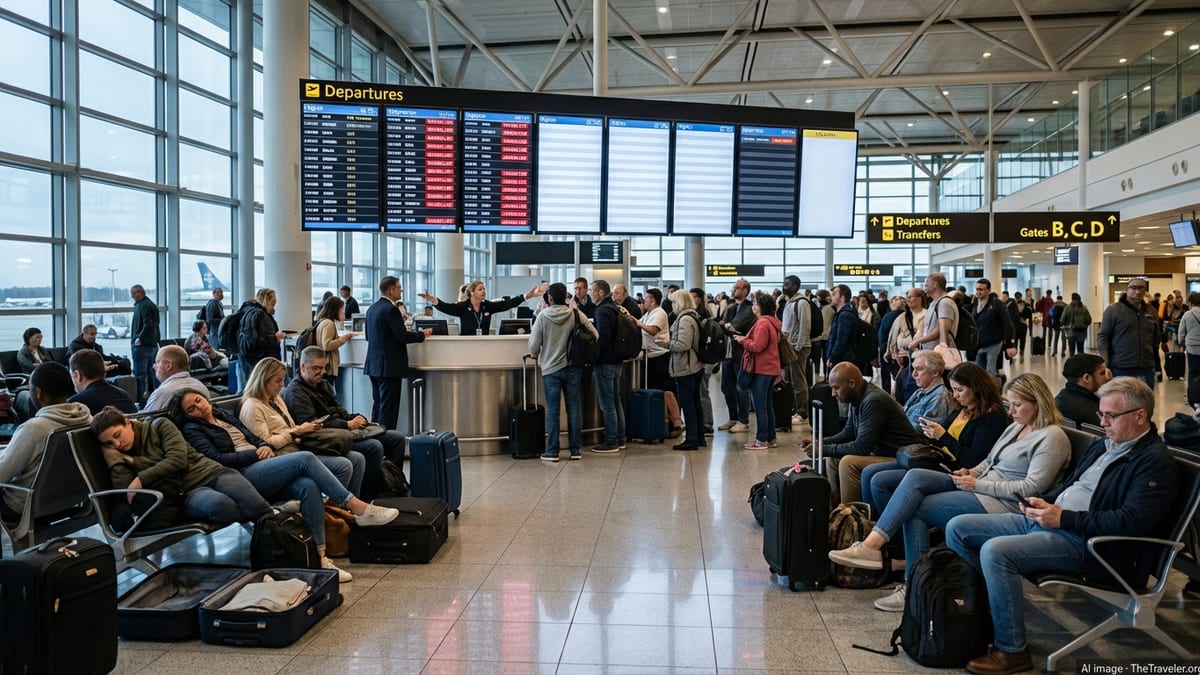
For passengers, the statistics translate into crowded customer-service desks, rebooked itineraries and, in some cases, extended airport stays while airlines work through backlogs. Social media posts and traveler forums over recent days describe queues at check in and transfer counters at several major hubs, as well as rolling updates on departure boards as flights slip back in the schedule.
Publicly available airport information suggests that some carriers are prioritizing long-haul and high-demand routes, protecting core intercontinental flights while thinning frequencies on secondary regional sectors. This approach can leave travelers on shorter routes with fewer same-day alternatives when a flight is cancelled, increasing reliance on overnight accommodation or complex re-routings.
Airlines in the region have reiterated through their published advisories that passengers should check the latest status of their flights before leaving for the airport and ensure contact details are up to date in booking records so that schedule changes can be communicated quickly. Some carriers are also offering fee waivers or flexible rebooking options on affected routes, reflecting the operational uncertainty.
Travel agencies report that clients with imminent departures are increasingly looking for reassurance about routings and connection times, and in some cases are considering itineraries that avoid the most congested or exposed hubs even if that adds time and cost to the journey.
Outlook For The Coming Days
With the regional security outlook still fluid, aviation analysts expect airlines across the Middle East to continue adjusting schedules on a rolling basis rather than issuing long-term cuts. Published schedules for the remainder of the summer season still show robust capacity on many routes, but the gap between timetabled and operated flights may remain wider than usual.
Airport and flight-tracking data from earlier disruption episodes this year suggest that, when conditions stabilize even briefly, carriers move quickly to restore services and clear backlogs. However, sustained airspace constraints or new security incidents can rapidly reverse those gains, leading to renewed clusters of cancellations and delays similar to those seen in the latest reporting period.
Travel planners note that flexibility will be key for passengers flying to, from or through Saudi Arabia, Egypt, Qatar, Bahrain and neighboring states in the short term. Allowing longer connection windows, monitoring flight status closely, and being prepared for schedule changes on the day of travel are likely to remain prudent steps while the region’s aviation network operates under heightened strain.
For now, the disruption underscores how closely global air travel remains tied to developments in the Middle East, where a combination of strategic geography and concentrated hub operations means that decisions made in a handful of control rooms can reverberate across continents within hours.