


More news on this day
Europe’s summer travel season has lurched into fresh turmoil as widespread disruption affecting an estimated 1,550 flights triggers rolling delays and airport gridlock across Madrid, Rome and London Gatwick, according to operational data and passenger reports from multiple carriers and tracking platforms.
Get the latest news straight to your inbox!
Major Hubs Buckle Under Mounting Delays
Operational data from flight tracking and passenger rights platforms indicates that a fresh wave of disruption is radiating across Europe’s busiest corridors, with Madrid Barajas, Rome Fiumicino and London Gatwick among the hardest hit. Collectively, an estimated 1,550 services are running late, creating knock-on congestion through already crowded summer schedules.
Madrid Barajas, one of Europe’s largest hubs for connections between Europe and the Americas, is experiencing extensive schedule slippage, with late afternoon and evening waves particularly affected. Delays on routes linking Madrid with Rome, London and major transatlantic destinations are rippling into missed connections, forced rebookings and long lines at customer service desks.
Rome Fiumicino, a critical gateway for Mediterranean and long haul traffic, is facing similar strain as inbound delays from northern Europe arrive late and cascade across outbound departures. London Gatwick, heavily focused on short and medium haul European services, has seen tight turnarounds unravel as late-arriving aircraft and crew duty limits combine to prolong disruption throughout the day.
Publicly available Eurocontrol delay statistics for early 2026 had already highlighted mounting pressure across the European network, with average delay minutes per flight rising and weather, staffing and congestion consistently cited as key drivers. The latest disruption is amplifying these underlying trends, leaving airlines with little spare capacity to absorb shocks.
Knock-On Impact for Passengers Across the Network
While the headline disruption is concentrated at Madrid, Rome and Gatwick, the effects are radiating throughout the network as aircraft and crews fall out of position. Travel data shows late-running sectors between these three hubs and secondary airports in France, Germany and the United Kingdom, as well as on holiday routes to Mediterranean islands and resort destinations.
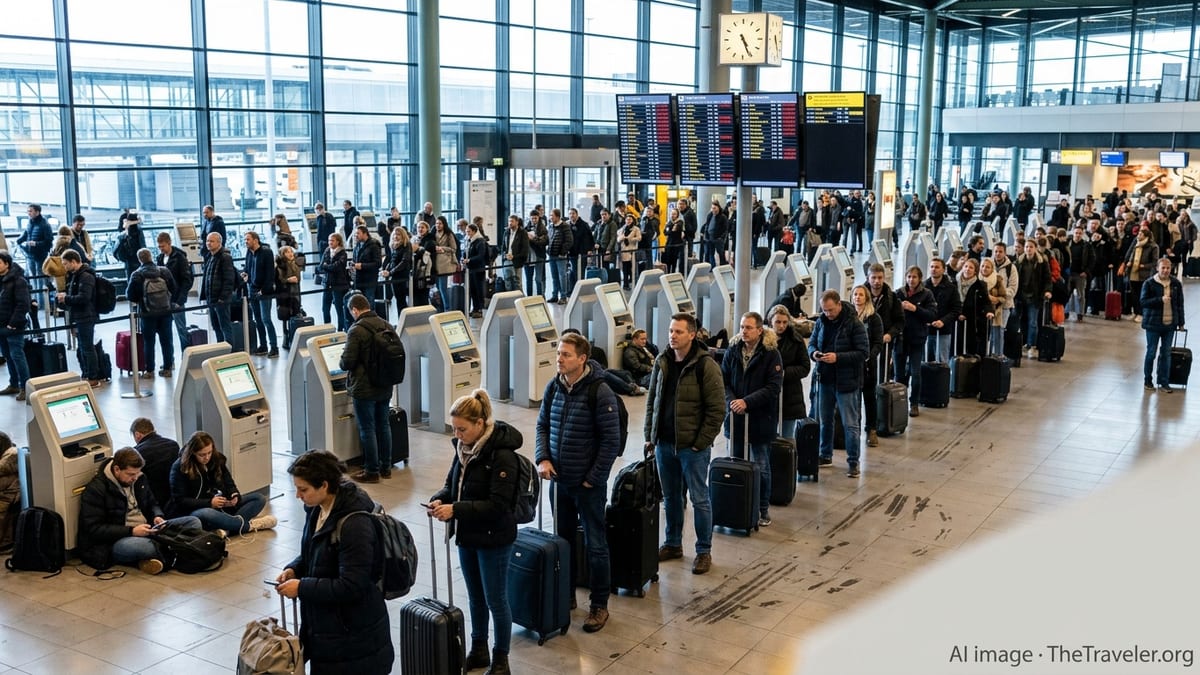
Passengers report lengthy queues at security, check in and rebooking counters, alongside crowding in departure lounges as rolling delay estimates are repeatedly updated. Families beginning school holiday trips and business travelers attempting to make meetings are among those facing extended waits, overnight stays and lost connections.
The impact is particularly acute for travelers on multi segment itineraries who rely on short connection windows. A moderate delay on an inbound flight into Madrid or Rome can easily mean a missed onward departure to smaller European or North African destinations, where alternative services may operate only once daily, if at all.
Travel rights advocacy organizations are reminding passengers that they may be entitled to compensation or care in cases of long delays, cancellations or missed connections within Europe, depending on the cause of the disruption and the carrier involved. Many are advising travelers to retain boarding passes, booking confirmations and receipts for food, transport and accommodation to support potential claims.
Operational Strains Behind the Chaos
Analysts point to a familiar mix of factors behind the latest wave of delays. Published operational updates for Heathrow and Gatwick earlier in June described how dense schedules, short aircraft turnarounds and crews approaching legal duty time limits can quickly multiply minor timing issues into large scale disruption. Similar dynamics are now visible at Madrid and Rome.
High aircraft utilization in the peak season leaves minimal slack in the system. When early morning flights depart late due to a technical check, weather constraint or previous arriving delay, subsequent rotations often begin one or two hours behind schedule. As the day progresses, that gap widens, especially if air traffic control restrictions or local weather reduce runway capacity.
Eurocontrol’s recent delay analyses for 2026 have highlighted that reactionary delays those caused by earlier disruptions now represent a major share of total delay minutes across the European Civil Aviation Conference area. Once a threshold of affected flights is crossed, airports, airlines and ground handlers find it difficult to catch up without cancelling services to reset the operation.
At hubs such as Madrid and Rome, where a large share of traffic connects between regions, a delayed bank of arrivals can leave hundreds of passengers misaligned with their outbound departures. Gatwick, by contrast, is heavily point to point, but the sheer number of short haul movements and intense scheduling narrow the margin for recovery when several waves of flights are affected at once.
How Airlines and Airports Are Responding
Publicly available information from airline websites, airport dashboards and passenger communications shows carriers are leaning on a familiar toolkit to manage the disruption: rolling delay estimates, selective cancellations, rebookings onto later services and, where necessary, overnight accommodation for stranded travelers.
Some airlines are proactively waiving change fees for itineraries touching the most affected airports, encouraging passengers with flexibility to move trips away from peak disruption periods. Others are prioritizing long haul departures in order to avoid widespread knock-on effects on intercontinental networks, resulting in shorter European hops bearing the brunt of schedule adjustments.
Airports are deploying additional staff to crowd management, signage and information points, based on reports from passengers and local media coverage. However, physical constraints in terminals and at gate areas limit how much congestion can be alleviated in the short term, especially during peak departure banks in the morning and late afternoon.
Ground handling companies, responsible for tasks such as baggage loading, aircraft towing and passenger boarding, are also under pressure. Recent seasons have seen tight labor markets and high turnover in this sector, and periods of intense disruption expose any remaining staffing gaps, slowing down key processes and further prolonging delays.
What Travelers Can Expect in the Coming Days
With the European summer peak now underway and schedules already tightly packed, recovery from such a large volume of delays is rarely immediate. Even if new disruptions ease, late running aircraft and out of position crews can continue to affect services for several days, especially on complex multi leg rotations linking Madrid, Rome and London with transatlantic and leisure markets.
Travel experts advise that passengers scheduled to fly through the affected hubs in the near term should monitor their bookings closely, using both airline apps and airport departure boards. Checking in online as early as possible and arriving at the airport well ahead of departure can provide a small buffer against further operational surprises.
Those planning new trips are being urged to factor in longer connection times, particularly when self connecting between separate tickets or carriers. Allowing additional hours between flights, or opting for itineraries with more robust rebooking options, can reduce the risk of being stranded mid journey if schedules unravel again.
For airlines and airports, the current disruption is another stress test of post pandemic rebuilding efforts and capacity planning. With demand for travel remaining strong, the ability of Europe’s aviation system to absorb shocks without spiraling into widespread gridlock will remain a central concern throughout the rest of the summer season.