


More news on this day
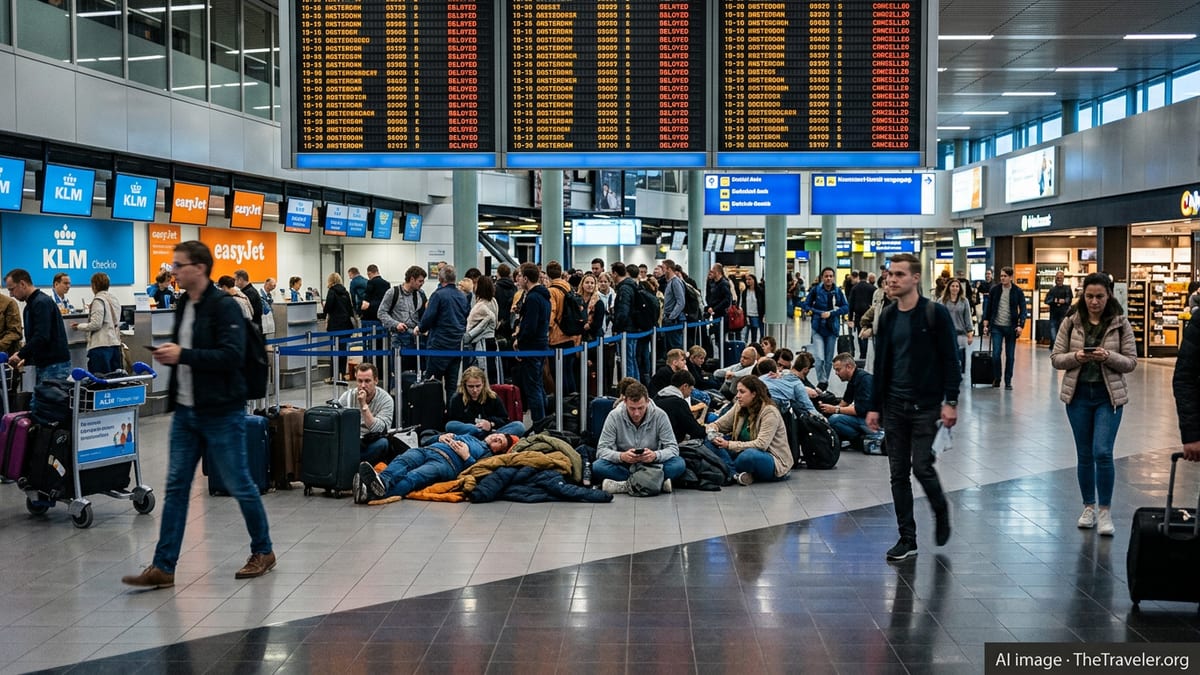
Flight disruptions intensified across Europe on July 8, 2026, as airports in Germany, England, the Netherlands, Norway and several other countries reported 1,245 delays and 56 cancellations, causing knock-on chaos for carriers including Lufthansa, British Airways, Austrian Airlines and SAS.
Get the latest news straight to your inbox!
Delays and Cancellations Ripple Across Key European Hubs
Publicly available operational data for July 8 indicates that disruption was spread across a wide geography, with Amsterdam Schiphol, Frankfurt, London Heathrow and Gatwick, Copenhagen, Helsinki, Oslo, Vienna, Palma de Mallorca and Moscow Sheremetyevo among the airports reporting significant schedule issues. The combined impact across these hubs reached 1,245 delayed services and 56 cancellations, affecting intra-European and long haul networks.
Reports from aviation analytics platforms and travel industry coverage describe the pattern as a familiar mix of persistent bottlenecks rather than a single dramatic incident. Staffing constraints, air traffic control flow restrictions, weather-related capacity cuts and aircraft rotation challenges all contributed to a day in which many flights operated late rather than being fully removed from schedules.
The imbalance between delays and outright cancellations meant that many aircraft still took off, but often well behind schedule. As planes and crews fell out of position, later rotations suffered further knock-on impacts, creating a rolling wave of disruption that extended into the evening peak at several airports.
Lufthansa, British Airways, Austrian and SAS Among Most Affected
Flag carriers and major network airlines bore much of the strain, as their operations are heavily concentrated at the affected hubs. Published disruption summaries show Lufthansa handling some of the highest numbers of delayed flights in Germany, particularly through Frankfurt, where its dense bank of European feeder services is highly sensitive to any constraint.
In the United Kingdom, British Airways faced delays and a limited number of cancellations at London Heathrow and Gatwick, where busy short haul routes to Germany, the Netherlands and Scandinavia are closely interconnected with long haul services to North America, Asia and Africa. Even modest delays on these feeder legs can lead to missed onward connections and lengthy rebooking processes for passengers.
In Austria and the Nordic region, Austrian Airlines and SAS were also caught up in the wider European pattern. Vienna and Oslo reported disrupted departures and arrivals, highlighting how operational issues in one part of the continent can quickly spread through alliance and codeshare networks to affect neighboring markets.
Amsterdam, Frankfurt, London and Nordic Airports Under Pressure
Amsterdam Schiphol and Frankfurt once again emerged as focal points, reflecting their role as major connecting hubs. Recent weeks have already seen both airports listed in roundups of Europe-wide disruption, and the July 8 figures underscore how sensitive they remain to even incremental strains on capacity or staffing.
London Heathrow and Gatwick added further complexity, as their schedules connect the United Kingdom to both continental European hubs and long haul destinations. Published accounts of the day’s operations describe long queues at departure gates, aircraft waiting for takeoff slots and extended turnaround times, which together contributed to a build-up of late-running flights.
Farther north, Oslo Gardermoen and other Nordic airports contributed to the pan-European picture. While the absolute number of affected flights was smaller than at the largest hubs, disruption on key routes linking Norway, Denmark and Finland into Amsterdam, Frankfurt and London amplified the reach of the problem, particularly for travelers relying on single-day connections.
Causes: Summer Demand, Operational Constraints and Airspace Limits
Industry observers point to a convergence of seasonal and structural factors behind the latest wave of disruption. Early July traditionally marks one of the busiest periods for European leisure and family travel, and demand in 2026 has remained strong despite cost pressures and a patchy record of reliability at several hubs.
Operationally, airlines and airports continue to balance tight staffing levels with ambitious summer schedules. Ground handling, security screening, aircraft maintenance and cabin crew availability are all cited in recent coverage as areas where limited spare capacity leaves little room to absorb unexpected events, from equipment failures to sudden weather changes.
Air traffic control restrictions also play a recurring role. Flow management measures designed to protect congested sections of European airspace often require temporary reductions in the number of movements an airport can handle per hour. When these limits coincide with strong demand and dense banks of connections, the result is a queue of aircraft on the ground and a chain of delayed departures.
What the Disruption Means for Travelers
For passengers, the July 8 figures translate into missed connections, rebooked itineraries and, in some cases, overnight stays far from final destinations. Travel advisories from consumer-rights and flight-compensation services continue to emphasize the importance of monitoring flight status in airline apps, allowing extra time at the airport and keeping all receipts and boarding passes.
Under European and UK passenger rights rules, travelers on qualifying flights may be entitled to assistance, rerouting or refunds, and in certain circumstances to financial compensation when delays or cancellations are not attributable to extraordinary circumstances. Consumer information sites stress that entitlement varies depending on the carrier, the route and the precise cause of disruption, so each case must be assessed individually.
With school holidays and peak summer travel now well underway, analysts expect that further days of concentrated disruption are likely in the weeks ahead. Travelers planning to transit through Amsterdam, Frankfurt, London or the Nordic capitals are being advised in public guidance to build in longer connection times, consider earlier departures where possible and stay alert to schedule changes that may appear at short notice.