


More news on this day
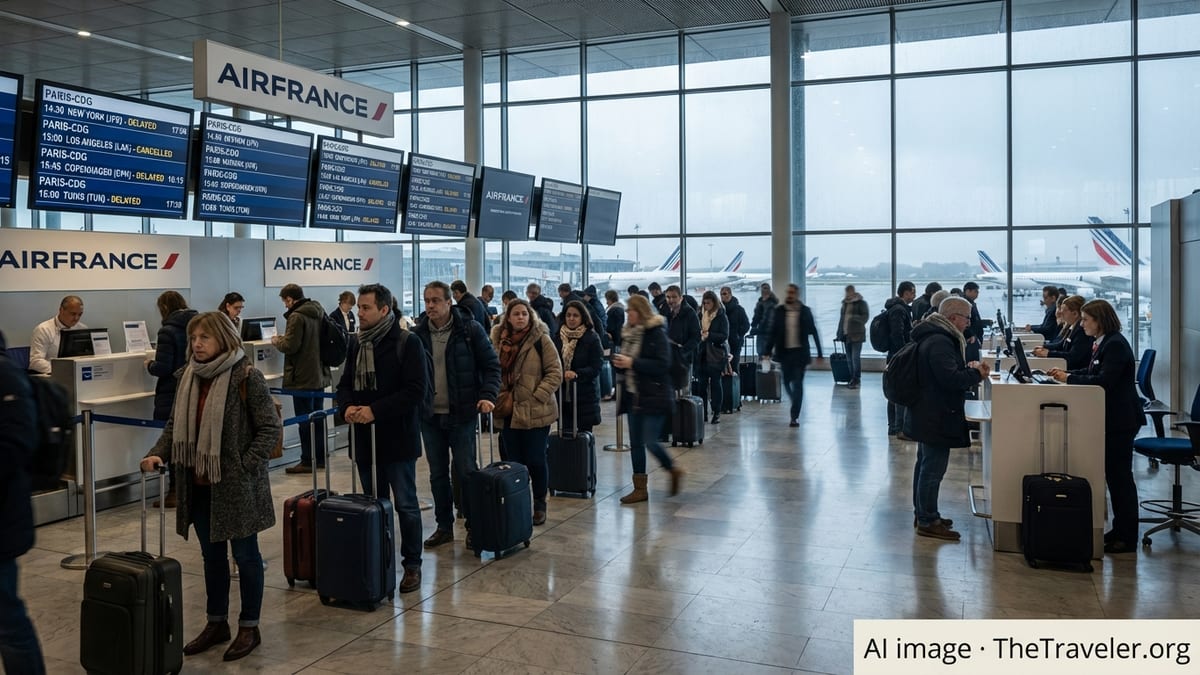
Hundreds of air travellers across Europe faced long queues, missed connections and overnight airport stays this week as widespread disruption led to 1,827 delayed flights and 105 cancellations, heavily impacting services in the Netherlands, Spain, France and several neighboring countries.
Get the latest news straight to your inbox!
Major Hubs Buckle Under Mounting Operational Strain
Publicly available flight tracking data and industry reports indicate that Europe’s congested aviation network has once again come under pressure, with disruption concentrated at major hubs such as Amsterdam Schiphol, Frankfurt, Paris and Madrid. The latest wave saw more than 1,800 flights delayed and over 100 cancelled in a single operating period, with knock on effects rippling to secondary airports across the continent.
Amsterdam Schiphol and Frankfurt Main featured prominently among the worst affected, reflecting their role as critical transfer points for both intra European and long haul traffic. Live data compiled by specialist travel outlets show that disruption at these hubs quickly translated into missed onward connections, particularly for passengers relying on tight transfer windows for North America, the Middle East and Asia.
Reports from recent days also highlight how a combination of factors, including congested airspace, local weather systems and crew and aircraft rotation challenges, has limited airlines’ ability to recover their schedules. As a result, relatively small disturbances in one part of the network have turned into system wide delays, leaving passengers stranded far from their final destinations.
In addition to the headline numbers, analysts point out that even a moderate proportion of same day cancellations can displace thousands of travellers when concentrated at hub airports. With many peak period flights operating close to full capacity in early July, the operational strain has been particularly visible in departure halls and transfer corridors.
KLM, Lufthansa, Ryanair and Others Face Cascading Disruptions
The disruption has been felt most acutely by carriers with dense European networks and strong reliance on hub and spoke operations. Reports focused on the latest travel period indicate that KLM recorded one of the highest tallies of delayed flights among European airlines, with more than one hundred services affected and several cancellations at its Amsterdam base.
Lufthansa has continued to experience pressure across its German hubs, especially Frankfurt, where earlier this year clusters of cancellations and delays aggregated into multi day disruption. Travel and aviation coverage notes that when Frankfurt’s schedule is constrained, the impact extends well beyond Germany, interrupting itineraries for passengers originating in Spain, France, Italy and the Nordic countries who rely on Lufthansa for onward connections to long haul destinations.
Low cost carriers have not been spared. Ryanair, with its extensive point to point network across Spain, France and the Netherlands, has featured regularly in delay statistics compiled by flight data providers during recent weeks. When large hubs encounter congestion, aircraft and crews arriving late from one airport can quickly trigger rolling delays on subsequent rotations, a pattern repeatedly observed in current disruption reports.
Other European brands, including Air France, British Airways, easyJet, SAS, Austrian Airlines and ITA Airways, appear across multiple recent datasets covering delays and cancellations. The combined effect has been to create a patchwork of irregular operations where passengers in one country are affected by constraints or weather systems hundreds of kilometres away.
Amsterdam and Frankfurt at the Center of Europe’s Network Web
Amsterdam and Frankfurt stand out in the latest statistics not only because of the number of flights affected, but also because of their central role in the European route map. Travel analysis notes that Schiphol’s disruptions have routinely spilled into the wider networks of partner carriers, affecting traffic to and from France, Spain, the United Kingdom and Scandinavia as delayed passengers attempt to reroute via alternative hubs.
Frankfurt, similarly, is a critical junction for Lufthansa and its alliance partners. When its operations are curtailed by capacity limits, adverse weather or staff shortages, a significant volume of connecting traffic from southern and western Europe can be left without same day alternatives. In several recent disruption events, flights into Frankfurt from Spain and France arrived late enough that onward long haul services departed without a portion of their connecting passengers.
Published coverage of this week’s delays indicates that secondary hubs such as Palma de Mallorca, Vienna, Copenhagen, Oslo and London Gatwick have also been drawn into the turbulence. As airlines adjust schedules in response to constraints at Amsterdam, Frankfurt and Paris, aircraft rotations through these leisure and regional hubs are often rescheduled or temporarily withdrawn, leaving holidaymakers and business travellers with limited rebooking options.
The interconnected nature of airline alliances and codeshare arrangements has further complicated the picture. A single cancellation on a feeder route can disrupt itineraries issued on multiple carriers’ ticket stock, increasing queues at transfer desks and call centres as travellers seek clarity on who is responsible for rebooking and care.
France and Spain Add Weather and Capacity Headwinds
While the Netherlands and Germany have featured heavily in delay tables, France and Spain have also contributed substantially to the latest disruption metrics. Recent operational summaries point to days where hubs in Paris and Madrid registered several hundred delays and a series of cancellations, especially on high density short haul routes.
In France, bottlenecks in the busy Paris region airspace have at times coincided with local weather systems, slowing arrival and departure flows and forcing airlines to space aircraft more widely. When this has overlapped with peak travel periods, reports show that even minor schedule adjustments at Charles de Gaulle and Orly have led to missed connections for travellers bound for Spain, Italy and the United Kingdom.
Spain’s major airports, including Madrid Barajas and Palma de Mallorca, have also faced weather related and capacity challenges during the early summer peak. Tourism focused coverage describes days where inbound services from northern Europe have arrived significantly behind schedule, compressing turnaround times and resulting in short notice delays or cancellations on outbound legs back to the Netherlands, Germany and France.
These regional stresses have reinforced a broader pattern of instability across Europe’s aviation network. Even where individual airports remain operational, upstream congestion and adverse weather elsewhere in the system can force airlines to trim schedules to keep aircraft and crews aligned with regulatory limits.
Passengers Struggle With Rights, Rebooking and Overnight Stays
For travellers on the ground, the practical impact of 1,827 delayed flights and 105 cancellations has been measured in long lines, missed events and unexpected hotel stays. Social media posts and local news coverage from recent disruption days describe passengers camping in terminal seating areas overnight when nearby accommodation has been fully booked or when rebooked flights depart early the following morning.
Consumer information sites reiterate that under European Union rules, many passengers departing from or arriving into EU and European Economic Area airports on EU carriers are entitled to assistance in cases of severe delay or cancellation, particularly when disruptions are within the airline’s control. This can include meals, refreshments, hotel accommodation where necessary, and, in certain circumstances, financial compensation.
However, travel advocates note that understanding these entitlements and securing timely support can be challenging in the middle of a large scale disruption. Passengers are frequently advised to retain boarding passes and receipts, document delays with screenshots from airline apps or departure boards, and submit claims through official airline channels once immediate travel has been resolved.
In the meantime, with Europe’s summer travel season entering its busiest weeks, analysts suggest that further clusters of disruption are possible at large hubs such as Amsterdam and Frankfurt, as well as at holiday gateways in Spain and France. Travellers planning journeys through these airports are being encouraged by public advisories to allow longer connection times, monitor flight status closely and build flexibility into their itineraries where possible.