


More news on this day
Royal Caribbean is preparing for one of the most aggressive growth phases in its history, with publicly available financial filings and shipyard announcements indicating plans to introduce seven new cruise ships over the next six years across its flagship brands.
Get the latest news straight to your inbox!
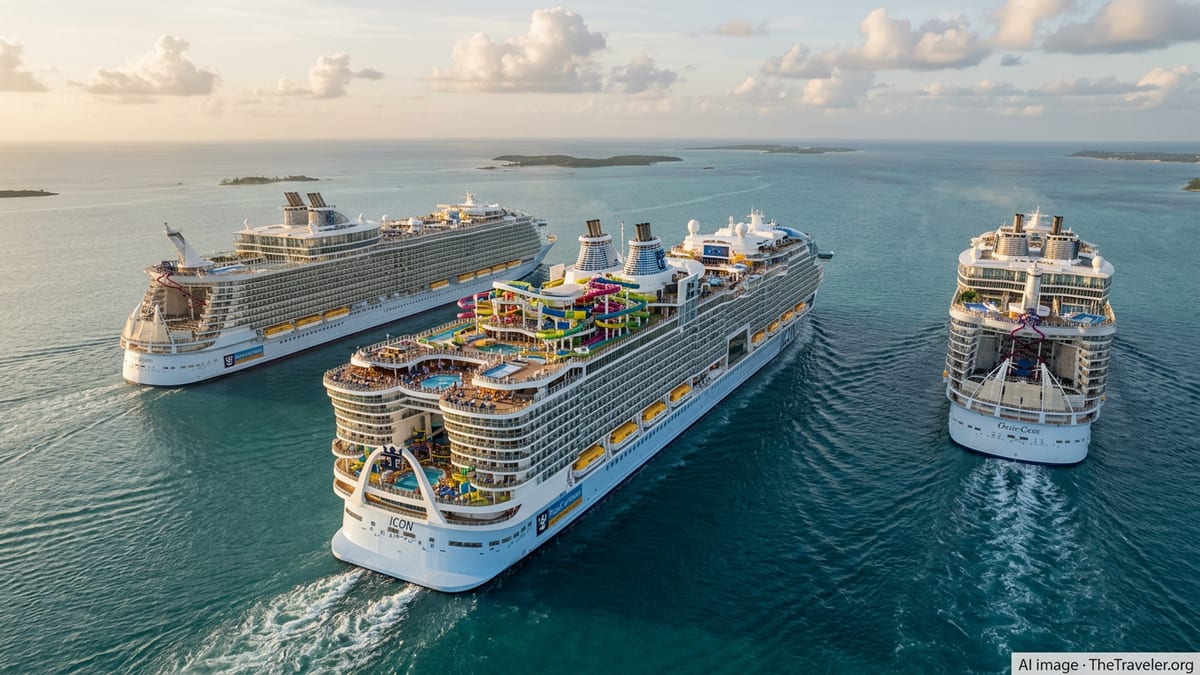
Orders Lock In a Dense Newbuild Pipeline Through 2030
Recent disclosures from Royal Caribbean Group and its shipbuilding partners show a rapidly expanding orderbook that stretches to the end of the decade. The company has confirmed that seven additional vessels are now scheduled for delivery over roughly a six year window, reflecting sustained confidence in long term demand for large scale cruise vacations.
Central to that strategy is the Icon class, which has become the line’s primary growth platform. After the debut of the first ships in 2024 and 2025, Royal Caribbean has moved to secure further deliveries late in the decade. An April 2026 investor statement confirmed firm contracts with Finnish yard Meyer Turku for a sixth and seventh Icon class ship, with handovers slated for 2029 and 2030.
These fresh commitments build on an orderbook that already included multiple Icon class vessels scheduled through the late 2020s, as well as a new Oasis class ship due in 2028 from Chantiers de l’Atlantique in France. Taken together, the sequence adds up to seven new launches within a relatively compressed period as Royal Caribbean layers large new ships onto an already sizable fleet.
The cadence of deliveries, roughly one major newbuild per year, is designed to smooth capacity growth, keep shipyard slots filled and give the company flexibility to adjust itineraries, markets and homeports as demand patterns evolve.
Icon Class Dominates Royal Caribbean’s Growth Story
The Icon class, now positioned as the world’s largest cruise ship platform by gross tonnage, sits at the heart of Royal Caribbean’s expansion plans. Trade and travel industry reports describe a seven ship Icon roadmap extending into 2030, transforming the line’s offering with a series of similarly configured, high capacity vessels aimed squarely at multigenerational family travel.
Icon of the Seas entered service in 2024, followed by Star of the Seas in 2025. Legend of the Seas, the third Icon class ship, is scheduled to begin sailing in 2026, with another vessel expected in 2027. With Icon 6 and Icon 7 now set for 2029 and 2030, the company is on track to field a full stable of seven Icon ships by the start of the next decade.
Each successive sister ship allows Royal Caribbean to iterate on its onboard concept while retaining a high degree of standardization. Industry coverage indicates that the line is using feedback from early Icon deployments to refine neighborhood layouts, waterpark and pool decks, and energy efficiency measures on later hulls, helping to spread design and technology gains across the class.
The concentration of investment in one flagship class also has commercial implications. With several near twin ships in service, Royal Caribbean can rotate them among key markets, adjusting deployment between the Caribbean, Europe and other regions while maintaining a consistent product that is easier to market at scale.
Seventh Oasis Class Ship Extends a Proven Platform
Alongside the Icon expansion, Royal Caribbean is not abandoning its long running Oasis class, which reshaped the industry when it first launched. Construction milestones reported in mid 2026 show work under way on a seventh Oasis class vessel at Chantiers de l’Atlantique, with delivery targeted for 2028.
That ship is expected to arrive about four years after Utopia of the Seas, the most recent Oasis class addition, giving designers time to fold in lessons from both Oasis and Icon operations. Industry analyses suggest the newbuild will feature updated public spaces, refreshed entertainment and dining concepts and upgraded energy systems to bring the platform closer in performance to the newer Icon ships.
By keeping the Oasis line active, Royal Caribbean preserves a two pillar large ship strategy, with Oasis and Icon operating at slightly different scales and price points. This dual approach broadens the company’s reach while allowing it to manage capacity across a mix of itineraries, including shorter cruises from Florida and longer voyages in Europe.
The seventh Oasis ship also contributes to the headline figure of seven new vessels in six years, reinforcing the company’s intent to keep its largest classes at the forefront of the global cruise market.
Fleet Renewal and Environmental Upgrades Drive the Timeline
The rapid buildout is not only about raw capacity growth. Company filings and public comments from executives highlight fleet renewal and environmental targets as key motivations behind the seven ship plan. Several of Royal Caribbean’s older vessels are approaching or exceeding two decades in service, and new builds provide a more efficient way to add modern hardware than extensive retrofits.
New Icon and Oasis units are being delivered with advanced propulsion and energy management systems, including dual fuel engines, optimized hull forms and integration of alternative power solutions such as fuel cells where feasible. These technologies are intended to reduce emissions per passenger and support the group’s long term decarbonization objectives.
The planned sequence of launches over six years creates room for the company to selectively retire or redeploy older tonnage as new ships come online. Analysts following the sector note that concentrating growth in the newest, most efficient platforms can improve margins, particularly on itineraries tied to Royal Caribbean’s private island and beach destinations, where onboard spending is a central part of the business model.
At the same time, the timeline provides flexibility. By staggering deliveries, Royal Caribbean can respond to economic conditions, adjusting deployment between core North American routes and emerging markets without introducing a sudden surge of capacity in any single year.
Competitive Pressures and Capacity Demand Shape the Strategy
Royal Caribbean’s accelerated build schedule is unfolding against a backdrop of strong post pandemic recovery in the cruise sector and intensifying competition among the largest players. Industry data shows that major rivals are also investing in new classes of large ships, with several high capacity vessels on order into the 2030s.
Within that environment, committing to seven ships in six years helps Royal Caribbean defend and potentially grow its share of the global cruise market. Public company reports indicate that the group already accounts for a significant portion of worldwide cruise capacity by passengers and revenue, and the addition of multiple Icon and Oasis ships is likely to reinforce that position.
The focus on large, amenities packed vessels aligns with trends in consumer demand. Travel coverage notes consistent interest in ships that function as destination resorts, offering waterparks, entertainment districts and expansive family accommodations. By dedicating much of its orderbook to megaships, Royal Caribbean is betting that this model will continue to resonate with travelers into the next decade.
For ports and destinations, the strategy presents both opportunities and challenges. New high capacity ships promise a steady flow of visitors, but they also require upgraded terminals, berths and local infrastructure. The pace of Royal Caribbean’s expansion suggests that the ripple effects of its seven ship plan will be felt far beyond the company’s own fleet as coastal communities and tourism authorities adapt to the next wave of giant cruise vessels.