


More news on this day
Prolonged disruption at European airports is converging with the region’s mounting sedentary lifestyle crisis, prompting renewed concern that stressed, idle travelers in hubs such as Greece, the Netherlands and Malta are being pushed even further away from recommended physical activity levels.
Get the latest news straight to your inbox!
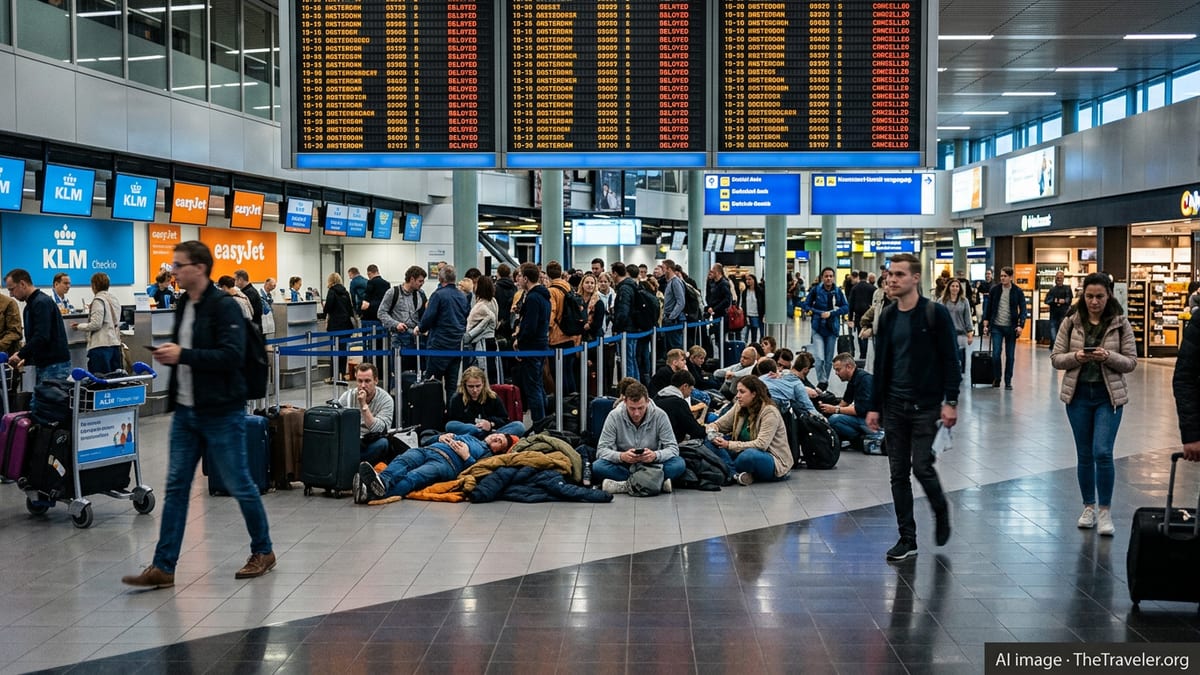
Flight Disruption Turns Travel Days Into Hours of Inactivity
Across Europe, aviation networks are entering another turbulent season, with delays, cancellations and weather-related shutdowns turning routine trips into long stretches of enforced inactivity. Network performance data from European air traffic bodies for early 2026 points to repeated delay spikes linked to winter weather, reduced runway capacity and bottlenecks at major hubs. Amsterdam Schiphol appears among the most impacted airports, with multiple days where a significant share of departures were delayed more than 30 minutes.
For passengers, those operational figures translate into hours seated in crowded departure halls, queues that move only intermittently and overnight stays in terminals when connections are missed. Long-haul travelers heading to or from the Mediterranean are particularly exposed, as a single missed link can cascade into a 24-hour journey largely spent sitting. Public-health specialists have repeatedly warned that extended sedentary periods, especially when combined with poor sleep and disrupted meal patterns, can aggravate cardiovascular and metabolic risks.
Unlike the occasional turbulence encountered in the air, much of the new discomfort is happening on the ground. Staffing transitions, infrastructure works and industrial actions across the continent are all contributing to longer processing times at security, baggage and border control. The result is a kind of “slow burn” disruption: not a single dramatic shutdown, but a pattern of persistent delay that normalizes long, inactive waits as a standard part of flying in Europe.
Schiphol’s Winter Chaos Highlights Systemic Strain
The Netherlands offers one of the clearest examples of how operational stress at a single hub can ripple through wider travel patterns and passenger health. In early January 2026, a sequence of heavy snow events and crosswinds severely disrupted Amsterdam Schiphol, one of Europe’s busiest transfer airports. Weather summaries and aviation data show that hundreds of flights were cancelled over several days, with thousands more delayed as de-icing capacity and runway availability struggled to keep pace.
Those winter shocks were followed by a new wave of disruption in May, when Schiphol switched to a fresh set of security contractors under a multibillion-euro deal. Dutch media reports describe “unexpected understaffing,” IT issues and higher-than-forecast sickness levels, all of which contributed to queues of several hours at security and widespread missed flights. Travelers reported arriving well ahead of departure only to spend most of the day standing or inching forward in line, before sitting again for rebooked flights.
While authorities and airport operators have outlined investments in infrastructure, staffing and winter resilience, the repeated breakdowns are reshaping the passenger experience. Instead of short, predictable transfer windows that allow for walking through terminals and brief active breaks, many itineraries routed via Schiphol now involve contingency time that may be spent sitting on the floor, confined to gate areas or resting in hotel rooms near the airport. For frequent fliers and business travelers, these patterns add up to a sizable additional sedentary burden each year.
Southern Hubs Face Summer Crowds and Health Pressures
Further south, Mediterranean gateways are bracing for a peak summer season in which operational challenges risk colliding with already high rates of inactivity. Greece and Malta, two countries heavily reliant on tourism, have both recorded concerns in recent European and World Health Organization reporting over the share of their populations failing to meet recommended physical-activity guidelines. In Malta, analyses of obesity and lifestyle patterns point to some of the highest levels of sedentary behavior in the European Union, with screen time and car dependence highlighted as contributing factors.
During the summer, these countries see dramatic swings in daily population as tourists arrive in large numbers. Greek islands and Malta’s compact territory depend on tight flight schedules and limited airport infrastructure to manage those flows. Any disruption, whether from heat-related runway constraints, local staffing shortages or knock-on effects from northern hubs, can leave travelers confined to overcrowded terminals or buses on the tarmac with few opportunities for movement.
Publicly available health strategies in both Greece and Malta emphasize walking, active commuting and sport as tools to counteract rising overweight and obesity rates. Yet the reality of high-season travel often pulls in the opposite direction. Package-holiday schedules encourage early-morning departures and late-night returns, with long transfers, sitting on coaches and waiting in terminals. When delays extend those periods, the travel day can become one of the least active days of the year for many visitors, undercutting the idea of a break that supports physical and mental wellbeing.
Europe’s Sedentary Crisis Meets the Realities of Modern Air Travel
Europe-wide health monitoring underscores why the interaction between aviation disruption and inactivity is attracting attention. The latest Health at a Glance Europe analysis by the OECD and European Union estimates that a large share of adults in the region fail to achieve recommended weekly physical-activity levels, with significant variation between countries. Some northern and western states report more than half of adults meeting guidelines, while others, including Malta, are positioned at the lower end of the spectrum.
Experts in physical-activity research point out that sedentary risk is not confined to leisure time. Travel, commuting and work patterns all contribute cumulatively to how much time people spend sitting. Long-haul air travel already involves several hours strapped into a seat at altitude. When that experience is framed by long lines at check-in, extended holding patterns on the apron and waits at baggage reclaim, the inactive window widens substantially.
For travelers with existing health conditions, the combination of prolonged sitting, dehydration and stress can be particularly problematic. Medical guidance commonly encourages passengers to walk the terminal during layovers and perform simple stretching exercises. In practice, disrupted operations often leave little room to do so. Crowded gate areas, shortages of seating and uncertainty over boarding times push many passengers to stay close to departure points, sacrificing movement for vigilance.
Airlines and Airports Explore Health-Focused Responses
Amid mounting scrutiny of both operational reliability and public-health outcomes, parts of the aviation sector are beginning to explore ways to mitigate the sedentary side effects of disruption. Some European airlines have expanded self-service tools that reduce the need for passengers to queue physically at service desks when flights are cancelled or rebooked, allowing travelers to move around the terminal while managing their itinerary from a phone. Airport operators have also publicized walking routes inside terminals, standing workstations and quiet zones where stretching is encouraged.
In the Netherlands, recent Schiphol planning documents and communications highlight investments in improved passenger flow, including redesigned security checkpoints and more centralized control of ground handling. Industry observers note that if such measures reduce bottlenecks, they could indirectly support better health behaviors, as travelers spend less time trapped in slow-moving lines and more time able to walk, shop or rest more comfortably.
Health advocates argue that there is further room for innovation. Ideas under discussion in policy and academic circles include integrating step-count targets into travel apps, promoting active transfers where feasible between terminals and rail links, and offering clearer guidance on safe in-terminal exercise during long delays. In countries such as Greece, the Netherlands and Malta, where tourism and air connectivity are critical economic pillars, aligning these initiatives with national strategies on obesity and activity could position airports as unexpected allies in the fight against sedentary living.