


Crossing into Europe now looks very different for American and British travelers. The European Union’s new Entry/Exit System, or EES, is fully live across the Schengen area, replacing passport stamps with biometric checks and a central database that logs each arrival and departure. If you are flying into Paris, Barcelona, Rome or entering by Eurostar or a ferry, you will encounter EES in some form at the border. Understanding what actually happens at the checkpoint, how long it can take and what this means for the 90‑day rule can help you avoid missed connections and stressful surprises.
Get the latest updates straight to your inbox!
What the EES Is and When It Started
The Entry/Exit System is the EU’s digital border register for non‑EU nationals making short stays. Instead of relying on ink stamps in passports, it records your biographic data from the passport together with biometrics and the exact time and place you enter and leave the Schengen area. The system currently covers 29 European countries that apply Schengen rules, including popular destinations such as France, Spain, Italy, Germany, Greece, the Netherlands and the Nordic Schengen states, plus newer members like Croatia and Bulgaria at their external borders.
EES began what the European Commission calls a progressive start on 12 October 2025. Airports, seaports and land borders introduced the technology in stages, sometimes only at selected terminals or during off‑peak hours. On 10 April 2026 the system was declared fully operational, meaning all participating countries are now expected to use EES consistently at their external borders for eligible travelers. Americans and British citizens arriving today at major hubs like Paris Charles de Gaulle, Amsterdam Schiphol, Frankfurt, Madrid Barajas or Rome Fiumicino can expect to be registered in EES when they first cross into Schengen.
The system is separate from visas. It does not change the basic rule that US, UK and other visa‑exempt visitors can spend up to 90 days in any 180‑day period in the Schengen area, provided they do not work. Instead, EES acts as the enforcement tool. Where border officers once had to scan through faded entry stamps, they now see your recorded entries and exits on screen in seconds, and the system automatically calculates whether you still have days left.
EES also sits alongside the planned ETIAS travel authorisation, which at the time of writing has not yet launched. ETIAS will eventually be a paid pre‑travel clearance similar to the US ESTA. For now, Americans and British citizens traveling for tourism or business under 90 days continue to board flights and ferries to the Schengen area without any prior electronic authorisation beyond normal airline check‑in checks.
Who EES Applies To and Who Is Exempt
For American and British travelers, the key point is that EES applies when you are entering the Schengen area for a short stay without a residence permit or long‑stay visa. A US tourist flying New York to Paris for two weeks, a British freelancer taking a month in Lisbon and a Canadian on a three‑month rail trip through Italy and Austria all fall into the category of visa‑exempt third‑country nationals, so they are registered in EES at the external border.
Certain groups are outside the system. If you are a US or UK citizen who also holds a residence permit or card from a Schengen state, such as a US engineer with a German residence card or a British spouse of a French citizen living in Lyon, you are generally exempt from EES when traveling on that permit. At the border you show your passport and residence card, and the officer checks national databases instead of registering a short stay in EES. Similarly, non‑EU family members of EU or Schengen‑associated citizens who hold an EU residence card are exempt when traveling on that status.
Inside the Schengen area, there are no routine internal border checks and no EES registration when moving between member states. A US traveler who flies from Boston to Amsterdam and connects onward to Venice, for example, completes EES registration in Amsterdam only. The Venice leg is treated as a domestic Schengen flight. The same holds for a British visitor landing in Madrid and later flying to Paris or taking a train to Barcelona. EES is only concerned with crossings at the external borders of the Schengen area, such as arrivals from the United States, the United Kingdom, Canada or Turkey, and departures back out of the zone.
It is also important to distinguish Schengen from the wider EU. Ireland, for instance, is in the European Union but not in Schengen and does not use EES. A New Yorker flying direct to Dublin still receives a classic passport stamp from Irish border control. If that traveler later takes a separate flight from Dublin to Paris, the EES registration happens when entering Schengen in Paris, not on arrival in Ireland.
How Biometric Registration Works at the Airport
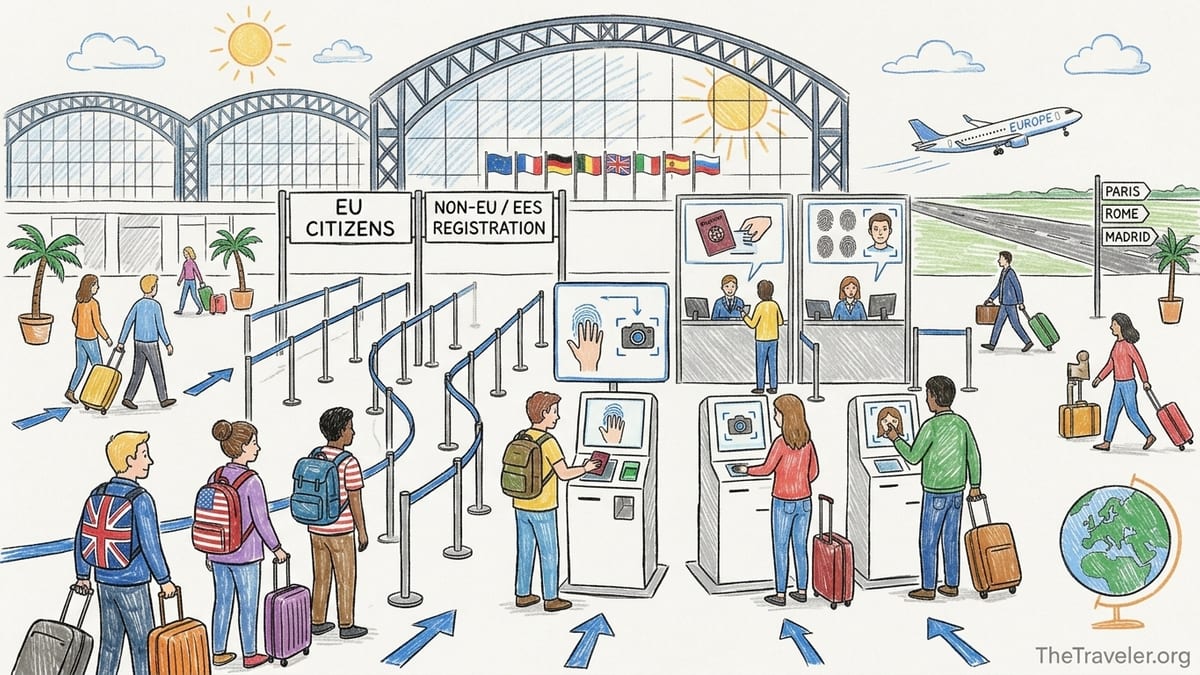
For most American and British visitors, the first encounter with EES is at a busy airport immigration hall. On your first trip into Schengen after 12 October 2025, border officers must create a new EES profile. This involves scanning your passport, taking a facial image and capturing four fingerprints from each hand. At some airports this happens at manned booths, at others it is done at self‑service kiosks before you join a staffed lane.
A typical scenario at Paris Charles de Gaulle or Amsterdam Schiphol now begins with signs directing “non‑EU / EES registration” passengers to banks of kiosks. There you place your passport on a glass reader, answer a few on‑screen questions about your trip, and look into a camera for a live photo. The machine then prompts you to place your fingers on a scanner, capturing your prints. A short slip or electronic token confirms completion, and you proceed to a border guard who calls you forward, reviews your passport and that token on their screen, possibly asks standard questions about your stay, and grants entry.
This initial enrollment can add several minutes per traveler. Reports from spring 2026 described non‑EU arrival queues of two hours or more at some airports during the early weeks, particularly at Brussels and Geneva, as passengers struggled with unfamiliar kiosks and staff worked through software glitches. By late summer 2026, several hubs had increased staffing and adjusted queue layouts, and wait times at many airports had eased, but peaks still occur around morning and evening long‑haul banks. Travelers arriving on full transatlantic flights into a terminal with limited kiosk capacity may still find themselves queuing for an hour or more at busy times.
On later trips, the process is usually quicker. Once you are in the system, border control can retrieve your EES file by scanning your passport, and you will not normally give fingerprints again for at least three years, unless the system flags a quality issue with your existing record. Some countries are gradually enabling e‑gates for repeat EES travelers, especially where facial recognition cameras can match your live image to the stored biometric template. An American business traveler who flies Chicago to Frankfurt several times a year, for example, might enroll at a staffed booth on the first trip, then use automated gates for later entries as the airport opens them up to eligible non‑EU passport holders.
What Happens at Land and Sea Borders
EES does not only apply to airports. Road and rail crossings into the Schengen area are also in scope, including busy routes between the United Kingdom and continental Europe. British motorists taking a car through the Channel Tunnel from Folkestone to Calais, for instance, must now complete EES registration with French border police before boarding the shuttle. The authorities have installed kiosks and staffed booths in the UK terminal where passengers exit their vehicles or roll down windows for document checks. Early trials produced headlines about potential tailbacks, and operators have since staggered check‑in slots and added staff at peak holiday weekends.
At ferry ports such as Dover, Portsmouth and Newhaven on the UK side, and Calais, Dunkirk or Dieppe on the French side, EES is gradually being integrated into joint border controls. A British foot passenger sailing from Portsmouth to St Malo may be asked to enroll at check‑in or on arrival, depending on how the route operator and the French authorities have configured their facilities. Motorists can expect a similar combination of kiosk use and inspection by French officers before driving onto the ferry. Because vehicle occupants must be processed one by one, families and coach groups should allow extra time.
On rail, the most high‑profile change is on the Eurostar services linking London St Pancras with Paris, Brussels and Amsterdam. Here, EES checks typically take place at the departure station before boarding, alongside UK exit checks and Schengen entry procedures carried out by French or Belgian officers. Eurostar has adjusted its recommended check‑in times in response. Where a traveler might once have arrived 45 minutes before departure, advice now often suggests arriving around 90 minutes ahead for peak departures, especially during school holidays and Friday evenings, to allow for biometric capture, security screening and passport control.
Elsewhere on the continent, land borders between Schengen states and their non‑Schengen neighbors are also moving to EES. An American backpacker traveling overland from Croatia into Bosnia and Herzegovina, then back into Croatia, now has each entry to Croatia recorded in the system. Likewise, a British family driving from Poland into Ukraine and back sees their return to the Schengen area registered at the road checkpoint. While infrastructure at smaller crossings can be basic, member states are required to ensure that EES registration occurs on entry and exit just as at major airports.
What Data Is Collected and How It Affects the 90/180‑Day Rule
When you are enrolled in EES, the system stores several types of information. From your passport, it captures your name, nationality, date of birth, document number and validity dates. It records the border crossing point, the time and date you entered or exited, and the type of travel document. It also holds biometric templates of your facial image and fingerprints, which are used to verify your identity on later crossings and to help detect fraudulent or multiple identities.
For Americans and British visitors, the most important consequence is how precisely the system counts your days. Each time you cross into the Schengen area as a short‑stay visitor, EES creates an “entry record.” When you leave, it creates an “exit record” and automatically calculates how long you stayed. If on a later trip the calculation shows that you would exceed 90 days within any rolling 180‑day window, border officers can be alerted before you are admitted. For example, if a US remote worker spends 85 days in Spain and Portugal in spring, leaves Schengen for a few days in Morocco and then tries to re‑enter in France two weeks later for another month, the system will flag that the new trip would lead to an overstay.
Previously, long‑term visitors sometimes relied on bilateral agreements or border officer discretion when stamps were unclear. With EES, errors in counting caused by missing or smudged entry stamps are less likely, but the scope for bending the rules is also reduced. It becomes harder to argue that you have not overstayed when the central record shows exact entry and exit times. Travelers who in the past tried to maintain a near‑continuous presence in Schengen by stringing together multiple short trips with brief exits should assume that such practices are now far more visible to authorities.
The system also helps identify so‑called overstayers who remain in Schengen beyond their permitted period without leaving. If there is an entry record but no matching exit once the authorised stay has expired, the traveler may face consequences on their next attempt to cross the border. These can include refusal of entry, fines under national law or entry bans, depending on the country. For this reason, it is more important than ever to ensure that your exit from Schengen is properly recorded, especially if you are using unusual routes, charter flights or small ports where automated systems may occasionally malfunction.
Practical Tips for US and UK Travelers at the Border
The most useful preparation is to build extra time into your journey, particularly for your first EES registration. For transatlantic flights from the United States or the United Kingdom to major Schengen hubs, aim to allow at least two hours between scheduled arrival and any onward connection within Europe. A traveler landing at Frankfurt at 9:00 a.m. for a 10:10 a.m. onward flight to Vienna may find that a single long queue at immigration, combined with a security re‑check in the transit area, makes that connection unrealistic. Choosing an itinerary with a longer layover, even if it means a later arrival, can remove a major source of stress.
At departure points where Schengen border checks are carried out before boarding, follow operator guidance closely. If the Eurostar app or your ticket confirmation now recommends arriving 90 minutes before your train from London to Paris, take that seriously in school holidays or on Sunday afternoons when lines tend to be longest. Similarly, if your ferry operator from Dover to Calais asks foot passengers to check in 90 minutes ahead and drivers two hours ahead, plan your road journey to arrive in good time. Border staff can occasionally move families with young children or passengers at risk of missing flights to priority lanes, but this is never guaranteed.
Documentation matters more in the EES era. While the system automatically tracks days, officers still ask about the purpose of your visit and sometimes request evidence. A British tourist heading for a two‑week stay on the Costa del Sol may be waved through with only a few verbal questions, but an American digital nomad arriving with a large suitcase and a one‑way ticket to Lisbon should expect closer scrutiny. Bringing printed or easily accessible confirmations for accommodation, onward or return travel, travel insurance and proof of funds, such as recent bank statements, can smooth the encounter if questions arise.
Finally, patience is part of modern European travel. Social media posts in early 2026 highlighted multi‑hour queues at some airports as staff and passengers adjusted to the system, but they also showed significant variation. One traveler might spend 20 minutes clearing EES kiosks and passport control at Amsterdam on a quiet Tuesday, while another arriving on a Saturday afternoon in midsummer faces ninety minutes in line at a different terminal. Monitoring recent traveler reports from news outlets and forums before your trip can give you a sense of current conditions at specific airports or ports, though exact wait times remain unpredictable.
What If Something Goes Wrong With Your Record
As with any large IT project, EES has experienced teething problems. Some travelers have reported instances where their exit was apparently not recorded, often after leaving the Schengen area from a small regional airport or a land crossing with manual procedures. Others have described kiosks freezing mid‑process, forcing staff to reset the machine and start again. While the overall system has stabilised since full rollout, glitches are still possible, particularly at smaller border posts or in very busy periods.
If you notice that your passport is not being accepted at a kiosk on departure, or a border guard tells you there is no matching entry in the system, remain calm and be ready to document your movements. Boarding passes, hotel invoices, train tickets and digital traces such as dated photos or transaction records can help reconstruct your itinerary. In most cases, officers can override or correct records once they are satisfied that you have not in fact overstayed. Being polite and patient is critical. Stories from 2026 show that travelers who respond with hostility or panic can quickly find themselves facing secondary questioning and much longer delays.
For long‑term visitors and those who move in and out of Schengen frequently, keeping a personal log of entries and exits is worthwhile even now that the EU tracks you electronically. Simple tools range from calendar apps where you note border crossings to spreadsheets that calculate your remaining days. This private record gives you confidence when planning future trips and provides a backup if you ever need to explain your travel history to an officer who is staring at a confusing screen.
In rare cases where an EES error leads to a formal finding of overstay or an entry refusal that you believe is unjustified, each Schengen country has its own appeal procedures. These often involve lodging a complaint or appeal with a national authority within a set deadline and may require legal advice. While such situations are exceptional, they underline the value of leaving a clear paper trail of your bookings and travel documents and avoiding cutting your permitted stay to the very last permissible day.
How EES Interacts With ETIAS and Future Changes
The new border environment in Europe is still evolving. EES is fully operational, but ETIAS, the separate pre‑travel authorisation for visa‑exempt visitors, has not yet started. Official EU communications currently point to a launch in late 2026 at the earliest, with a transition period after that before ETIAS becomes mandatory for all eligible travelers. For now, neither Americans nor British citizens are required to apply for ETIAS approval to visit Schengen for tourism or business under 90 days. Border guards, however, are already using EES data to make their decisions and assess risk.
When ETIAS does arrive, it will sit on top of EES rather than replace it. A future US traveler heading to Italy might, for example, apply online for ETIAS approval several days before departure, pay a fee set by the EU and receive an email confirmation. At the airport, the airline would verify that approval before boarding. On arrival in Rome, passport control would then register or update the traveler’s EES record as it does today, capturing biometrics if this is a first trip, and logging the entry details. The two systems work together: ETIAS screens passengers in advance, while EES records what they actually do at the border.
Transport operators are also adapting their procedures as experience with EES accumulates. Airlines such as United, Delta, British Airways and Air France now brief passengers about the system in pre‑departure emails, and some mobile boarding‑pass apps display reminders that first‑time visitors should expect biometric registration on arrival. Eurostar and major ferry companies adjust recommended check‑in times around public holidays and sporting events, such as the summer tourism peak, major football tournaments or large trade fairs in cities like Barcelona and Frankfurt, to reflect anticipated congestion at joint border control facilities.
Travelers should expect further refinements over the next few years as the EU introduces new automated gates, improves kiosk software and trains additional staff. Experiences reported in 2025 and early 2026 ranged from smooth, ten‑minute arrivals at well‑resourced airports to three‑hour queues at understaffed terminals. As authorities respond to these pressures and the traveling public becomes more familiar with the steps, the overall process is likely to feel closer to the automated, quick experience that EES was designed to deliver.
Final Thoughts: Planning Trips in the EES Era
For American and British visitors, Europe’s new border reality is less about new paperwork and more about new procedures at the frontier. You still enjoy visa‑free access for short stays in the Schengen area, and popular trips from New York to Paris, London to Barcelona or Chicago to Rome remain entirely possible with a valid passport and return ticket. What has changed is the precision and consistency with which your movements are tracked and the amount of time you may spend in queues on your first few crossings.
Approaching EES with realistic expectations makes travel smoother. Assume that your first entry after October 2025 will involve having your fingerprints and face scanned, and schedule your connections and transfers accordingly. Treat the 90‑day rule as a firm ceiling, now backed by an unforgiving database rather than a handful of stamps. Keep records of your bookings and border crossings, and be prepared to show them if questions arise. For most tourists coming for a week in Paris, a cruise from Barcelona or a ski trip in the Alps, the experience will amount to a slightly longer line at passport control and a new set of digital records behind the scenes.
As with airport security measures introduced in earlier decades, EES will likely become a familiar background feature of European travel. Over time, kiosks and e‑gates should speed up repeat crossings for frequent visitors. Until that happens everywhere, patience, preparation and good information remain the best tools for navigating Europe’s new biometric borders with minimal disruption to your holiday or business trip.