


More news on this day
The United States Federal Aviation Administration is accelerating its use of artificial intelligence in a bid to ease mounting air traffic congestion and chronic flight delays, backing new software that aims to predict bottlenecks before they ripple across the country’s skies.
Get the latest news straight to your inbox!
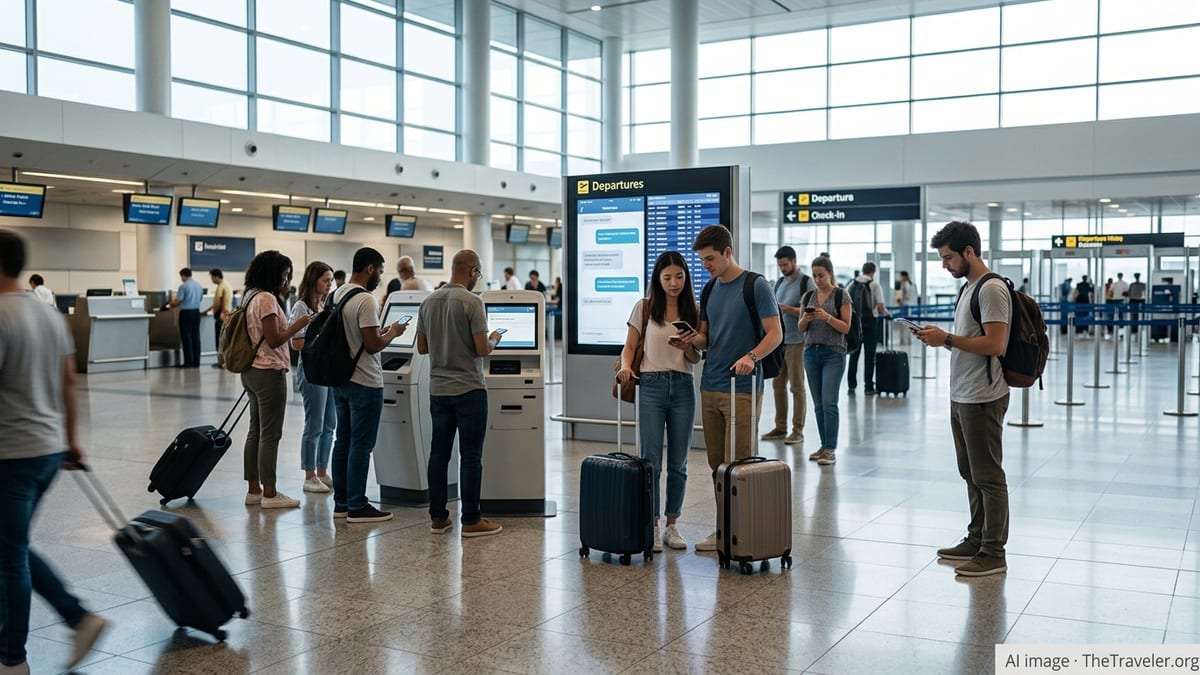
A Multi-Billion Passenger System Strains Under Growing Delays
Published data shows U.S. air travel has grown faster than the capacity of aging air traffic control systems, contributing to persistent congestion and delay spikes, particularly during peak travel seasons and severe weather. Flight-delay minutes attributed to equipment problems alone in 2025 were reported to be several times higher than the average from the previous decade, underscoring how vulnerable the network has become when key systems falter.
Industry analyses indicate that only a portion of delays are caused directly by weather. Significant shares stem from airline and airport inefficiencies and from limits within the wider aviation system, including the way traffic is sequenced and routed. When congestion builds at one major hub, it can trigger a chain reaction of late departures and missed connections across multiple time zones.
In this environment, simply adding more controllers or incremental hardware upgrades has not been enough to keep pace with demand. Planners and researchers have increasingly turned to data science and artificial intelligence to search for patterns in years of flight, weather, and operational data that might reveal where small, early interventions could prevent large-scale disruption later in the day.
SMART and FMDS: New AI Nerve Center for U.S. Airspace
According to recent coverage of federal contracting activity, the FAA has awarded an $875 million, 12-year agreement to Air Space Intelligence to deploy new software and AI tools aimed at overhauling how U.S. flights are scheduled and managed. The effort centers on the Flow Management Data and Services platform and a companion capability known as Strategic Management of Airspace, Routes, and Trajectories, or SMART.
Public explanations of the program describe SMART as a planning and prediction engine that continuously ingests airline schedules, forecast and real-time weather, airport capacity, airspace constraints, and other operational variables. By simulating traffic flows hours before aircraft leave the gate, the system is intended to pinpoint where demand will exceed capacity and where minor timing or routing changes could ease the crunch.
The FAA’s traffic managers are expected to use data from these tools to coordinate more precise departure times and flight paths, particularly into the busiest corridors and hubs. Rather than reacting to gridlock that is already visible on radar, the new approach is designed to anticipate overloads early and adjust flows in a coordinated way, reducing the need for blunt instruments such as long ground delay programs or rapid-fire re-routing once congestion has already formed.
Program documentation and research plans indicate that AI and machine learning are being positioned as a core part of the National Airspace System’s modernization, not as a side experiment. The systems are being framed as decision support, providing recommendations and forecasts to human controllers and managers, who remain responsible for safety-critical decisions.
How AI Aims to Turn Small Adjustments Into Big Time Savings
Concepts behind SMART and related tools mirror techniques already used in airline and airport operations, where machine learning models forecast demand, no-show rates, and likely disruptions. In the FAA context, AI models can scan thousands of planned flights to identify where a few minutes of departure time adjustment or a slightly different routing can prevent airborne holding patterns, arrival queues, or ground stops later in the day.
Research summaries on FAA flow management highlight efforts to use AI-enhanced applications to balance demand and capacity across the National Airspace System. These applications are being built to reduce the need for last-minute reroutes, lower average delay per flight, and cut excess fuel burn caused by aircraft circling or deviating significantly from optimal routes.
In practice, the new decision tools are expected to operate much like high-speed scenario generators. When storms threaten key hubs or busy transcontinental corridors, the AI engines can run thousands of what-if simulations within seconds, comparing different combinations of minor delays, re-sequencing, and re-routing. Traffic managers can then select options that maintain safety margins while spreading small schedule adjustments across many flights instead of imposing long waits on a smaller group of aircraft.
Supporters of the approach argue that even modest reductions in average delay per flight can translate into millions of minutes saved annually when applied to the entire domestic network. They also note potential knock-on benefits for passengers, including fewer missed connections, more predictable boarding times, and improved reliability for crews and aircraft that need to be in place for subsequent legs.
Balancing Innovation With Safety and Reliability
The FAA has previously outlined an artificial intelligence safety roadmap emphasizing that any new tools must complement, rather than replace, human expertise in safety-critical operations. Public research plans stress that AI systems will be rigorously tested within simulation environments and phased into live operations only after demonstrating reliability and resilience under varied conditions.
Experts in aviation and computer science have also drawn attention to broader concerns associated with AI, including the risk of models producing highly confident but incorrect outputs if they are trained on incomplete or biased data. In the context of air traffic management, such errors could carry serious consequences, so program documents point to layered safeguards, continuous monitoring, and the ability for controllers to override or disregard automated suggestions.
Regulators and planners are also weighing how AI-driven decisions interact with longstanding rules on fairness and access within the airspace system. If algorithms prioritize certain routes or carriers to minimize total delay, the distribution of delays among airlines and airports may shift, raising questions for industry stakeholders and consumer advocates.
These debates are unfolding as other parts of the aviation ecosystem, from airlines to airports and ground handlers, deploy their own AI tools to forecast delays, rebook passengers, and reposition crews and aircraft. The FAA’s push into AI-supported flow management sits within this wider digital transformation, increasing the importance of consistent data sharing and interoperability so that one organization’s optimization does not worsen bottlenecks for another.
What Travelers Can Expect in the Coming Years
Implementation timelines described in public materials suggest that the new AI-supported flow management capabilities will roll out gradually over the next two to three years, starting with limited operational use before expanding to more traffic flows and regions. During that period, travelers are unlikely to see an overnight transformation of delay statistics, but analysts anticipate more incremental improvements as the tools gain sophistication and coverage.
In the near term, the most visible effect for passengers may be subtle schedule adjustments and a shift in where and when delays occur. Instead of long, unpredictable lines of aircraft waiting for takeoff or circling near destination airports, more flights may push back a few minutes later or be assigned slightly different routings to keep overall flows smooth.
Longer term, if the systems perform as intended, air travel in the United States could become more resilient to routine shocks such as seasonal storms, short-term staffing imbalances, or temporary runway and equipment outages. Reduced congestion would not eliminate delays altogether, but it could narrow the gap between published timetables and actual arrival times, which has widened in recent years.
For now, the FAA’s investment in AI-driven traffic management marks one of the most significant attempts yet to apply advanced data science to the complex, interlocking network that underpins modern air travel. Its success or failure will help determine whether AI is seen primarily as a tool for smoothing the passenger experience at scale or as a technology that introduces new layers of complexity into an already intricate system.