


More news on this day
Severe late-summer storms and ripple-effect congestion prompted the Federal Aviation Administration to order ground stops at 15 U.S. airports over two days, pushing nationwide flight delays and cancellations close to 2,000 and leaving travelers scrambling to rebook weekend plans.
Get the latest news straight to your inbox!
Two Days of Ground Stops Ripple Across the Network
Publicly available aviation disruption trackers and newswire summaries indicate that the FAA imposed ground stops at 15 U.S. airports over a 48-hour window as intense thunderstorms moved across multiple regions. The orders, issued on Thursday and Friday, temporarily halted departures at affected hubs while allowing arriving aircraft already en route to land, a standard protocol designed to prevent airborne traffic from overwhelming congested airspace.
The pattern of disruption fits into a broader August marked by repeated weather-driven slowdowns. Earlier in the month, a separate multi-day storm system prompted ground stops at major hubs including Chicago O’Hare, Midway, Denver, Las Vegas, Tampa, and the three primary New York–area airports, with more than 2,000 delays and hundreds of cancellations logged across those events. That earlier episode underscored how quickly localized thunderstorms can cascade into nationwide schedule upheaval when they strike the busiest nodes in the U.S. network.
In the most recent two-day stretch, aggregated reporting suggests that delays and cancellations combined approached the 2,000 mark, with some airports experiencing extended departure queues even after formal ground stops were lifted. Travel-intelligence services describe the impact as moderate but widespread, noting that the disruption index for the United States has remained elevated throughout the month.
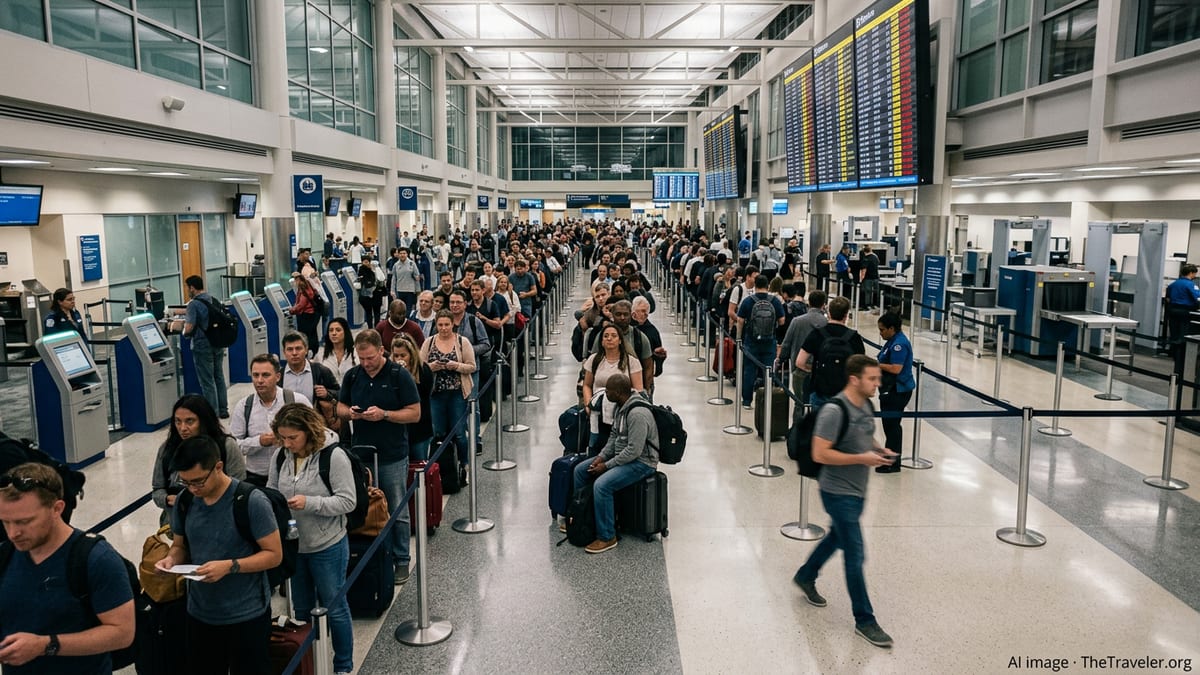
Because ground stops concentrate disruption into short time windows, the visible effect in terminals can be dramatic: aircraft parked at gates awaiting release times, long lines at customer service desks, and rolling delay estimates on departure boards. Yet the operational influence extends beyond the immediate period, as aircraft and crews fall out of position for subsequent flights.
Weather, Congestion and Technology Collide
The latest ground stops primarily trace back to convective weather, but they are unfolding against a backdrop of other stresses on the aviation system. Earlier this summer, a separate FAA-directed nationwide ground stop paused all American Airlines departures for nearly an hour following an internal technology failure at the carrier. Flight-tracking data in that case recorded around 1,100 delays and slightly more than 220 cancellations tied to the outage, illustrating how non-weather events can rapidly translate into large-scale disruption when fleets are fully utilized.
Those technology issues arrived on top of an unusually stormy season in key regions such as the Northeast and Midwest. Independent analyses of the August 9 to 11 storm system, for example, documented more than 2,000 delays and over 250 cancellations as FAA traffic managers cycled ground stops through major hubs including Chicago and New York. In that episode, O’Hare emerged as the most-delayed airport, while LaGuardia alone saw more than 200 delays and roughly 100 cancellations in a single day.
Industry observers note that record passenger volumes compound the effects of both weather and technology failures. Transportation Security Administration screening figures for the summer indicate some of the busiest days on record at U.S. airports, leaving airlines and airports with less slack to absorb misaligned crews, displaced aircraft, and sudden capacity reductions from ground stops.
The current two-day wave of FAA orders thus reflects a convergence of factors: seasonal thunderstorms, tight schedules, and a network still recalibrating from earlier operational shocks. Even when each individual ground stop is relatively brief, the combined effect across multiple airports in rapid succession can rival that of a single, more dramatic nationwide order.
Airports and Travelers Hit Hardest
While detailed airport-by-airport tallies for the most recent event are still being compiled, patterns from similar disruptions earlier this month suggest that large connecting hubs and slot-constrained coastal airports are most vulnerable. When FAA traffic managers slow or halt departures at facilities such as O’Hare, Newark, or LaGuardia, the effect quickly spreads to smaller cities whose flights depend on timely connections through those hubs.
Analyses of prior August disruptions show that a relatively small number of airports can account for a disproportionate share of nationwide knock-on effects. In the August 9 to 11 storm system, for instance, just a handful of hubs generated the majority of the 2,036 delays and 263 cancellations reported by regional media and specialized aviation outlets. When those same or similar hubs appear again on FAA ground stop lists, travelers across the country feel the impact even if their local airport is not directly named in the order.
For passengers, the practical consequences range from missed weddings and cruises to unplanned hotel nights. Travel-intel coverage of the recent American Airlines outage, as well as earlier weather events, emphasizes that brief ground stops can still strand travelers overnight when last departures of the day are canceled or when long-haul connections are broken by even modest delays.
Families traveling with children or tight international itineraries are particularly exposed. Missed onward flights can trigger new visa considerations, lost prepaid tours, or separation from checked baggage that continues on a different routing. In this context, the raw count of cancellations and delays tells only part of the story; the timing of a disruption within a passenger’s journey often determines its severity.
What Travelers Can Do When Ground Stops Hit
Recent coverage of both weather-related ground stops and technology failures highlights several practical steps for travelers trying to navigate days like these. First, checking flight status through airline apps or official websites before leaving for the airport has become essential, as departure boards may lag behind real-time operational decisions. Many carriers now post specific travel alerts during major disruptions, allowing fee-free changes in affected regions or date ranges.
Second, passengers whose flights are canceled or significantly delayed may have more options than they realize. Consumer-advocacy explanations of federal rules emphasize that when an airline cancels a flight or makes a substantial schedule change, travelers who choose not to fly are typically entitled to a cash refund, even if the underlying cause is weather or an FAA directive. Separate from refunds, airlines often provide rebooking assistance and, in some cases, meal or hotel vouchers when disruptions are within their control.
Third, experts recommend building extra connection time into itineraries during peak storm seasons, especially when routing through congestion-prone hubs. Earlier write-ups on the August 9 to 11 storm system note how quickly a 45-minute thunderstorm cell over a major airport can erase standard connection buffers. Choosing slightly longer layovers or earlier flights in the day can reduce the risk of misconnection as delays accumulate.
Finally, travelers who can be flexible sometimes find that rebooking to alternate airports in the same region speeds recovery. When a ground stop targets one major facility, nearby secondary airports may still be operating with fewer restrictions. However, that strategy works best for those comfortable navigating ground transportation or shifting rental car and hotel arrangements on short notice.
Another Stress Test for the Summer of Air Travel
The latest round of FAA ground stops adds another stress test to a summer already defined by a series of operational flashpoints. Between recurring thunderstorms, isolated IT failures, and high demand on both airlines and air traffic control staffing, the system has faced repeated examinations of its resilience.
Airline executives and regulators have previously pointed to infrastructure modernization and technology upgrades as long-term solutions to chronic bottlenecks. Recent events, including the grounding at 15 airports and the earlier American Airlines outage, suggest that those efforts will likely face continued scrutiny from travelers, policymakers, and industry analysts watching how quickly operations recover after each shock.
For now, the practical message for travelers is straightforward: conditions can change quickly, and major hubs can experience sharp slowdowns with little warning when weather and congestion intersect. As delays and cancellations from the most recent two-day disruption work their way through the system, passengers departing over the weekend are being advised in public-facing travel guidance to monitor flights closely and consider contingency plans, even if their local skies appear clear.
Source: GGS Aviation newswire index
Source: FAA Newswire via EIN Presswire
Source: Karmactive analysis of August 9-11 storm disruptions
Source: The American Quorum on American Airlines IT outage
Source: Travelers Today traveler guidance