


Faro Airport is the main gateway to Portugal’s Algarve, and for many visitors the easiest way to explore the region’s beaches, villages and cliff-top viewpoints is with a rental car. Yet the experience at Faro can vary a lot depending on which company you choose, what insurance you buy, how you handle tolls and where you park. This guide focuses on the practical details that matter in 2026 so you can step off the plane, collect your keys and start your Algarve road trip with confidence.
Get the latest updates straight to your inbox!
Faro Airport car rental basics: what to expect in 2026
Faro Airport (FAO) is one of Portugal’s busiest holiday airports, and car rental is set up with leisure travelers in mind. Major international brands such as Avis, Budget, Hertz, Europcar, Sixt and Enterprise operate here, alongside Portuguese and Algarve-focused companies like Drive on Holidays, Visacar, Amoita and several small brokers that meet customers outside the terminal. The result is a wide spread of prices and service levels, from low-cost deals with high deposits and aggressive upselling to slightly higher daily rates that include more transparent insurance and simpler pick-up.
Most travelers arrive with a reservation made through comparison sites or directly with a rental company. In peak summer, especially July and August, walk-up rates at the counter are usually significantly higher, and smaller local companies sometimes sell out of automatic cars altogether. Booking ahead is strongly recommended if you need an automatic, a seven-seater or extras such as child seats for a family trip along the Algarve coast.
Faro Airport is compact, so even when different companies use different pickup areas, you are never more than a few minutes from your car. The main choice is between on-airport rentals, where you collect the car in the airport’s own parking areas, and off-airport firms that shuttle you to a nearby depot. Understanding that difference before you book can save you time when you land and help you avoid unexpected fees.
Opening hours also matter. Many Faro Airport car hire desks are open into the late evening to match arriving flights, but not all operate 24 hours. If you land close to midnight or after a significant delay, it is safer to choose a company that explicitly confirms late pickup in its conditions or that operates directly in the terminal rather than in an off-site industrial estate.
On-airport vs off-airport: where you actually get the car
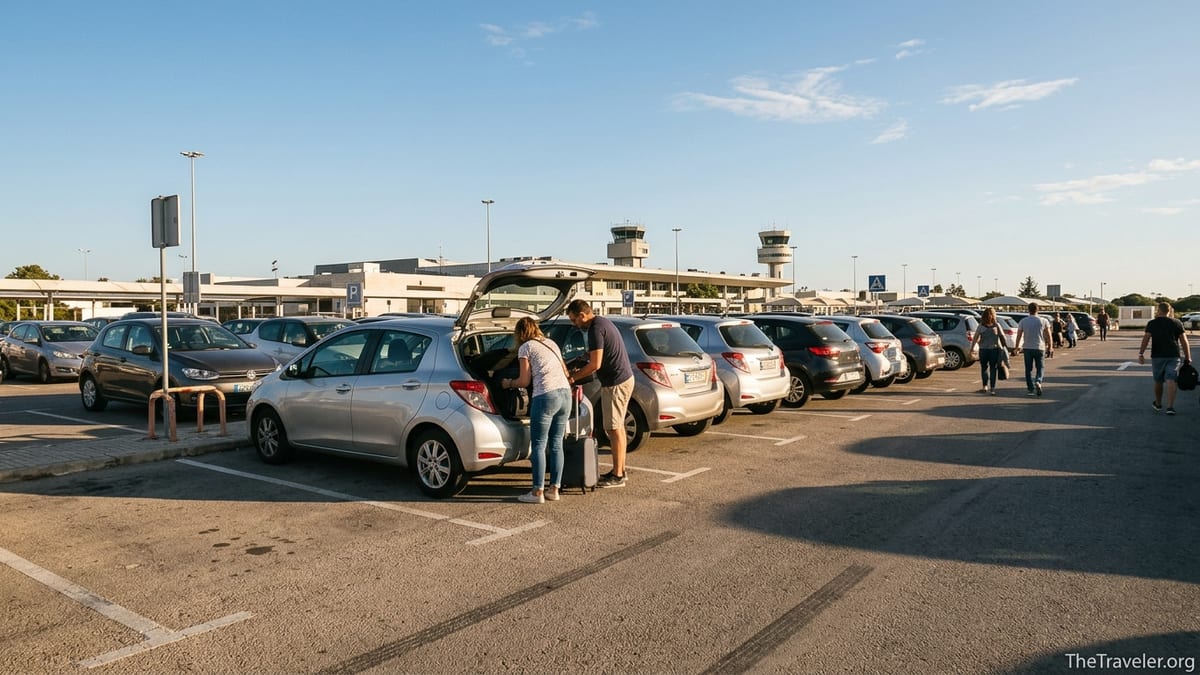
At Faro Airport, most large brands have counters in the arrivals hall and use the airport’s car parks as their main pick-up area. A common arrangement is that you check your paperwork at the desk inside the terminal, then follow signs to car park P4 just outside to collect the vehicle. For example, several international brands group their cars in a marked section of P4, where staff carry out the handover and record existing damage before you drive away.
Local and lower-cost companies often operate “airport service” rather than true on-terminal locations. You may meet a representative in the arrivals hall or just outside, then walk or take a shuttle minibus to a nearby office. Some firms deliver the car to P4 for an extra fee while keeping their main depot off-site. It is common, for instance, to see small Algarve-based companies charging a modest airport pick-up and drop-off fee to bring cars directly into P4, while offering a free transfer if you are willing to collect the vehicle at their office a few minutes’ drive away.
If you are traveling with young children, heavy luggage or surfboards, an on-airport pick-up in P4 can justify paying a little more. You simply roll your trolley across the short pedestrian route, load the car and join the exit road. For couples or solo travelers on tight budgets, an off-airport shuttle can be good value, but it does add 20 to 40 minutes to the process during busy periods, especially if you have to queue again at a separate office when you arrive at the depot.
Returning the car is usually the reverse of pickup: on-airport companies direct you back to the same car park, where staff quickly check the fuel level and obvious damage. Off-airport providers either take the car at P4 for a fee or ask you to return it to their base and then shuttle you back to the terminal. If you have an early-morning flight, consider how much extra time that shuttle could take when you are trying to reach check-in.
Deposits, credit cards and rental desk upselling
One of the biggest surprises for first-time renters at Faro is the size of the security deposit. Standard practice among large companies is to place a hold on your credit card instead of a charge. For a compact car with basic insurance, that hold often ranges from roughly 800 to 1,600 euros, depending on the brand and level of excess on the policy. Local firms sometimes require similar or slightly lower deposits but can be stricter about needing a proper credit card rather than a debit card.
In recent seasons, some companies have started to offer what they call “no deposit” or “carefree” packages. These usually combine a higher daily rental rate with full collision damage waiver that reduces the excess to zero, so they do not need a large hold on your card. Travelers who have accepted these options at Faro commonly report paying more at the desk than they expected based on the headline online rate, but they also report less hassle when returning the car after small incidents such as minor scratches in supermarket parking lots.
Insurance upselling at Faro’s rental desks can be intense, especially with lower-priced intermediaries. Staff may insist that without their extra cover you will be responsible for almost the full value of the car or claim that third-party excess policies bought online are not accepted. In practice, many travelers choose to rely on an external excess policy or a premium credit card that covers damage, accept the standard collision and third-party coverage included by law, and then focus on a thorough pre-rental inspection. Others prefer to pay more locally for peace of mind, especially on short holidays where arguing over a scratch is the last thing they want to do.
Whatever your choice, it is important to arrive at the desk with a clear plan. If you intend to decline additional cover, note the expected deposit amount from your booking conditions and make sure your credit card limit easily covers it. If you lean toward accepting the rental company’s full coverage, use the booking stage to compare inclusive packages instead of deciding under time pressure at the counter when you are tired from the flight.
Understanding insurance, tolls and cross-border rules
By law, Portuguese car rentals include basic third-party liability coverage, and most rates at Faro also come with collision damage and theft protection subject to an excess. That excess is the maximum amount you pay toward damage before the insurance takes over. In the Algarve, it is typical for that excess on a small car to run into several hundred euros, rising further for SUVs and premium models. Full coverage options offered at the desk aim to reduce that excess, often to zero, but they can add a significant percentage to the total rental cost.
Toll rules in southern Portugal have changed notably. The A22 motorway, which runs the length of the Algarve between Lagos and the Spanish border, used to be an electronic-toll road with no booths, but from early 2025 it became toll free. That means you can now drive the A22 between common resort areas such as Lagos, Portimão, Albufeira, Faro and Vila Real de Santo António without worrying about charges. However, other motorways further north, including the main A2 route towards Lisbon, still carry tolls that you pay either at physical booths or via the national electronic system.
Many Faro car rental companies fit their vehicles with Via Verde transponders, the small boxes that let you pass through electronic toll lanes. At the rental desk, you may be offered automatic toll service for a flat activation fee plus the cost of any tolls you incur, charged later to your card. This can make sense if you plan to drive from the Algarve to Lisbon or explore tolled roads in central Portugal. If your plans stay within the Algarve region and mainly on the now-free A22 and local roads, it is often enough to pay tolls manually at the occasional traditional booth you encounter, making the transponder less essential.
Cross-border travel into Spain is generally allowed but not always included. Rental conditions from both international and local Algarve companies commonly specify that you must notify them if you plan to drive into Spain and pay a per-rental cross-border fee. This is often in the range of a few dozen euros and helps cover additional insurance requirements. Taking a Portuguese rental car from Faro and dropping it off in Spain, for instance in Seville or Málaga, is possible with some international brands but usually carries a substantial one-way surcharge, sometimes larger than the rental price itself. For straightforward Algarve itineraries with a day-trip to Seville, it is normally cheaper to pay the cross-border fee and return the car to Faro.
Driving, tolls and parking day-to-day in the Algarve
Once you leave Faro Airport and join the A22 or the older N125 coast road, driving in the Algarve is generally relaxed, especially outside of August. The A22 gives quick, now toll-free access to major hubs, so a visitor staying in Carvoeiro or Albufeira can realistically use Faro as a base to explore both the western cliffs around Sagres and the eastern villages near Tavira on separate day trips. The N125 is slower, with roundabouts and local traffic, but it takes you through towns and is lined with fuel stations and supermarkets where you can stock up for self-catering stays.
Parking varies by town. In many resort areas such as Alvor, Praia da Rocha and parts of Lagos, off-season street parking is relatively easy and free, especially a few blocks back from the beachfront. In high summer, beachfront lots fill up by late morning, and you may need to use paid municipal parking areas or underground garages. Coastal beauty spots like Praia da Marinha and the Benagil area see heavy demand; early arrival or flexible timing later in the afternoon helps you avoid circling narrow lanes in a hired car while hunting for a space.
Faro Airport itself has several parking zones managed by the airport operator, ranging from short-stay passenger drop-off areas close to the terminal to longer-stay car parks a short walk away. Rental car returns in P4 are usually signposted as you approach. If you are only dropping fellow travelers before returning the car, the airport’s signed quick-stop area allows a few minutes’ free stopping time near the terminal entrance, after which surcharges apply. It is not a place where you can leave a rental car unattended for long, and staff enforce time limits during busy periods.
Meters and parking rules are generally clear, but signs are in Portuguese, so it is worth learning simple phrases such as “dias úteis” for weekdays and checking whether paid hours apply in the evening. In some historic centers, like Lagos old town or the compact streets of Tavira, car parks outside the core make life easier than trying to squeeze a rental into tight parallel parking slots on cobbled streets.
Is renting a car at Faro Airport worth it for your trip?
Whether a Faro Airport rental is worth it depends on your itinerary, budget and comfort with driving abroad. For travelers staying in a well-connected resort such as Albufeira, Vilamoura or Lagos and mainly planning beach days, boat tours and occasional organized excursions, a combination of airport transfers and local taxis can work, particularly outside peak season when rideshare and taxi availability is good. Regional trains and buses connect the main coastal towns, though frequencies can be limited in the evenings or on weekends.
For visitors who want to explore smaller villages, hidden coves and cliff walks, a rental car unlocks a very different Algarve. Locations such as Cacela Velha on the eastern side, the countryside around Silves, or the dramatic coast near Sagres are either slow or awkward to reach by public transport. Many rural guesthouses and villas, especially inland farm stays and hillside retreats with sea views, effectively require a car because taxis can be sporadic and expensive for repeated trips to supermarkets or restaurants.
For a typical one-week holiday in June or September, a compact rental from Faro booked in advance is often competitively priced compared with airport transfers plus multiple taxi rides, especially for families or groups of friends splitting the cost. The key is to factor in extras such as full cover insurance, cross-border fees if you intend to visit Spain, and parking at popular hotspots. If you prefer not to drive but still want one or two flexible exploration days, a practical alternative is to base yourself in a town like Lagos or Albufeira and rent a car locally just for those days, returning it in the evening so you do not pay for unused overnight parking.
Ultimately, Faro Airport car rental makes the most sense if you value independence, are comfortable navigating roundabouts and are happy to read the fine print at the rental desk. If your plan is mainly to relax at a resort with only occasional excursions booked through tour operators, the convenience of a car may not outweigh the cost and the formality of deposits and inspections.
Practical pick-up and drop-off tips at Faro Airport
To keep things smooth on arrival, it helps to organize a few details before landing. Have your driving licence, passport, booking confirmation and credit card in the main driver’s name ready to present together. Faro rental desks can get busy when several flights land around the same time, and you will move faster through the queue if you are not searching for documents at the counter. If more than one person may drive, confirm extra driver fees in advance; they are often charged per day and must usually be added to the contract from the start.
At the car, take a slow walk around with your phone camera before driving away. Photograph each panel, wheel and the windscreen, plus the fuel gauge and odometer. This is particularly useful with budget companies where damage reports can be strict. Many travelers have successfully used such photo sets to query later claims about existing scratches or chips. Do the same on return, ideally with a staff member present to sign off the car as undamaged if everything is in order.
Plan a little extra time for drop-off, especially if you are returning on a Saturday morning in summer when many weekly rentals change over. Allow for traffic on the A22 and approach roads, a brief queue at the fuel station closest to the airport, and the inspection itself. Airport fuel prices are often slightly higher, but topping up just outside Faro town or along the N125 can be cheaper while still leaving you close enough to return the car with a full tank.
Finally, keep all paperwork and final invoices, including any toll or cross-border charges, for a few weeks after your trip. Occasionally, electronic tolls or parking fines can be processed after you have flown home and passed to the rental company to collect from you, so having your documents to hand makes it easier to understand and, if necessary, dispute any unexpected card charges.
The Takeaway
Faro Airport is one of Europe’s more straightforward gateways for hiring a car, provided you know the main pressure points: the choice between on-airport parking and off-airport shuttles, the size of deposits, the realities of insurance, and how tolls now work in the Algarve. With the A22 motorway made toll free, day-to-day driving between the region’s main towns has become simpler, and a rental car can be an excellent value way to connect beaches, cliff walks and inland villages at your own pace.
For many visitors, particularly families and anyone staying outside the big resort cores, picking up a compact car at Faro and using it for a week of coastal exploration is still the most flexible option. For others who prefer a resort-based stay, the combination of airport transfers, local taxis and a short local rental or two may strike a better balance. The crucial step is not to treat car hire as an afterthought: read the terms, understand how deposits and coverage work, and arrive with a clear sense of what you will accept at the desk.
If you do that, Faro Airport car rental becomes less a source of stress and more a simple first chapter in your Algarve journey. From the moment you load your bags into the boot and join the A22, the region opens up: quiet coves early in the morning, hilltop sunsets inland, evening dinners in towns where the last bus left hours ago. With a realistic view of the costs and a few practical habits around pickup and return, your hire car can be a helpful tool rather than a holiday headache.
FAQ
Q1. Do I really need to rent a car at Faro Airport to explore the Algarve?
For resort-based stays with limited sightseeing, you can manage with transfers, buses and taxis, but a car is highly recommended if you want to visit smaller villages, beaches and viewpoints on your own schedule.
Q2. Is it better to book an on-airport or off-airport car rental at Faro?
On-airport rentals with pickup in the airport car parks are more convenient and usually faster, while off-airport companies can be cheaper but involve a shuttle ride and sometimes extra fees for airport delivery.
Q3. How large are typical car rental deposits at Faro Airport?
Deposits are usually a credit card hold of several hundred euros, often approaching or exceeding 1,000 euros for standard cars, higher for larger or premium vehicles and lower if you buy full coverage from the rental company.
Q4. What insurance cover do I really need when renting in the Algarve?
Basic legal coverage is included, but you must decide whether to accept the rental company’s full coverage, rely on an external excess policy or use a credit card benefit; choose in advance so you are not pressured at the desk.
Q5. Are there still tolls on the A22 motorway in the Algarve?
The A22 across the Algarve is now toll free, but other Portuguese motorways remain tolled, so you only need to think seriously about Via Verde or toll payments if you plan to drive beyond the Algarve, for example to Lisbon.
Q6. Should I pay for the Via Verde toll device in my rental car?
It is useful if you will drive on tolled motorways outside the Algarve, as it lets you pass through electronic lanes easily, but if you are staying local you can often skip it and simply pay at any traditional toll booths you encounter.
Q7. Can I drive my Faro rental car into Spain?
Most companies allow cross-border trips to Spain for an additional fee and with prior notice, but dropping the car in Spain instead of returning it to Faro usually carries a substantial one-way surcharge.
Q8. How difficult is parking in popular Algarve towns with a rental car?
Outside peak summer, parking is generally manageable, especially a few streets back from the waterfront, but in July and August coastal lots and viewpoints can fill early and you may need to use paid municipal car parks or garages.
Q9. What should I check when picking up the car at Faro Airport?
Inspect the bodywork, wheels, glass and interior, photograph existing damage, confirm the fuel and mileage, and make sure any issues are noted on the rental form before you drive away.
Q10. How early should I return my car before a flight from Faro?
In summer, aim to arrive at the rental return area at least two hours before your flight check-in closes to allow for traffic, refuelling, inspection and walking or shuttling back to the terminal.