


More news on this day
A newly released federal accident report on the April freight train derailment in Austin, Texas, concludes that a combination of localized track defects, undetected wear and train handling contributed to the cars leaving the rails near the city’s core, offering the clearest picture yet of what went wrong on a corridor shared by freight and passenger traffic.
Get the latest news straight to your inbox!
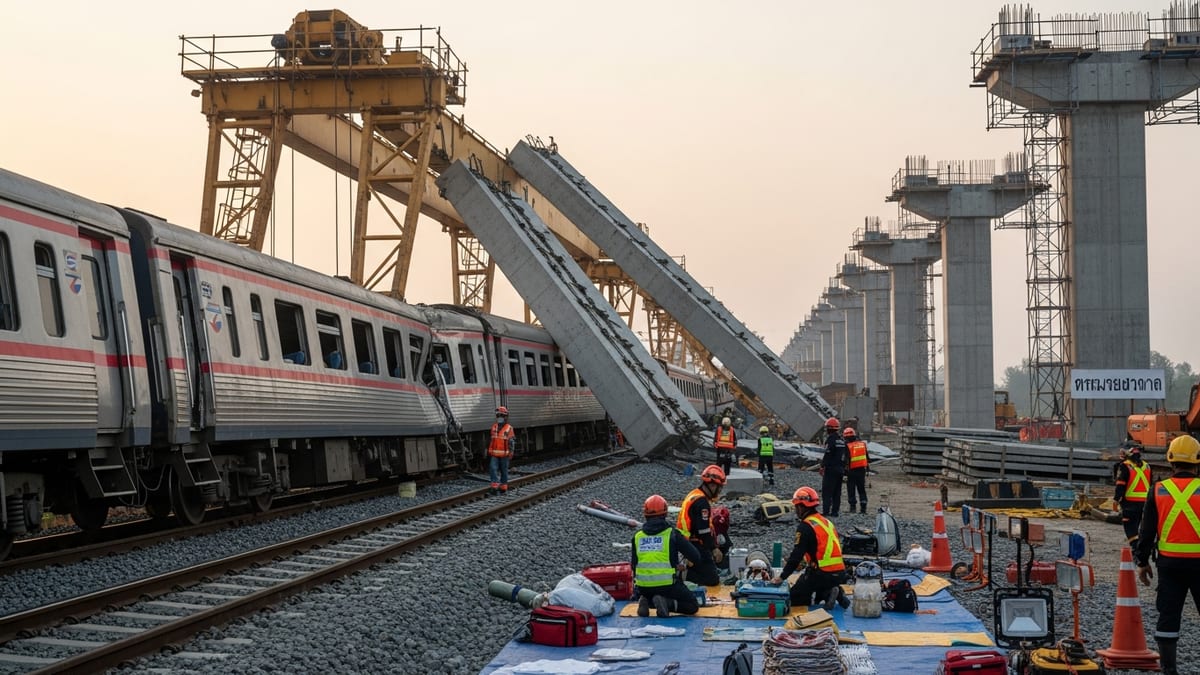
How the Austin derailment unfolded
According to publicly available federal records and summarized coverage of the case, the derailment occurred on a busy freight corridor that threads through central Austin, carrying long trains through residential neighborhoods, parkland and key road crossings. On the day of the accident, a heavy manifest freight train was moving at or below the authorized track speed when several cars in the consist suddenly derailed, scattering railcars and forcing the immediate closure of nearby streets.
Investigators reconstructed the train’s final minutes using event recorder data, track geometry records and crew statements preserved in the federal docket. The timeline indicates that the train entered a section of track that had a history of maintenance activity and prior slow orders but was cleared for normal operation at the time of the derailment. Within seconds of entering this segment, the train experienced abnormal lateral forces and a rapid change in resistance, consistent with cars beginning to climb the rail.
Although no fatalities were reported, the derailment damaged multiple freight cars and track infrastructure and temporarily disrupted both freight and passenger operations. Nearby residents and trail users were kept away from the site while crews cleared wrecked equipment and rebuilt the damaged track, highlighting how closely rail freight movements intersect with daily life in Austin’s rapidly growing urban core.
Track defects and undetected wear at the center of findings
The new report points primarily to conditions in the rail and track structure as the initiating factors behind the derailment. Federal investigators identified local areas of vertical and lateral track deviation, including subtle alignment problems and variations in surface that, in combination, reduced the safety margin for a long, heavy train. These irregularities were present despite recent geometry car runs and visual inspections that had not triggered mandatory slow orders or immediate repairs.
Publicly available information from the investigation indicates that internal rail defects and localized wear at joints and welds were also factors. Small cracks and shelling in the running surface of the rail can progress between scheduled inspections, particularly under repeated heavy axle loads. When a loaded freight train encounters such a weakened section at the right combination of speed and curvature, the rail can spread or break under stress, creating a path for wheelsets to leave the track.
The report notes that while the railroad complied with minimum federal inspection intervals, some emerging defects went undetected or were not prioritized for repair. Investigators pointed to this gap between compliance and actual risk as a key lesson from the Austin derailment, echoing concerns raised in prior national rail accident reports where track conditions appeared acceptable on paper yet proved vulnerable under real-world operating loads.
Role of train handling, train make-up and operating practices
In addition to physical track conditions, the federal review examined how the train was assembled and operated. Data in the docket shows that the derailed cars were positioned toward the middle of a long consist that combined loaded and empty freight cars. That type of mixed train make-up can create complex in-train forces, especially when the train transitions between grades, curves and changes in speed.
The report indicates that normal throttle and braking commands, although within carrier rules and federal regulations, produced longitudinal forces that interacted with the track irregularities at the critical point. When buff and draft forces peak in a segment of track that has reduced lateral restraint or hidden defects, wheel climb and gauge spreading become more likely. The Austin derailment illustrates how otherwise routine handling can become problematic when infrastructure and operating conditions align unfavorably.
Investigators also evaluated whether temporary speed restrictions, different placement of empty cars, or the use of distributed power could have lowered peak forces on the vulnerable track segment. While the report does not assign sole blame to handling decisions, it concludes that a more conservative operating profile, paired with earlier recognition of the underlying track risk, might have reduced the chances of a derailment or limited its severity.
Impacts on Austin travel and freight corridors
The accident had immediate consequences for travelers and freight customers who rely on the Austin rail corridor. Passenger services that share the line were delayed or rerouted while crews responded to the derailment and assessed the remaining infrastructure. Road closures around the site disrupted vehicle traffic and access to nearby riverfront trails, underscoring how incidents on urban rail lines can ripple through multiple modes of transportation.
Published local coverage describes how the derailment renewed concerns among residents about long freight trains crossing central Austin, particularly along routes used by intercity passenger trains. The line involved is an important link for both regional freight movements and long distance passenger services, and any extended outage can force detours across a large swath of Texas, adding time and complexity to already constrained rail networks.
In the weeks that followed, railroad crews replaced damaged rail, ties and ballast and conducted additional geometry testing before restoring full operations. The federal report’s findings are expected to influence how future maintenance is prioritized on this and similar stretches of track, especially where freight traffic runs close to densely populated neighborhoods and recreational areas.
Safety recommendations and what comes next
The Austin findings arrive amid heightened national scrutiny of rail safety, and the report adds another case study to a growing body of federal work on derailment risks. The document emphasizes the importance of more data-driven maintenance planning, urging closer attention to locations where traffic patterns, curvature and historical defects point to elevated risk even if conditions remain technically within existing standards.
Recommendations highlighted in the report and related coverage include refining inspection schedules on busy urban corridors, expanding the use of automated track and rail condition monitoring, and revisiting criteria for when speed restrictions should be imposed after borderline geometry or rail findings. The Austin derailment is presented as an example of how incremental changes in track condition can accumulate into a serious hazard if they are not caught early.
For travelers, the report underscores both the resilience and the vulnerability of shared corridors in fast growing cities. Freight rail remains a critical part of the supply chain, and passenger services depend on the same infrastructure remaining robust under heavy use. The Austin case suggests that as traffic increases, safety strategies will need to evolve beyond minimum compliance and toward more proactive risk management tailored to specific locations.
Rail safety advocates point to the Austin derailment as further evidence that infrastructure and operating practices must keep pace with changing demand. As carriers, regulators and local governments digest the federal findings, discussions are expected to focus on how best to target investments along the Austin corridor so that freight and passenger trains can move reliably through the city while minimizing the chances of another disruptive derailment.