


From November 20 to 22, 2026, Jayuya will once again become the cultural heart of Puerto Rico during the 56th Festival Nacional Indígena. This free three day gathering in the mountain town’s central plaza blends Taíno inspired ceremonies, educational talks, live music, artisan markets and serious Puerto Rican comfort food. For travelers, it is both a busy, festive weekend and one of the clearest windows into how Jayuya understands and celebrates its Indigenous heritage today.
Get the latest updates straight to your inbox!
Key dates, location and what is confirmed for 2026
The 56th Festival Nacional Indígena de Jayuya is scheduled for Friday to Sunday, November 20 to 22, 2026. Recent event listings and municipal cultural calendars confirm those dates and indicate that the activities will again concentrate around the Plaza Pública Nemesio R. Canales, Jayuya’s main square. Entry to the festival area is expected to remain free of charge, with food, drinks and crafts sold at individual kiosks.
As of late October 2026, organizers have confirmed the dates and general format but have not yet released the full hour by hour program for each day. In past years the detailed schedule was published by the Centro Cultural Jayuyano and the municipality in the weeks leading up to the event, often shared through local media and social networks. Travelers planning a visit in 2026 should check for the official program closer to November to verify performance times, special ceremonies and any last minute changes.
Looking at recent editions gives a reliable sense of what to expect. The 2024 ordinance regulating the 54th festival, along with independent festival reports, describes three days of activities using the plaza and surrounding streets for stages, artisan rows and food kiosks. The 2025 55th anniversary celebration followed the same pattern. For 2026, a cultural theme tied to Taíno cassava and casabe has been announced, so visitors can expect programming that highlights traditional agriculture, bread making and the symbolic meaning of yuca within Taíno worldviews.
The festival typically runs from late morning into the night, with artisan stalls and food stands opening by around 10:00 a.m. and headline concerts and ceremonies scheduled in the evening. Families with young children often visit during the daytime for workshops and the mock Taíno village, then either leave before the late night crowds or stay in town to avoid driving the mountain roads after dark.
Taíno history in Jayuya and how the festival interprets it
Jayuya markets itself as the “capital indígena” of Puerto Rico in part because of its geographic and archaeological context. The surrounding mountains contain numerous petroglyph sites and have long been associated with the historical cacique Hayuya, one of the Taíno leaders recorded in early colonial chronicles. Academic work on Taíno resistance also connects the region to episodes of uprisings against Spanish rule, giving the town symbolic weight in Puerto Rico’s Indigenous narrative.
The Festival Nacional Indígena emerged around 1970 as a local cultural initiative that expanded into a national event. It weaves together Taíno iconography, historical research, community pride and contemporary Puerto Rican identity. Over the years, anthropologists and archaeologists have contributed to talks and exhibits at the festival, and institutions like the Instituto de Cultura Puertorriqueña and the Puerto Rico Tourism Company have supported programming. This mix of scholarship and community creativity shapes how visitors encounter Taíno heritage in Jayuya today.
At the festival, you are likely to see people wearing body paint inspired by documented petroglyph designs, musicians playing mayohuacán style drums and dancers performing areyto style circle dances in front of the plaza’s main stage. Some presentations include explanations by cultural leaders who link these forms to historical sources and modern research. Others are artistic interpretations, aimed at evoking a Taíno environment rather than strictly reproducing precolonial practices.
For travelers, it is important to understand that the event operates in the space between historical commemoration and living culture. Local groups, including people who identify as Taíno or as part of broader Indigenous movements in Borikén, use the festival to affirm identity and community. At the same time, the municipality and tourism operators frame the weekend as a major attraction. Approaching the experience with curiosity and respect means paying attention to who is speaking in each space, how they describe their relationship to Taíno heritage and what they ask of visitors.
Living Indigenous identity, documented history and modern reenactment
One common misunderstanding among visitors is to assume that every performance they see in Jayuya represents an unchanged survival from before 1493. In reality, the festival brings together at least three distinct layers: people and organizations that claim a living Indigenous or Taíno identity, academic and archaeological knowledge about the precolonial Caribbean, and creative reenactments designed for public education and celebration.
Living Indigenous identity appears when you hear members of Taíno descendant organizations speaking in first person about ceremony, spiritual practices or community issues. They may lead blessings, areytos or small rituals around the ceremonial fire, sometimes using a mix of reconstructed Taíno vocabulary and modern Spanish. These practices are shaped by family traditions, oral histories and decades of cultural revival movements across Puerto Rico and the diaspora.
Documented history is present in museum style exhibits, talks by invited researchers and educational panels. Here you might see archaeological artifacts from sites in Jayuya and nearby municipalities, reproductions of Spanish chronicles describing caciques like Hayuya, or timelines that connect Taíno history with later events such as the Grito de Jayuya in 1950. These spaces tend to be careful about what is known from evidence and what remains speculative.
Modern reenactments include the reconstructed Taíno village, costumed parades and some stage shows. The “aldea taína” usually combines archaeologically inspired house structures with interpretive demonstrations of cassava grating, basket weaving or stone tool making. While informed by research, these activities are mediated by present day facilitators and adapted to fit time, safety and tourism expectations. Recognizing this helps visitors avoid treating performers as living museum pieces, and instead engage them as contemporary Puerto Ricans using Taíno heritage to educate, protest, celebrate or earn a living.
Program highlights: ceremonies, music, artisans, food and family activities
The final 2026 program will not be official until published by the Centro Cultural Jayuyano and the municipality, but patterns from 2023 to 2025 indicate the types of activities travelers can anticipate. The opening night has recently featured the lighting of a ceremonial fire in the plaza, accompanied by the Banda Indígena de Jayuya and protocolary acts that include dedications, awards and invocations. It is one of the most atmospheric moments of the weekend, as the mountains cool after sunset and the plaza fills with drums and conch shell calls.
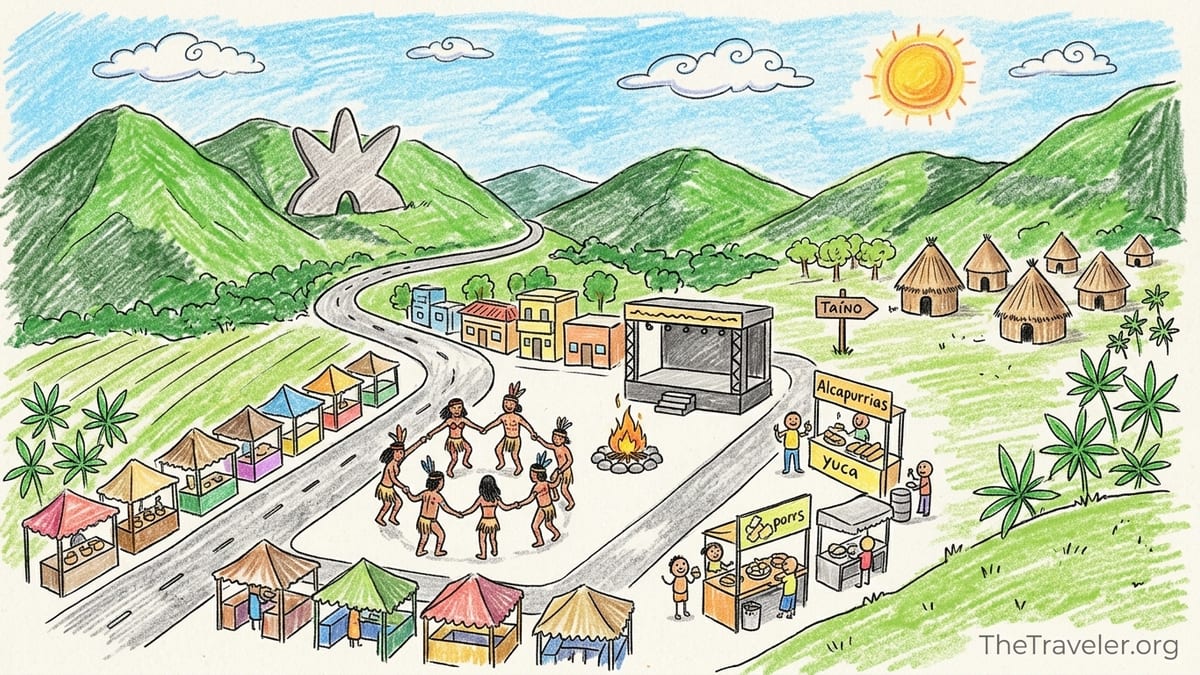
Throughout the weekend, the artisan fair occupies streets radiating from the plaza. Past municipal ordinances mention using Calle Catalina Figueras and Calle Nemesio R. Canales for artisan booths and food kiosks, with a main stage installed on another adjoining street. Visitors can expect dozens of certified Puerto Rican artisans offering wood carvings with Taíno motifs, ceramic reproductions of cemí figures, traditional vejigante masks, silver jewelry, embroidery and more. Prices in recent years ranged widely, from modest keychains under 10 dollars to museum quality carvings worth several hundred dollars.
Food is a major draw. Festival regulars describe lines for alcapurrias, bacalaítos, mofongo stuffed with pork or shrimp, pinchos grilled on open flames and, increasingly, dishes that play with the yuca and casabe theme such as yuca al mojo, alcapurrias made with yuca dough, or casabe topped with local cheeses. A couple might easily spend between 30 and 60 dollars over a full day on meals, snacks and drinks, depending on choices and portions. Many kiosks are cash based, although card payment is slowly becoming more common, so arriving with enough small bills speeds up transactions.
For families, the middle of Saturday and Sunday is usually the best time to explore kid friendly activities. The reconstructed Taíno village commonly opens by late morning, and volunteers guide children through hands on stations that can include grinding yuca on a burén, trying simple percussion instruments or learning about cave art. The festival often includes a children’s costume contest or “reinado indígena” with age categories, but details for 2026 will depend on the final program. Parents who want to avoid dense crowds may enjoy arriving shortly after opening and leaving before the evening concerts begin.
Practical logistics: getting there, traffic, parking and weather
Jayuya sits high in Puerto Rico’s Cordillera Central, roughly a two to three hour drive from San Juan depending on traffic and precise route. Most visitors rely on rental cars using navigation apps, approaching from the north via Utuado or from the south via Ponce. The roads into town are paved but winding, with frequent curves, changes in elevation and occasional fog or rain, especially in the late afternoon. Drivers not used to mountain conditions should build extra time into their schedule.
On festival weekend, the municipality typically closes several streets around the plaza and reroutes traffic. A 2024 municipal ordinance for the 54th edition authorized the closure of Calle Figueras and sections of Nemesio R. Canales, both central arteries, to host artisans and kiosks and to protect pedestrians. Similar measures were reported in 2025. In practice, this means that parking near the plaza becomes scarce. Residents and past attendees often park in informal satellite areas a few blocks away or use school and church lots when opened temporarily for a donation fee.
There is no confirmed central park and ride shuttle for 2026 at the time of writing, so independent travelers should be prepared to park on side streets and walk. Arriving before midday is usually the easiest way to secure a reasonable space. Visitors staying in lodging within or near the town center can often leave their cars parked and walk to the festival each day, avoiding the heaviest congestion. Those driving in from elsewhere at night should be ready for slow traffic entering and exiting town, especially after headline concerts finish.
Weather in Jayuya in late November is warm but usually slightly cooler than coastal towns, with frequent brief showers. Rain affects the experience: plaza tiles and side streets can become slippery, and some dirt parking areas turn muddy. Pack a compact rain jacket, a small umbrella and shoes that can handle wet pavement rather than delicate sandals. If thunderstorms are forecast, check municipal announcements on the morning of your visit for any adjustments to the schedule or temporary pauses in open air activities.
Combining the festival with Museo El Cemí, Casa Canales, Piedra Escrita and coffee
One of the advantages of basing yourself in Jayuya for the festival is the chance to connect plaza activities with key heritage sites nearby. The Museo El Cemí and Casa Canales share grounds in the Barrio Coabey, a short drive from the town center along PR 144. According to recent visitor information from the museum operators, both spaces open daily from 10:00 a.m. to 12:00 p.m. and again from 1:00 p.m. to 3:30 p.m., with a modest entrance fee of around 1 to 2 dollars per person that covers both the distinctive cemí shaped museum and the restored historic house.
During festival weekend, mornings are often the most relaxed time to visit these museums before returning to the plaza. For example, a couple staying near central Jayuya might drive out to Coabey for the 10:00 a.m. opening on Saturday, spend an hour viewing Taíno artifacts, interpretive panels and the exhibits on Rosario and Nemesio Canales, then stop for coffee at a nearby cafetín or small coffee shop along PR 144 that serves local mountain beans. By midday they can be back in town as food kiosks and artisan stands reach full momentum.
Piedra Escrita, one of the island’s best known petroglyph sites, lies along the river off PR 144 as well. Recent travel guides describe a short walk from the road to a large boulder carved with precolonial designs beside a natural swimming area. Combining the museums, Piedra Escrita and the festival in a single day is realistic, but only for travelers who start early and accept that returning to town after noon will mean heavier traffic and more distant parking. If you prefer a slower pace, consider visiting Piedra Escrita on the Friday morning before the main crowds arrive in Jayuya.
Coffee culture is deeply tied to Jayuya’s mountain landscape. Several small coffee farms and cafes operate within a 20 to 40 minute drive from town, some offering tastings and light meals. Information changes frequently, so it is wise to confirm current hours by phone or social media before setting out. A reasonable pattern for a two night stay might be to reserve Saturday morning for the museums, Saturday afternoon and evening for the festival, then use Sunday morning for a leisurely coffee stop and a short hike before heading back to the plaza for one last meal and artisan shopping.
Where to stay: town center, countryside cabins and nearby municipalities
Accommodation in Jayuya is limited compared with larger cities, and festival weekend is one of the busiest times of the year. Visitors typically choose among three strategies: staying within or walking distance of the town center, renting a countryside cabin in the surrounding barrios, or basing themselves in a neighboring municipality such as Utuado or Ponce and commuting in for the day.
Staying in or near central Jayuya offers the easiest access to the festival. Small guesthouses, short term rentals above shops and modest inns give travelers the option to walk to the plaza, return to their room for a rest and go back out for evening concerts without using the car. This is especially attractive for those who do not feel comfortable driving curvy mountain roads late at night. The trade off is noise: music from the stage and crowds can continue well into the evening, so light sleepers should pack earplugs.
Countryside cabins scattered in the hills around town provide a different experience. These properties, often marketed as eco cabins or mountain retreats, typically include parking next to the unit, cooler temperatures and starry skies on clear nights. However, reaching the festival requires driving in and out of Jayuya once or twice a day, dealing with detours, one way sections and limited parking. After dark, the same curvy roads can be tiring, especially in rain or fog. Couples who value quiet mornings and do not mind a careful 15 to 30 minute drive may find this option ideal, while families with young children might prefer being closer to the plaza.
Using nearby towns as a base can make sense when Jayuya’s limited rooms are sold out or priced above a traveler’s budget. Utuado to the north and Ponce to the south both offer a wider range of hotels and guesthouses, including chains and mid range city hotels. From Ponce, the drive to Jayuya can take about an hour and a half in good conditions; from Utuado, driving time is generally shorter but still involves mountain roads. Taxi and ride share availability in the interior is irregular, so visitors should not rely on getting a late night ride back to another municipality. Having a rental car, driving in daylight as much as possible and designating a driver who abstains from festival alcohol are all important safety considerations.
Costs and sample budgets for couples and families
Because entry to the Festival Nacional Indígena remains free, most of the trip cost comes from transportation, lodging, food and crafts. Prices change with inflation and demand, but information from recent years and current travel listings allows for illustrative budgets that help visitors plan realistically. All amounts here are approximate and should be checked again closer to the 2026 dates.
For a one day visit by a couple driving in from another part of Puerto Rico, basic expenses might include fuel and tolls, meals and snacks at the festival and modest artisan purchases. A reasonable range for fuel and tolls from the San Juan area could fall between 35 and 60 dollars round trip depending on the vehicle and route. Eating lunch, an afternoon snack and dinner at kiosks, plus non alcoholic drinks, might total 50 to 80 dollars for two people if they choose typical street food portions. Adding one or two modest artisan items such as earrings, a small wood carving or a T shirt might add 30 to 60 dollars. Under this scenario, a one day couple’s visit could land in the 120 to 200 dollar range.
A two night cultural weekend for a couple staying in or near Jayuya will be higher but more relaxed. Modest guesthouses and cabins in the central mountains have recently advertised nightly rates in the broad range of 100 to 180 dollars per night, sometimes higher for particularly scenic or secluded cabins on busy weekends. Using 140 dollars as a mid range example, two nights would cost around 280 dollars in lodging. Adding roughly 200 to 260 dollars for fuel, tolls, six to eight meals between festival kiosks and small local restaurants, coffees and a few artisan or museum related purchases brings the total near 480 to 540 dollars for the weekend.
Families need to factor in additional meals and the appeal of children’s activities. A family of four visiting for a single day could easily spend 80 to 120 dollars on food and drinks in the plaza, especially if including sweets, ice cream and extra snacks. Craft purchases add up quickly when each child chooses a souvenir. Using a modest estimate of 15 to 25 dollars per child, plus perhaps 40 to 60 dollars for a larger household item or carving, brings souvenir spending into the 70 to 110 dollar range. Combined with transportation, a one day family outing might reasonably fall between 200 and 320 dollars.
For a two night cultural weekend, a family of four sharing a simple cabin or multi room rental at around 180 dollars per night would spend about 360 dollars on lodging. Adding two days of festival food, one meal in a sit down restaurant, museum entrance fees, a coffee stop for the adults and a few more substantial artisan or educational purchases could bring the total into the 650 to 900 dollar range. These examples highlight why it is worth setting a daily cash budget for food and crafts before entering the plaza, especially when traveling with children eager for every wooden sword and painted gourd in sight.
The Takeaway
The Festival Nacional Indígena de Jayuya is more than a busy weekend fair. From November 20 to 22, 2026, it will again offer one of Puerto Rico’s most concentrated encounters with Taíno inspired art, ceremony, scholarship and activism in a single small mountain town. For first time visitors, approaching the event as both celebration and classroom can deepen the experience: listen to who is speaking, ask questions respectfully, visit the museums in Coabey and take time at Piedra Escrita to connect the noise of the plaza with the carved stone records along the river.
Families interested in cultural education will find a mix of hands on activities, performances and exhibits, but should plan carefully around heat, crowds and noise. Arriving earlier in the day, choosing one long festival block instead of multiple in and out trips by car and balancing plaza time with a quiet hour at Museo El Cemí or a shaded river stop can keep children engaged without exhaustion. Parents may also want to talk in advance about the difference between historical exhibits and modern reinterpretations so that older kids can ask informed questions.
Travelers debating whether to visit on festival weekend or choose a quieter time face a real trade off. Outside November, Jayuya offers cooler air, easier parking, empty viewpoints and unhurried museum visits. You can linger over coffee at a mountain hacienda, take your time at Piedra Escrita and talk at length with guides without the pressure of crowds. During the festival, some of that quiet disappears in favor of intense, layered programming that exists only for three days a year.
If your priority is immersion in contemporary Puerto Rican cultural life and seeing how Taíno heritage is performed, debated and celebrated today, the festival weekend is worth the congestion, limited parking and risk of rain. Build in patience, drive carefully on the mountain roads and set a realistic budget. If instead you want solitary time in the mountains and slow reflection at archaeological sites, consider visiting Jayuya on another weekend and using municipal and cultural websites to follow the festival from afar.
FAQ
Q1. When will the Festival Nacional Indígena de Jayuya take place in 2026?
The 56th Festival Nacional Indígena de Jayuya is scheduled for Friday to Sunday, November 20 to 22, 2026, in and around the Plaza Pública Nemesio R. Canales.
Q2. Is there an admission fee to enter the festival area?
Entry to the festival area has historically been free and current 2026 event listings again describe it as a free public event, with attendees paying only for food, drinks and crafts.
Q3. Where is the festival held within Jayuya?
The festival centers on the main plaza, Plaza Pública Nemesio R. Canales, and extends into surrounding streets that are temporarily closed to traffic to host stages, artisans and food kiosks.
Q4. How can I find the official daily program and performance schedule?
The detailed schedule is usually released by the Centro Cultural Jayuyano and the municipality in the weeks before the event, often through their official channels and local media; travelers should verify times there closer to November 2026.
Q5. Is the festival suitable for children and families interested in cultural education?
Yes, families typically appreciate the reconstructed Taíno village, daytime workshops, parades and museum visits, though parents should plan around crowds, heat, noise and the challenges of late night driving in the mountains.
Q6. What is the best way to get to Jayuya for the festival?
Most visitors arrive by rental car or private vehicle using navigation apps, driving two to three hours from cities like San Juan or Ponce along paved but curvy mountain roads; building extra travel time and driving mainly in daylight is advisable.
Q7. Where should I stay if I want to walk to the festival instead of driving each night?
Booking a guesthouse or short term rental within or near central Jayuya allows you to walk to the plaza, avoid searching for parking during peak hours and skip nighttime drives on mountain roads, though you may experience more noise from the festivities.
Q8. Can I combine the festival with a visit to Museo El Cemí and Casa Canales?
Yes, Museo El Cemí and Casa Canales in Barrio Coabey are typically open daily from late morning to mid afternoon with a short midday closure, so many visitors spend a morning there and then return to town for afternoon and evening festival activities.
Q9. What kind of food and crafts will I find, and how much should I budget?
You can expect classic Puerto Rican street foods such as alcapurrias, mofongo, pinchos and cassava based dishes, along with artisan wood carvings, ceramics and jewelry; couples often spend 50 to 80 dollars on food in a day and another 30 to 60 dollars on modest souvenirs.
Q10. How do rain and limited parking affect the festival experience?
Showers are common in Jayuya in November and can make streets and informal parking areas slick or muddy, while temporary street closures create scarce parking near the plaza; arriving early, wearing shoes for wet conditions and being ready to walk several blocks all make the visit easier.