


More news on this day
Rail traffic in central Catalonia was briefly disrupted when a vegetation fire near Cervera, in Lleida province, forced trains to stop for about 45 minutes while emergency crews secured the area.
Get the latest news straight to your inbox!
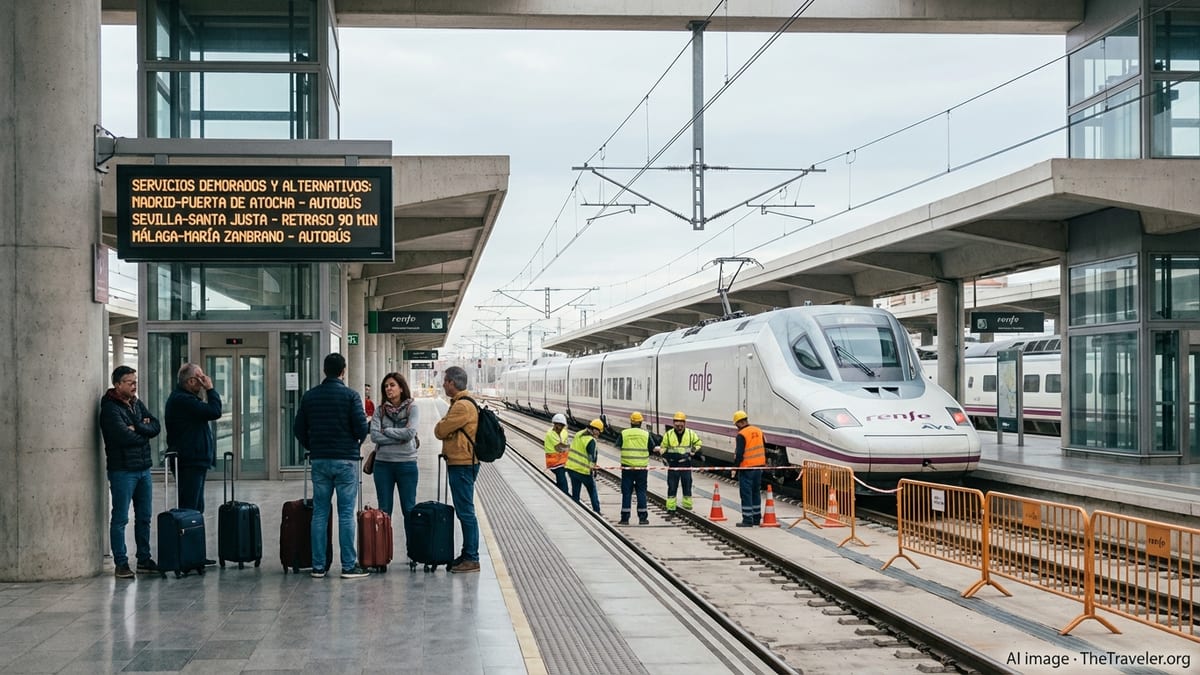
Brief stoppage on a key regional corridor
The incident occurred on Thursday near the town of Cervera, an important point on the rail corridor that links Lleida with Barcelona and other Catalan destinations. According to published coverage from regional outlets, a fire broke out in an area of vegetation close to the tracks, prompting a precautionary halt to services while conditions were assessed.
Reports indicate that trains in both directions were affected, with services stopped for approximately three quarters of an hour. During this period, no trains passed through the affected section as rail infrastructure managers prioritized safety on and around the line.
The stoppage took place at a time of day when commuter and regional movements are significant, adding to the impact on passengers. While the interruption was relatively short in duration, it underscored how even a localized incident can ripple across a wider network in a densely used rail corridor.
Once the fire was brought under control and the immediate perimeter declared safe, traffic was gradually restored. Initial services moved through the area at reduced speed while teams verified that the heat and smoke had not damaged signaling, catenary components or other critical infrastructure.
Passengers face delays but no reported injuries
Available information from local media suggests that, despite the abrupt halt, there were no reports of injuries among passengers or rail staff. Trains that were already in motion were stopped at stations or in controlled sections of track until the situation near Cervera stabilized.
Travelers faced delays estimated at around 45 minutes on the most directly affected services, with some secondary delays as operations were rescheduled and rolling stock repositioned. Rail operators used standard contingency protocols, which typically include holding trains at upstream stations to avoid congestion close to the incident area.
Some passengers experienced missed connections and extended journey times, particularly those heading toward or from Lleida and intermediate towns. Publicly available information from user reports on social networks described crowded platforms and uncertainty while awaiting confirmation that traffic would resume.
Once green lights were given for circulation, operators worked to absorb the backlog by adjusting stops and timetables over the following services. In similar past events in Catalonia, full timetable regularity has generally been restored within a few hours after such short-duration interruptions.
High wildfire risk heightens sensitivity around rail corridors
The fire near Cervera occurred during a period of elevated wildfire risk in much of inland Catalonia, with several active blazes reported in recent days across Lleida province. Regional coverage has highlighted that strong sun, low humidity and dry vegetation have created particularly delicate conditions in many rural and peri-urban areas.
In this context, any fire detected close to critical infrastructure such as railway lines, highways or power corridors tends to trigger swift precautionary actions. The priority is to prevent flames or dense smoke from affecting visibility, damaging equipment or endangering people in trains or stations.
Rail corridors can be especially vulnerable when vegetation grows close to the ballast and embankments. Sparks from braking systems, overhead line incidents or nearby agricultural activity can all act as potential ignition sources. In recent years, transport authorities and infrastructure managers in Spain have increased vegetation control and surveillance along key routes during the hottest months.
The Cervera incident aligns with that precautionary approach. Although the fire was controlled within a relatively short window, the decision to halt traffic for about 45 minutes reflects a low-tolerance stance toward any blaze that approaches operating rail lines in high-risk conditions.
Operational response and checks before full service resumption
After the fire was contained, technical teams inspected the line to verify that the heat and smoke had not compromised infrastructure. Standard post-incident practice includes visual checks of sleepers, ballast and nearby embankments, as well as inspection of cables, signaling equipment and overhead lines where present.
According to publicly available information about similar interruptions on Spanish lines, trains are initially authorized to pass the affected section at reduced speeds. This allows drivers increased time to react to any unforeseen obstacle while giving inspectors additional opportunities to observe how equipment responds in real operating conditions.
During this controlled phase, dispatch centers often adjust spacing between trains to reduce pressure on the section that has just reopened. This can prolong delays slightly even after the official resumption of traffic, but it is considered preferable to resuming full-speed operations too quickly in a recently affected area.
Once several trains have passed without incident and on-site checks are completed, speeds and frequencies are progressively normalized. At that point, the main remaining impact for travelers is residual timetable disorder, particularly for later services that rely on rolling stock and crew rotations affected by the earlier stoppage.
Implications for summer travel in inland Catalonia
The Cervera fire and its impact on the railway come as the summer travel season gathers pace across Spain, with domestic and international visitors increasingly using rail to move between coastal areas and inland destinations. Lleida province serves as a gateway to both Pyrenean mountain regions and central Catalan towns, making reliable rail links a key component of regional mobility.
Travel commentators often highlight that short, localized disruptions of this kind rarely alter broader plans, but they can complicate multi-leg itineraries when connections are tight. The incident serves as a reminder for travelers to factor in potential delays during periods of high wildfire risk, especially when planning same-day links with flights, long-distance trains or organized tours.
Infrastructure managers and regional institutions in Catalonia have, in recent years, placed increased emphasis on rapid detection and response to vegetation fires near key transport corridors. According to published coverage, additional monitoring resources and coordination protocols are typically activated during peak risk periods.
For visitors and residents alike, the episode near Cervera illustrates both the vulnerability of rail services to environmental incidents and the capacity of the system to recover operations relatively quickly once conditions are brought under control.