


More news on this day
Europe’s long‑planned biometric border overhaul is now colliding with peak travel demand, as the European Union’s new Entry/Exit System brings mounting reports of queues, missed flights and uneven implementation across major airports.
Get the latest news straight to your inbox!
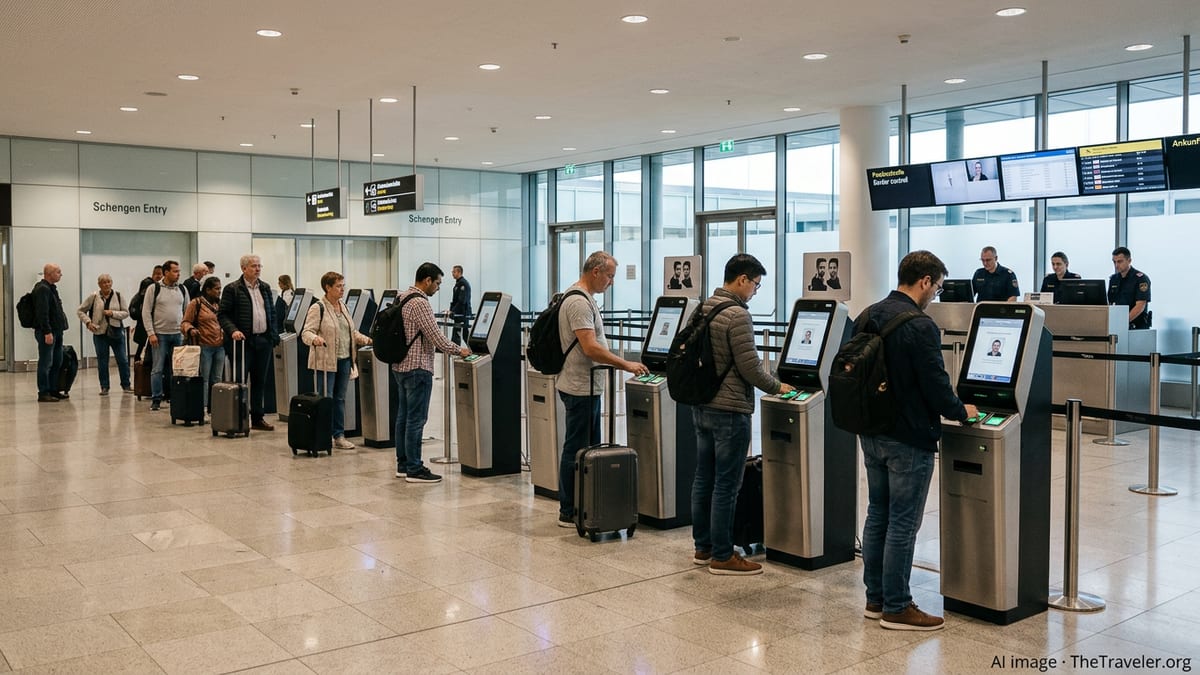
Biometric border system goes live across Schengen
The EU’s Entry/Exit System, or EES, began its progressive roll-out in October 2025, replacing manual passport stamping for most non-EU visitors to the Schengen area with a centralised digital record of entries and exits. Publicly available information shows that border authorities are required to register fingerprints and a facial image for many third-country nationals on their first crossing, then verify at least one biometric on subsequent trips.
The system is now active at airports across 29 participating European countries, with a phased deployment that allows states to start with limited volumes and specific border points before scaling up. According to official documentation, the EU’s objective is to tighten controls on overstays and irregular migration while ultimately speeding up checks for returning travellers once the initial enrolment wave is complete.
In practice, the transition period is proving the most disruptive. Travellers arriving from the United Kingdom, the United States and other non-Schengen countries are encountering new kiosks, fingerprint scanners and camera kiosks that add several minutes to each first-time registration. When multiplied across multiple full inbound flights, that extra processing time is feeding directly into longer queues and a more fragile airport operating environment.
Queues, missed flights and inconsistent wait times
From Geneva and Brussels to Spanish and Italian gateways, reports indicate that queues of one to three hours at passport control have become a regular risk when several long-haul or UK flights arrive close together. Individual accounts from spring 2026 describe passengers waiting more than an hour to clear border checks at regional airports where only a handful of EES kiosks are installed, and where technical glitches have pushed traffic back to manual booths.
In the most serious cases highlighted by recent coverage, entire planeloads of passengers have missed onward connections or even their primary departures because they were still waiting to complete biometric checks. Aviation industry groups have publicly warned that, without urgent adjustments, summer peaks could see waits stretching to four hours for some non-EU travellers at the busiest hubs.
The experience is far from uniform. Feedback from travellers also points to smooth processing at well-resourced hubs where additional staff and automated lanes have been deployed and thoroughly tested. At some airports, first-time registration is being completed in under ten minutes and subsequent crossings in a matter of seconds, especially where self-service kiosks and eGates are integrated effectively.
The contrast highlights how sensitive the system is to local staffing levels, hardware reliability and terminal layouts. Airports that historically relied on a small number of manual booths for third-country arrivals are finding that the extra steps, combined with any technical interruptions, quickly tip operations into gridlock.
Industry calls for flexibility as peak season nears
Airlines and airport operators have been lobbying for a more flexible implementation calendar, arguing that full-scale biometric registration for every eligible traveller during the height of summer would overwhelm existing infrastructure. Joint letters from major European aviation associations, cited in recent media reports, urge the European Commission and national governments to allow temporary suspensions or reductions in EES usage when queues become unmanageable.
Some member states already appear to be using the leeway built into the progressive roll-out. Publicly available guidance indicates that border agencies can revert to conventional stamping and manual checks when systems are unavailable or when passenger flows become too dense, a safety valve that has been used repeatedly during the first months of operation.
Airport groups are also pressing for clearer communication and more coordination. They argue that staffing models, terminal design and airline schedules were built around pre-EES assumptions, and that additional funding and planning time are needed to avoid systemic disruption. According to statements from industry bodies, the mix of older infrastructure, chronic staffing shortages and complex transfer flows at major hubs leaves little margin for error when a new process adds even modest delays.
EU institutions, for their part, continue to frame the roll-out as a necessary modernisation rather than a temporary experiment. They point to millions of successful registrations already logged and describe the early bottlenecks as the kind of start-up friction seen whenever a large-scale border technology is introduced.
Passenger experience shaped by airport and preparation
For travellers, the impact of the new system currently depends heavily on which airport they use and how prepared they are. Reports on travel forums and social media suggest that those arriving at quieter times of day, or into airports that have separated lanes for EES-registered and unregistered passengers, can pass through relatively quickly, especially on repeat trips once biometric data is on file.
Others have encountered scenes of confusion, with limited signage about the new requirements and little distinction between queues for first-time enrolment and routine checks. In several cases described in recent accounts, self-service machines have operated intermittently, forcing passengers to queue twice: once for a kiosk that collects data and again for an officer who validates the record and finalises the crossing.
Airlines and travel advisers are increasingly recommending that non-EU passengers build additional time into their airport routines. Guidance circulating in the sector commonly suggests arriving at least three hours before departure, and longer at busier hubs or during school holidays, to create a buffer against unpredictable queues at exit controls.
Families and travellers with reduced mobility appear particularly exposed to delays. Biometric capture for children and those unfamiliar with the technology often requires more assistance, which slows each transaction and can cause entire queues to back up if support staff are stretched thin.
Long-term goals versus short-term disruption
Behind the immediate queues, the EU continues to promote the Entry/Exit System as a long-term investment in both security and efficiency. Policy documents describe future interoperability with the planned European Travel Information and Authorisation System, which will pre-screen many visitors before they even board a flight, and with existing databases used for law enforcement and visa management.
If the system beds in as intended, returning travellers could eventually see faster crossings through automated lanes that rely on a single biometric check instead of manual stamps and visual inspections. Advocates argue that, once the initial registration surge passes and technical issues are resolved, EES could support more predictable flows and clearer records of who is entering and leaving the bloc.
Much will depend on whether authorities and airports can compress that painful adjustment period before another high-demand season. Calls for additional staff, more robust hardware, better passenger information and fine-tuned scheduling are mounting as summer 2026 approaches. For now, non-EU travellers heading to Europe are being urged to expect queues, plan extra time and brace for a border experience that is still in transition.