


More news on this day
Air travel across Canada faced significant disruption today as major airports in Toronto, Ottawa, Montreal, Vancouver, Halifax, and Edmonton reported a combined 83 flight cancellations and 356 delays, snarling schedules for thousands of passengers and affecting carriers ranging from Air Canada and Jazz to Cathay Pacific and Air France.
Get the latest news straight to your inbox!
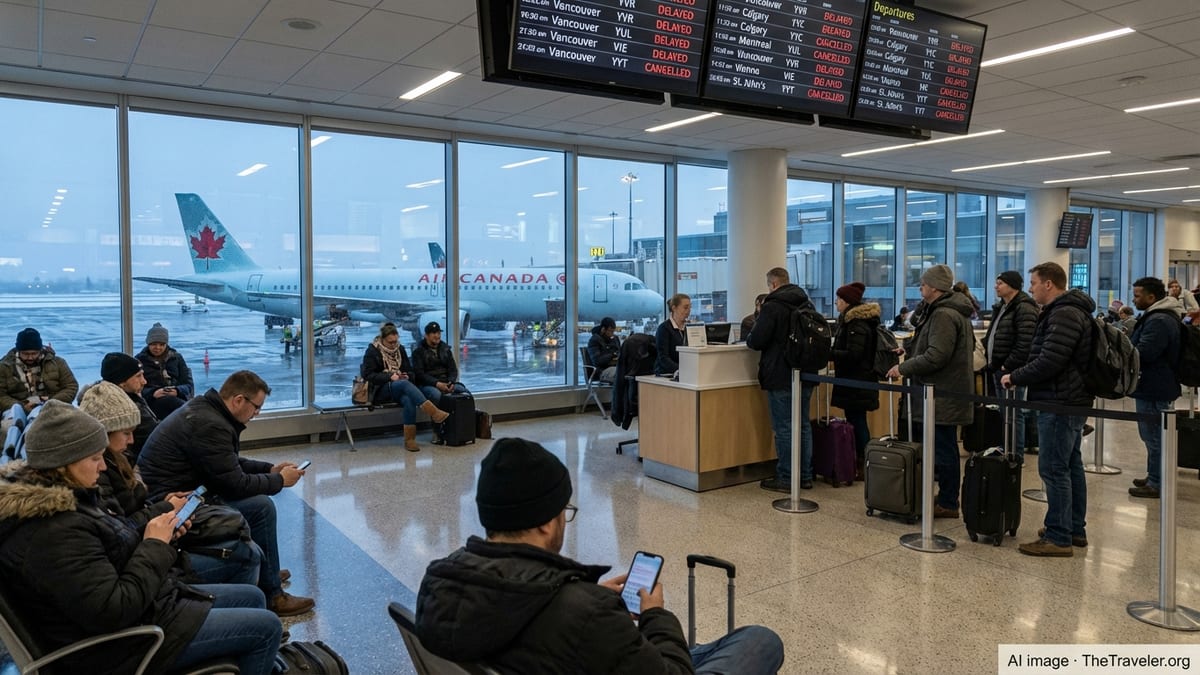
Widespread Disruptions Across Key Canadian Gateways
Published data from flight tracking platforms shows that Canada’s busiest hubs struggled to keep aircraft moving on time, with Toronto Pearson International Airport, Montreal–Trudeau International Airport, Vancouver International Airport, Halifax Stanfield International Airport, Edmonton International Airport, and Ottawa International Airport all recording elevated levels of disruption. The six airports together accounted for 83 outright cancellations and 356 delayed departures and arrivals.
Toronto Pearson, the country’s largest hub, recorded the highest concentration of disrupted movements, creating knock-on effects throughout domestic and transborder networks. Delays at Pearson rippled into smaller airports as aircraft rotated through the system, leaving passengers in cities such as Ottawa and Halifax facing missed connections and extended waits at departure gates.
In Western Canada, Vancouver and Edmonton also reported clusters of delayed and cancelled services, compounding the pressure on east–west routes. Publicly available airport dashboards indicated busy early-morning departure banks followed by growing backlogs as the day progressed, with turnaround times stretching and scheduled departure slots slipping further behind.
Ottawa and Halifax, typically more modest in scale than Toronto or Vancouver, nonetheless experienced enough cancellations and late operations to strain terminal operations. Travelers in these markets reported longer check-in lines and uncertainty at boarding as airlines attempted to reassign aircraft and crew to cover as many planned flights as possible.
Air Canada, Jazz and Global Partners Among Those Hit
The disruption has been especially visible at Air Canada and its regional partner Jazz, which together operate a dense network linking the six affected airports. Flight status boards at Toronto, Montreal, and Vancouver showed numerous Air Canada and Jazz services flagged as delayed, along with a smaller but notable number listed as cancelled, particularly on high-frequency domestic routes.
Because many international carriers share codes with Canadian operators, the knock-on impact extended beyond local brands. Flights marketed by Cathay Pacific, Air France, and other overseas airlines but operated within Canada by partners such as Air Canada and WestJet were also caught in the delays, leaving some long-haul passengers waiting for connecting segments to or from Asia and Europe.
In Edmonton and Vancouver, several departures appeared under multiple airline identifiers, reflecting code share arrangements that broaden the number of passengers affected when a single aircraft is delayed or cancelled. A single late departure from Toronto to Vancouver, for example, can simultaneously impact ticket holders booked under Air Canada, Cathay Pacific, and other partner flight numbers.
Regional carriers and low-cost operators were not spared. Publicly accessible flight information shows schedule interruptions for airlines including Porter, Flair, and WestJet on routes feeding into the main hubs, meaning that even travelers not directly booked with Canada’s largest carrier faced cancellations or substantial delays as network congestion worsened.
Weather, Congestion and Network Knock-on Effects
While specific causes vary by flight and airport, operational data and recent coverage of Canadian aviation performance suggest a familiar mix of contributing factors behind the latest wave of disruptions. Weather systems moving across multiple provinces, including low cloud and thunderstorms in some regions, constrained runway capacity and extended spacing between arrivals and departures at peak times.
Once early services fall behind schedule, Canada’s tightly interconnected domestic network can quickly experience a cascading effect. Aircraft scheduled to operate multiple legs within a day can arrive late into Toronto or Montreal and depart late again for onward flights to cities such as Halifax, Edmonton, or Vancouver, compounding delays through the afternoon and evening.
Airports themselves face limitations in staffing and gate availability, particularly during holiday periods and peak travel seasons. When a surge in delayed arrivals collides with a busy departure bank, ground-handling teams, security checkpoints, and air traffic control can all become bottlenecks. Publicly available flight statistics for Canadian hubs in recent months highlight recurring patterns of afternoon and early evening congestion following morning disruptions.
Analysts also note that airlines sometimes resort to consolidating lightly booked flights or preemptively cancelling select departures to stabilize schedules, a practice that can reduce further cascading delays but sharply impacts the affected passengers. The profile of today’s 83 cancellations, spread across several hubs and concentrated around key connection times, is consistent with a mix of reactive and preventive network adjustments.
Passenger Impact and Options for Disrupted Travelers
For travelers caught in the latest disruption, the immediate consequences have been missed connections, extended waits in terminals, and in some cases the need for overnight accommodation when rebooking options are limited. With transcontinental routes between Toronto, Montreal, Vancouver, and Edmonton experiencing delays, passengers traveling onward to smaller Canadian cities or to international destinations often found themselves stranded partway through their journeys.
Consumer advocacy groups regularly advise passengers in such situations to monitor airline apps and departure boards closely, as rebooking options can appear and disappear quickly when multiple flights are experiencing schedule changes. When cancellations occur at major hubs like Toronto or Vancouver, open seats on alternative departures can be snapped up rapidly by travelers from multiple disrupted flights.
Travel rights organizations also emphasize that passengers should keep records of their flight numbers, delays, and any documented reasons for disruption, since eligibility for refunds, vouchers, or compensation can depend on both the cause and the length of the delay. In Canada, compensation rules differ depending on whether the disruption is within an airline’s control or the result of external factors such as severe weather or air traffic restrictions.
Experienced travelers often recommend carrying essential items in hand luggage, including medications and a change of clothes, particularly when connecting through hubs that have seen repeated disruption in recent months. With six of Canada’s key airports jointly reporting more than 400 affected flights today, those practical preparations made a marked difference in passenger comfort as the delays accumulated.
Ongoing Monitoring as Airlines Work to Reset Schedules
As the day’s operations progress, publicly available flight trackers indicate that airlines are attempting to realign aircraft and crews to restore more regular patterns of service. Recovery typically begins with stabilizing core trunk routes between major hubs such as Toronto, Montreal, Vancouver, and Edmonton, then gradually extending reliability to smaller regional spokes including Ottawa and Halifax.
Industry observers note that the timing of disruptions is critical for recovery. Significant interruptions in the early morning can take an entire operating day to resolve, especially across a geographically large country where aircraft must traverse several time zones. Even as some routes return to near-normal performance, residual delays can persist on evening departures and on next-morning rotations for aircraft and crews that did not reach their planned overnight destinations.
Travel and aviation data outlets are continuing to track the situation, comparing today’s 83 cancellations and 356 delays with recent disruption events that have affected Canadian airports. While the overall numbers are lower than the most severe storm-related incidents seen earlier in the year, they still represent a difficult day for carriers and passengers alike, especially on high-volume holiday and business travel dates.
For now, travelers with upcoming itineraries through Toronto, Ottawa, Montreal, Vancouver, Halifax, or Edmonton are being advised by public information sources to check their flight status frequently on the day of travel and to allow additional time at the airport, as airlines work to normalize schedules following Canada’s latest wave of flight disruptions.