


More news on this day
Thousands of air passengers have been left stranded across France as a fresh wave of disruption triggers around 60 flight cancellations and more than 500 delays, snarling services on key routes through Paris, Lyon, Nice and Toulouse and affecting operations at Lufthansa, easyJet, British Airways, Air France, KLM and other major carriers.
Get the latest news straight to your inbox!
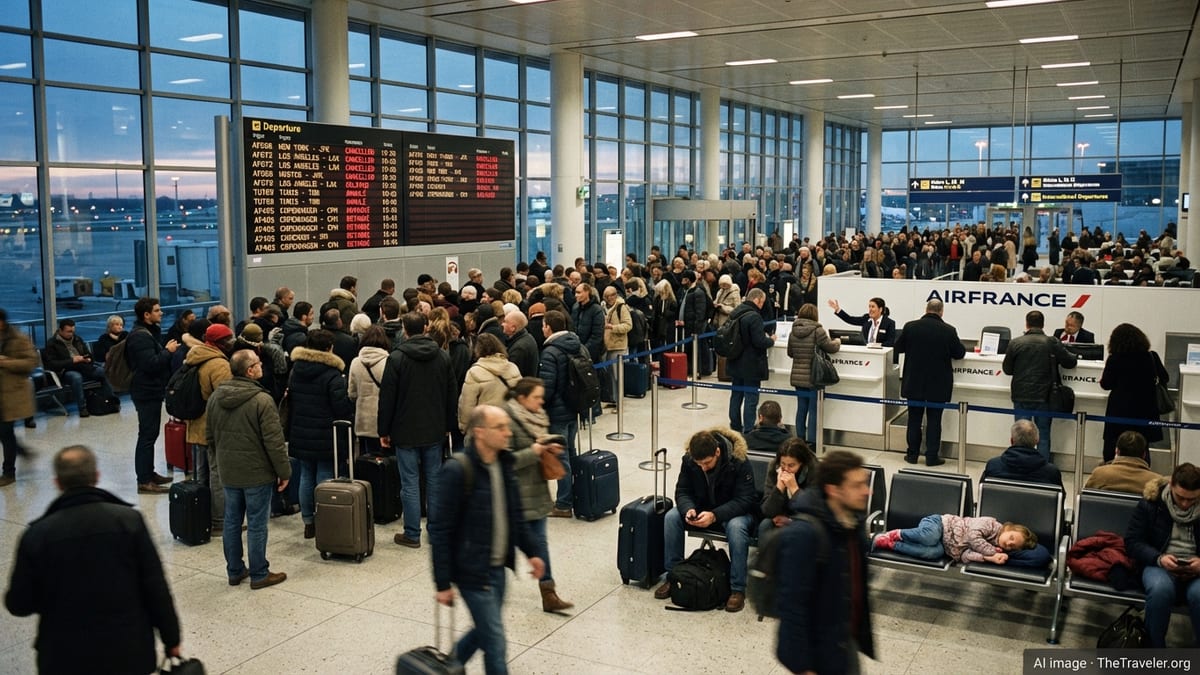
Major French Hubs Hit by New Wave of Disruption
Operational data from live flight-tracking platforms and aviation monitoring services indicate that congestion has mounted across France’s main hubs, with Paris Charles de Gaulle and Paris Orly again at the heart of the disruption. Knock-on effects are being felt at Lyon Saint-Exupéry, Nice Côte d’Azur and Toulouse Blagnac, where both domestic and international services are running behind schedule.
Current tallies from these services point to roughly 60 cancellations and in excess of 500 delayed departures and arrivals within French airspace and at French airports. The pattern mirrors recent episodes where a similar combination of cancellations and hundreds of delays left thousands of travelers stranded or facing missed connections across Paris, Lyon, Nice and Toulouse.
While the latest disruptions are spread across multiple carriers, the impact is sharpest on high-frequency routes linking Paris with other major French cities and nearby European hubs. Aircraft and crews pushed out of position earlier in the day are creating a cascade of late-running flights, extending delays into the evening peak and complicating recovery efforts.
Passenger flows at these airports are particularly sensitive during busy summer and shoulder-season travel periods, meaning even a modest number of cancellations can quickly translate into crowded terminals, long queues at customer service desks and limited availability on alternative departures.
Network Carriers and Low-Cost Airlines Among the Worst Affected
Publicly available disruption snapshots for today show that both full-service and low-cost operators are heavily represented in the list of affected flights. Air France and KLM are contending with widespread schedule stretching on short and medium haul sectors that connect Paris with Lyon, Nice and Toulouse, as well as onward services across Europe.
At the same time, airlines such as Lufthansa, British Airways and easyJet are grappling with delays and selected cancellations on services into and out of French airports. Earlier disruption on intra-European legs has led to late inbound aircraft from hubs such as Frankfurt, Munich, Amsterdam and London, which then feed into departures for France’s main cities.
Live monitoring from consumer-facing delay trackers highlights that low-cost carriers operating dense point-to-point networks are particularly vulnerable when tight turnarounds are disrupted. A late arrival in Paris or Nice can reverberate through multiple subsequent legs, affecting flights that may no longer appear directly connected to the original problem.
Regional and holiday-focused carriers are also feeling the strain, particularly on routes that rely on a single daily rotation. For passengers on these services, a cancellation can mean waiting until the following day or being rerouted via another European hub with lengthy layovers.
Operational Pressures Behind Cancellations and Delays
Recent months have seen a series of contributing factors behind flight disruption in French airspace, including air traffic control walkouts, staffing shortages and bouts of severe weather. Industry analyses of earlier events involving hundreds of delays and dozens of cancellations across Paris, Nice and Lyon point to recurring structural pressures that make the system vulnerable when conditions deteriorate.
On strike days or during periods of constrained air traffic capacity, regulators often require airlines to cut a portion of their schedules in advance. This leads to preemptive cancellations that reduce pressure on control centers but leaves passengers scrambling to find alternatives, particularly on busy domestic corridors such as Paris to Nice or Paris to Toulouse.
Weather-related disruption has also played a notable role in the past year, with storms and winter conditions causing large spikes in delays and cancellations at French airports and at key hubs elsewhere in Europe. When aircraft are diverted or held on the ground for extended periods, airline crews can quickly run up against duty-time limits, adding an additional layer of complexity to rescheduling efforts.
Industry reports note that even when the immediate trigger eases, it can take airlines and airports many hours to work through the backlog. Flights later in the day may still depart late or be canceled altogether as operators attempt to restore aircraft and crew rotations to normal patterns.
Knock-on Effects for Passengers Across Europe
The latest disruption in France is rippling far beyond the country’s borders, as many of the affected flights form part of wider European and long-haul networks. Data from previous large-scale events show that when delays accumulate at French hubs, services linking to the United Kingdom, Germany, the Netherlands, Spain and Italy often experience secondary delays.
Travel platforms tracking flight performance across Europe have previously recorded similar situations in which a cluster of cancellations and more than a thousand delays at major airports resulted in thousands of travelers stranded or forced into overnight stays. Today’s pattern of around 60 cancellations and over 500 delays in France fits into that broader trend of tightly interconnected schedules amplifying local problems into continent-wide disruption.
Passengers connecting at Paris Charles de Gaulle or Orly on itineraries involving Lufthansa, British Airways, KLM and other European partners may face missed onward flights even if their original departure left only slightly behind schedule. In some cases, travelers are being rerouted via alternative hubs or shifted to rail services on shorter intra-European sectors.
Hotel capacity near key airports can also come under pressure when evening departures are canceled or heavily delayed. During past disruption episodes, nearby accommodation has quickly filled as stranded passengers search for somewhere to stay while awaiting rebooked flights.
What Impacted Travellers Can Do Now
Consumer organizations and air travel rights platforms advise passengers caught in the current disruption to monitor their flight status closely through official airline channels and airport departure boards. Many carriers now allow rebooking or refund requests to be initiated online or via mobile apps, reducing the need to wait in long lines at service counters.
Under European passenger rights rules, travelers departing from airports in France or flying into the European Union on eligible carriers may be entitled to assistance such as meals, refreshments and hotel accommodation when delays stretch into long waits or overnight stays. In certain circumstances, fixed-sum financial compensation is also possible when the cause of the disruption falls within the airline’s control.
Travel advocates recommend that affected passengers keep boarding passes, booking confirmations and any written notices about delays or cancellations. These documents can be important when submitting claims later, particularly in complex situations involving multiple segments or partner airlines like Lufthansa, easyJet, British Airways, Air France and KLM on a single itinerary.
For now, forecasts suggest that it may take time for schedules in France to fully stabilize. Travellers with upcoming journeys through Paris, Lyon, Nice or Toulouse are being encouraged by public information sources to allow extra time at the airport, consider earlier departures where possible and remain prepared for further changes as airlines work to bring their operations back on track.