


More news on this day
U.S. flight delays surged past the 5,000 mark on Thursday, September 17, 2026, with real-time tracking showing thousands of late departures and arrivals as weather and air-traffic management programs snarled schedules at several major hubs.
Get the latest news straight to your inbox!
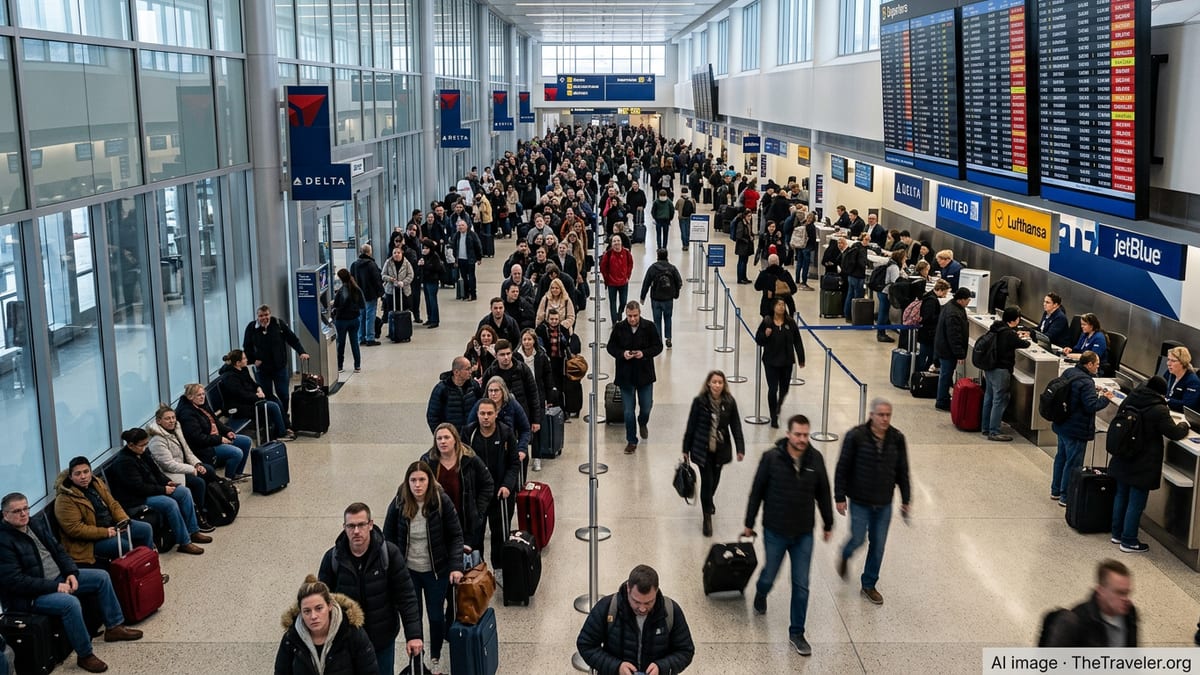
Delay count climbs as FAA programs stack up across key hubs
Publicly available flight-tracking tallies showed 6,881 delays nationwide on Thursday, underscoring how quickly localized constraints can ripple through airline networks as aircraft and crews get out of position.
At the system level, the Federal Aviation Administration’s National Airspace System status page listed five Ground Delay Programs affecting Boston Logan (BOS), Ronald Reagan Washington National (DCA), Chicago O’Hare (ORD), San Diego (SAN), and San Francisco (SFO). Each program reflects metered arrival rates and controlled departure releases designed to prevent airspace and airport surface congestion from worsening into gridlock.
Separately, the FAA’s live status feed also showed additional delay impacts in the Washington region, with delay information entries for Baltimore-Washington International (BWI) and Washington Dulles (IAD) tied to thunderstorms, a sign that travelers may feel disruption even if they are not connecting through the airports listed under national programs.
Boston, Chicago, and San Francisco: longest average delays in the FAA feed
Among the five Ground Delay Programs listed Thursday, Boston Logan stood out for the longest average delay in the FAA summary feed, where the cause was runway and taxiway construction. The program’s published average delay was 136 minutes, indicating extended holding times for flights destined for the airport during the affected window.
Chicago O’Hare also appeared under a Ground Delay Program, with the FAA listing weather and wind as the reason and a published average delay of 104 minutes. Because O’Hare is a high-volume hub that feeds connections across the country, even a short period of reduced arrival capacity can cascade into missed connections and delayed outbound legs later in the day.
On the West Coast, San Francisco International was placed under a Ground Delay Program tied to low ceilings, with an FAA-listed average delay of 77 minutes. Low clouds and reduced visibility can constrain arrival rates when instrument approaches and spacing requirements limit how many aircraft can safely land per hour.
Washington-area thunderstorms add ground stops and growing taxi waits
The FAA’s detailed delay information page showed both a Ground Delay Program and a Ground Stop associated with Ronald Reagan Washington National on Thursday due to thunderstorms. The same page also indicated increasing gate-hold and taxi delays tied to traffic management initiatives, signaling conditions that can change quickly as storm cells move through the region.
In addition to DCA, the FAA feed showed a Traffic Management Ground Stop for flights arriving at Baltimore-Washington International due to thunderstorms, along with growing departure delays there as aircraft waited at gates or on taxiways. Washington Dulles also appeared with an arriving-traffic Ground Stop for thunderstorms, reinforcing the likelihood of multi-airport impacts in the region.
For travelers, the practical implication is that a flight can be delayed far from the weather itself if it is scheduled to arrive into constrained airspace. Flights departing from airports well outside the Mid-Atlantic may be held on the ground to prevent airborne congestion over Washington-area arrival corridors.
San Diego volume constraints and the day’s “hardest hit” pattern
San Diego International was listed under a Ground Delay Program Thursday due to volume, with the FAA publishing an average delay of 40 minutes. Volume-driven programs can emerge when arrival banks peak, runway configuration limits throughput, or traffic management initiatives are used to keep taxiways and ramps from clogging.
Across the country, the day’s hardest-hit airports were not all disrupted for the same reason. FAA program listings pointed to a split between infrastructure constraints (Boston’s construction), low-visibility operations (San Francisco’s low ceilings), and convective-weather impacts (Washington-area thunderstorms), with Chicago’s weather and wind adding a central-U.S. hub pressure point.
This mix matters because it affects how quickly conditions can improve. Thunderstorm-driven programs may be adjusted as cells weaken or move, while construction-related constraints can persist for set time windows, keeping recovery slower even after weather improves elsewhere.
What travelers can do right now to reduce disruption risk
With delays spread across multiple regions, travelers can improve their odds by checking both their airline’s flight status and airport-wide conditions before leaving for the terminal, since a flight may be held for destination-airport metering even if the departure airport appears clear.
During high-delay days, earlier departures typically provide more recovery time if an inbound aircraft arrives late, while late-evening flights are more vulnerable to cancellations when crews time out or replacement aircraft are scarce. Travelers with tight connections may want to evaluate same-day alternatives that avoid the most constrained hubs, particularly when ground delay programs are in effect for the intended destination airport.
Passengers should also keep an eye on rebooking flexibility if waivers are offered, but terms vary by carrier and event. In practice, the fastest path to an alternative itinerary on a disruption day is often to rebook as soon as a delay becomes significant, rather than waiting until a cancellation is posted.