


More news on this day
Air travelers across the United States faced another day of significant disruption today as publicly available tracking data showed 2,982 flights delayed and 335 canceled nationwide, with major hubs including Atlanta, Philadelphia, Newark, New York, Detroit, Salt Lake City and Cleveland among the hardest hit and operations for Delta Air Lines, Endeavor Air, United Airlines, Republic Airways and other carriers heavily affected.
Get the latest news straight to your inbox!
Thunderstorms, Congestion And Crew Limits Converge
Operational data and published coverage indicate that a mix of severe spring weather, chronic airspace congestion and tight crew scheduling limits combined to push delays sharply higher at several of the country’s busiest hubs. Storm systems moving through the Eastern United States disrupted arrivals and departures into Atlanta, Philadelphia, the New York area and Cleveland, with knock-on effects that rippled into Detroit and Salt Lake City.
Air traffic management advisories show that when thunderstorms park over major hubs or key en route corridors, controllers space aircraft further apart, reducing runway throughput and quickly forcing departure queues to build. Once ground delay programs are in place at one or two big airports, connections across the network are threatened, since aircraft and crews arriving late into hubs cannot turn quickly for outbound flights.
Industry analyses of similar past events note that even a short burst of bad weather at a primary hub often leads to hours of disruption as airlines scramble to reset schedules. With load factors running high in late May and spare aircraft and crew capacity limited, carriers have less flexibility to absorb shocks, which can turn a handful of weather-related holds into hundreds of delayed departures by the end of the day.
Published trackers also emphasize the role of airspace complexity in the Northeast corridor, where New York and Newark sit in tightly constrained airspace. When that region slows due to storms or runway work, transcontinental and Midwest connections are affected, often spilling impacts as far as Salt Lake City and the Mountain West.
Major Hubs Bear The Brunt
Today’s disruptions were concentrated at several major connecting points that serve as critical junctions for domestic and international traffic. In Atlanta, a centerpiece of Delta’s network, waves of thunderstorms prompted holding patterns and departure delays that cascaded across the carrier’s extensive system. Travelers reported long waits at gates as aircraft queued for limited departure slots and inbound flights arrived out of sequence.
In the Northeast, Newark Liberty, New York’s three main airports and Philadelphia all experienced elevated delay levels, according to airport status dashboards and flight-tracking platforms. New York’s LaGuardia has been operating under periodic ground delay measures tied to both runway maintenance and traffic management initiatives, which can push average delays for some periods beyond an hour. When combined with convective weather in the region, recovery windows shrink and airlines are forced to trim schedules or consolidate lightly booked flights.
Detroit and Cleveland also saw their operations squeezed as connecting banks built around on-time arrivals from the East Coast and South broke down. With multiple hubs dealing with weather and volume issues at once, flights that would typically operate as short, routine hops became vulnerable to cancellation when inbound aircraft missed their planned turns or when crews approached federally mandated duty limits.
Farther west, Salt Lake City reported growing delays on some departures as late-arriving aircraft from the East and Midwest pushed departure times outside their usual banks. Although overall cancellation rates there remained lower than at some Eastern hubs, the airport’s role as a key connection point for transcontinental and mountain-region flying meant even modest disruption affected a wide radius of domestic routes.
Delta, United And Regional Partners Disrupted
The brunt of today’s disruption fell on airlines with large hub operations at the affected airports. Delta Air Lines, with its primary hub in Atlanta and significant operations in New York, Detroit and Salt Lake City, saw dozens of flights pushed back from scheduled departure times, along with a share of the day’s 335 cancellations. Publicly available trackers also showed Endeavor Air, a Delta Connection carrier, contending with late-running regional hops into and out of constrained hubs.
United Airlines, the dominant carrier at Newark and a major player at other Northeast airports, also faced a heavy operational load as storms and traffic initiatives slowed flows into its New Jersey hub. Regional affiliates such as Republic Airways, which operate United Express flights at several of the affected airports, were drawn into the disruption as inbound aircraft and crews failed to arrive in position for later segments.
Because mainline and regional operations are tightly linked in carrier schedules, a delay to a single inbound regional flight can cause a mainline departure to miss its planned slot, or vice versa. Analysts regularly point out that this tight interdependence magnifies the impact of even moderate weather events, particularly on peak travel days when most seats are already sold and there is limited slack to re-accommodate passengers.
Other airlines with a smaller presence at the named hubs, including low-cost carriers and ultra-low-cost operators, also reported scattered delays. However, the sheer concentration of flights operated by Delta, United and their regional partners at Atlanta, Newark, New York and Detroit meant those brands were most visible in airport departure boards filled with amber and red status notices.
Passengers Face Missed Connections And Overnight Stays
For travelers, the combined total of nearly 3,000 delayed flights and more than 300 cancellations translated into hours of uncertainty, missed connections and, for some, unexpected overnight stays. Social media posts and consumer reports described passengers waiting through a string of rolling departure time changes, only to see flights eventually canceled when weather bands failed to clear or when flight crews reached their duty time limits.
Consumer advocates note that while U.S. regulations do not require airlines to provide compensation for delays or cancellations caused by weather, carriers often provide hotel rooms, meal vouchers or rebooking assistance in cases where internal operational issues contribute to the disruption. Travelers affected today were encouraged by advocacy groups to check airline customer service dashboards and published “customer commitment” documents to understand what assistance, if any, might apply in their situation.
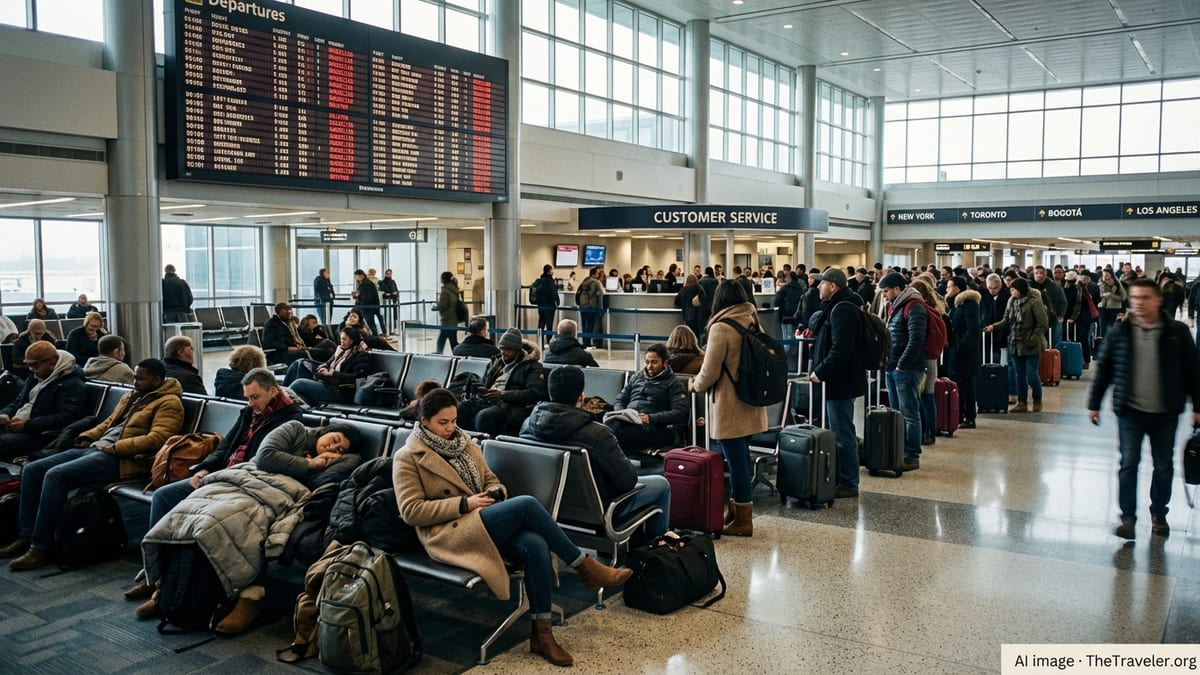
Industry observers also highlighted the stress placed on airport infrastructure during large-scale irregular operations. Long lines formed at customer service counters as staff attempted to rebook passengers on limited remaining seats, while baggage handling systems worked through growing backlogs of checked luggage that missed their original flights. In some hubs, employees directed passengers to self-service tools and mobile apps in an effort to spread the load away from physical counters.
Travel advisers suggest that during widespread disruptions such as today’s, passengers with flexible travel plans can sometimes avoid the worst bottlenecks by accepting alternative routings through less affected hubs, even if those options involve longer overall journey times. Others may find it more practical to delay travel by a day rather than risk extended overnight delays in already crowded terminals.
Summer Travel Outlook Raises Concerns
Today’s broad disruption has raised new questions about the resilience of the U.S. air travel system as the busy summer season approaches. Recent analyses of federal on-time performance data show that large hubs like Atlanta, Newark, New York airports, Detroit and Philadelphia consistently rank among the most delay-prone when weather and traffic volumes peak, reflecting both infrastructure constraints and the density of connecting traffic funneled through a limited number of runways.
Industry reports note that while airlines and the Federal Aviation Administration have invested in new technology and procedures to improve efficiency, capacity growth at major airports has not kept pace with demand. As a result, relatively minor disturbances can still trigger outsized impacts, especially on days with heavy schedules and during late-afternoon and evening peaks when traffic is most concentrated.
Travel analysts expect that airlines will continue to fine-tune schedules, trim marginal flights and adjust connection times to improve reliability heading into June and July. However, many caution that days like today are likely to recur whenever strong convective weather intersects with peak travel volumes at one or more key hubs.
For passengers, the pattern underscores the importance of proactive planning. Booking earlier flights in the day, allowing generous connection times at known congestion points and monitoring itineraries closely through airline apps or flight-tracking services are among the steps commonly recommended by consumer advocates to reduce the risk of being caught in widespread disruptions like those seen across the country today.