


More news on this day
Air travelers across the United States are facing another turbulent day as nearly 3,000 delays and more than 300 cancellations ripple through major hubs including Atlanta, Philadelphia, Newark, New York, Detroit, Salt Lake City and Cleveland, disrupting schedules on Delta Air Lines, United Airlines and regional operators such as Endeavor Air and Republic Airways.
Get the latest news straight to your inbox!
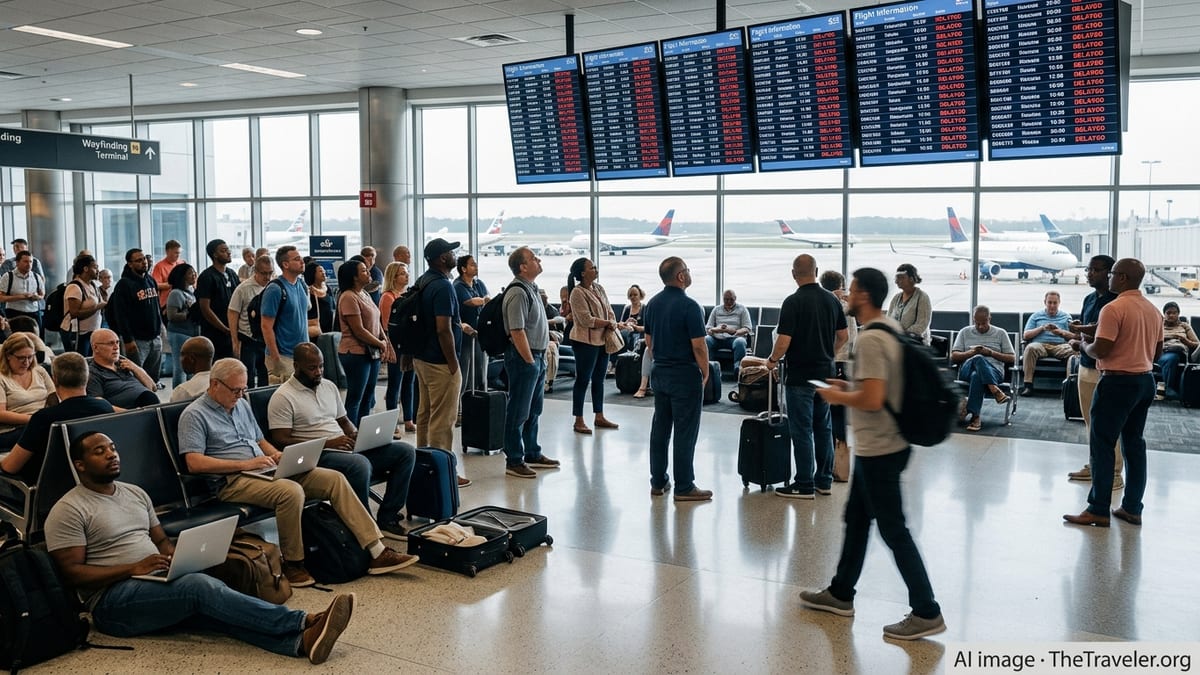
Thunderstorms And Congestion Hit Atlanta and East Coast Hubs
Disruption today is concentrated around some of the nation’s busiest connecting hubs, with weather and airspace congestion combining to snarl operations. Publicly available airport and airline advisories show thunderstorms moving through the Atlanta area, triggering a weather waiver and slower traffic flows in and out of Hartsfield Jackson Atlanta International Airport, the primary hub for Delta Air Lines.
The impact is not limited to the Southeast. East Coast airports at Philadelphia, Newark and the New York area are reporting elevated delay levels as storms pass through key flight corridors. Data from online tracking dashboards and airport status pages indicate arrival and departure slowdowns, with holding patterns and ground delays adding to knock-on congestion across the national network.
Even modest schedule adjustments at high-volume hubs can cascade throughout the day. When departure rates are cut to maintain safety margins during storms, flights queue on the ground and in the air, forcing airlines to trim frequencies and hold aircraft out of position for their next rotations.
As a result, passengers connecting through these major hubs are experiencing extended layovers, missed onward flights and rebookings onto already crowded services, contributing to the tally of 2,982 delays and 335 cancellations recorded across the U.S. system.
Delta, Endeavor And United Bear The Brunt
Published tracking feeds for the U.S. airline system show that Delta Air Lines and its regional affiliate Endeavor Air are among the most affected carriers today. The bulk of the disruptions appear tied to Delta’s hub operations in Atlanta and New York, where weather-related traffic management programs are combining with what recent coverage has described as ongoing staffing challenges on the carrier’s pilot and operations side.
United Airlines is also seeing elevated disruption on its East Coast routes, especially through Newark Liberty International Airport. Recent travel waivers around thunderstorms on the Eastern Seaboard have highlighted Newark, New York LaGuardia and Philadelphia as particular pinch points, and this is reflected in today’s systemwide figures on delays and cancellations.
Regional operators such as Republic Airways and Endeavor Air, which fly under the banners of larger network carriers, are especially exposed when hubs clog. Their schedules rely on tight turnaround times and high aircraft utilization, meaning that a short ground stop or flow-control program at a hub can quickly create waves of late departures and forced cancellations on shorter spokes.
Industry data and earlier analyses of similar disruption days show that these cascades can develop even when weather appears localized. An aircraft that starts the morning with a minor delay leaving a congested hub can remain out of sync for several legs, extending the disruption into the evening across distant cities.
Secondary Hubs And Connectors Feel The Ripple Effect
While headline numbers focus on large coastal hubs, secondary airports across the interior of the country are also feeling the strain. Information from real-time airport delay trackers shows Salt Lake City experiencing longer-than-normal departure holds at various points this month, with average wait times climbing when national airspace programs are in place.
Detroit and Cleveland, both important nodes for connecting traffic in the Upper Midwest and Great Lakes region, also feature in today’s disruption picture. Historical analyses of delay patterns have consistently highlighted these airports as sensitive to upstream issues at larger East Coast hubs; when routes to and from New York and Newark slow down, aircraft and crew rotations into Detroit and Cleveland tend to bunch up later in the day.
This dynamic means travelers departing from quieter regional airports can find themselves affected even when local skies are clear. Flights arriving late from an earlier congested hub may leave less time for refueling, catering, cleaning and crew rest, reducing the buffer that airlines rely on to keep itineraries on schedule.
Online flight boards at affected airports show a patchwork of status updates, with some carriers maintaining near-normal operations while others post clusters of late or canceled departures based on how heavily their fleets are tied to the most disrupted hubs.
Why 2,982 Delays Turn Into 335 Cancellations
The relationship between delays and cancellations is central to today’s travel woes. Aviation performance data and past Department of Transportation reporting show that once delays grow beyond a certain point, airlines often conclude that it is more efficient and predictable to cancel a flight entirely than to operate it many hours late.
In practice, this means initial weather or airspace issues frequently manifest first as delayed departures. As aircraft and crews fall further behind schedule, operational planners evaluate whether the aircraft is needed more urgently on a later leg or at a particular hub. When that happens, the earlier flight may be scrubbed so the aircraft can be repositioned.
For Delta, United, Endeavor and Republic, this tradeoff is happening against a backdrop of already tight staffing and high seasonal demand. Recent analyses of Delta’s operation have pointed to pilot staffing imbalances and training backlogs that reduce the airline’s flexibility to swap crews at short notice, a factor that can push marginal flights toward cancellation when weather closes in.
Regional carriers face similar constraints but with fewer spare aircraft and limited crews qualified on specific routes and aircraft types. A single out-of-position jet can therefore trigger multiple schedule adjustments, adding to the cumulative total of 335 flights canceled across the U.S. system today.
What Passengers Can Expect Next
With delays and cancellations clustered at major connecting hubs, recovery typically depends on how quickly weather systems move out of critical airspace and how efficiently airlines can reset their fleets. When thunderstorms ease and the Federal Aviation Administration lifts or relaxes flow restrictions, departure rates can increase and some of today’s late-running flights may still operate, though often hours behind schedule.
However, airline operations teams must also account for crew duty limits, overnight maintenance requirements and the need to stage aircraft for the next morning’s departures. That calculus means some of the flights already canceled today are unlikely to be reinstated, and overnight schedules could be reworked to restore normal patterns by tomorrow.
For travelers, publicly available guidance from airlines and airports consistently emphasizes the importance of monitoring flight status and using self-service tools or mobile apps to rebook quickly when schedules change. Same-day alternatives may be scarce on heavily affected routes, particularly from smaller regional airports into hubs such as Atlanta, Newark and New York.
Given the scale of today’s 2,982 delays and 335 cancellations, residual disruption may linger into subsequent days on the most affected carriers. Passengers with time-sensitive connections or onward international travel are likely to face the greatest risk of extended itineraries as Delta, United and their regional partners work to rebalance aircraft and crew across the network.