


You have landed hours late, your connection has vanished, and the airline is offering a voucher and an apology. What you may actually be entitled to, under EU and UK passenger law, is up to several hundred euros in cash compensation. Flightright, one of Europe’s leading air passenger rights platforms, exists to fight that battle for you. This guide walks you step by step through using Flightright, from checking if your case qualifies to getting money in your bank account, with real examples of what to expect at every stage.
Get the latest updates straight to your inbox!
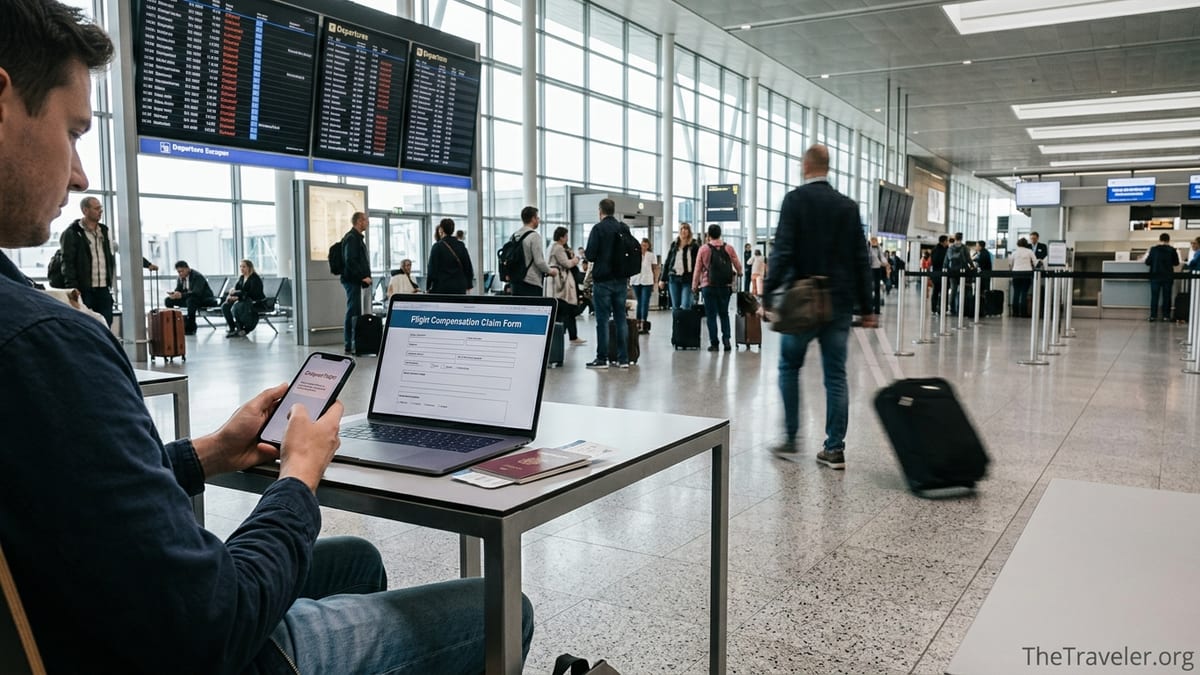
What Flightright Is and When It Makes Sense To Use It
Flightright is a Berlin based legal tech company that specializes in enforcing air passenger rights under EU Regulation 261/2004 (EU261) and the post-Brexit UK261 rules. Operating since 2010, the company focuses on delays, cancellations and denied boarding on flights connected to the European Union, the UK, and certain partner countries. In practice, that means it helps travelers claim fixed-sum compensation that can range from roughly 250 to 600 euros per person, depending on distance and delay length, when airlines do not pay voluntarily.
The platform follows a success based model. You do not pay anything up front. Instead, Flightright keeps a success fee from the compensation it wins and sends you the balance. On its European sites, the company indicates that this fee is typically between 20 and 30 percent of the compensation plus VAT. Independent fee comparisons suggest that, once tax and possible legal surcharges are included, the effective cut can reach roughly one third of the payout in difficult cases that go to court. In straightforward cases resolved without litigation, the final fee is usually toward the lower end of that range.
Flightright is most useful in two situations. First, when an airline has flatly refused a claim you believe is valid, such as turning down a 600 euro EU261 claim for a long haul delay out of Paris with arguments you find unclear or technical. Second, when you simply do not have the time, language skills, or energy to argue through multiple complaint rounds, regulator escalation, and possibly court filings. If you are comfortable writing formal emails, attaching boarding passes, and pushing an airline yourself, you can always try a direct claim first and use Flightright only if the carrier resists.
Before you start, it is important to understand one limitation: Flightright cannot change the underlying law. If EU261 or UK261 do not apply to your particular trip, or if the delay was due to extraordinary circumstances such as air traffic control closures or severe storms, no platform can create a right to compensation that does not exist. What Flightright does is maximize your chances of actually receiving money when those rights do exist.
Step 1: Check If Your Flight Qualifies
The first active step is to check eligibility. Flightright provides an online form where you enter your departure and arrival airports, dates, flight number, and how long you arrived late or whether your flight was canceled or overbooked. Behind the scenes, the company runs these details through its legal rules engine, taking into account court decisions and practical experience accumulated since 2010.
As a rule of thumb, EU261 or UK261 coverage is strongest in a few scenarios. Any flight that departs from an EU or UK airport is generally covered, regardless of the airline, so a New York bound Delta flight leaving from Rome is treated the same as an ITA Airways flight on the same route. Flights that arrive in the EU or UK on an EU or UK based carrier, such as a Montreal to London flight on British Airways or a Dubai to Frankfurt flight on Lufthansa, can also be covered. Typical compensation kicks in when you arrive at your final destination three hours or more after the scheduled time, the cancellation or delay is the airline’s responsibility, and the distance band matches one of the set brackets used in the regulations.
Real world examples illustrate this better. Imagine a traveler flying Barcelona to Berlin on a low cost European airline. The aircraft develops a technical fault that is not caused by a bird strike or external hazard, and the replacement plane only departs six hours later. Under EU261, that passenger will often be entitled to compensation, plus meals while waiting. By contrast, if the same route is heavily delayed because of an airport closure due to snow or a nationwide air traffic control strike, regulators and courts generally classify that as an extraordinary circumstance. In that case, the airline must still care for passengers but may not owe compensation, and Flightright is unlikely to accept the claim.
When you run your details through Flightright’s checker, you will typically receive an instant on screen answer saying either that you have a good chance of compensation and how much it could be, or that the case is not promising under current rules. This early filter is important. It means the company only takes on cases where its lawyers and algorithms see a realistic path to recovery, which saves you time and prevents false expectations.
Step 2: Gather Documents and Evidence
Once you see that your flight appears eligible and you decide to proceed, you will be asked to supply supporting documents. At minimum, Flightright usually needs your booking confirmation or e ticket receipt, which shows your name, flight number, dates, and booking reference. It may also ask for boarding passes, photos of airport information screens, or written communications from the airline, especially if you received an email confirming that a flight was canceled for “operational reasons” or “technical issues.”
For example, a family of four returning from a summer holiday in Crete to Manchester might upload a single PDF that contains their package holiday booking invoice, along with four digital boarding passes issued in their airline app. If their easyJet flight was canceled the day before departure and rebooked two days later, a screenshot of the rebooking message can be extremely helpful. Flightright can use that wording when addressing the airline and, if needed, in court filings to show what was communicated and when.
Some travelers worry that they have thrown away paper boarding passes or that their mobile passes expired in their airline app. In practice, this is often not fatal. As long as you know your flight number, rough departure time and date, and the names used in the booking, Flightright can frequently retrieve the key data from reservation systems and published schedules. However, having at least one original document like a confirmation email speeds up verification and makes it harder for an airline to dispute your presence on the flight.
If you incurred expenses during a long delay or overnight stay, such as paying 140 euros for an airport hotel at Frankfurt or 35 euros for meals at a restaurant while waiting in Lisbon, it is worth keeping those receipts. While Flightright’s main focus is on the fixed EU261 or UK261 compensation, airlines are separately required to reimburse reasonable care costs in many cases. In practice, Flightright can often fold these receipts into the negotiation, especially when an overnight delay was clearly the carrier’s responsibility.
Step 3: Assign Your Claim and Understand the Fees
An important legal step in the Flightright process is the assignment of your claim. Rather than merely acting as a messenger, Flightright typically asks you to sign a digital document transferring your right to claim compensation to the company. In legal terms, you assign your claim so that Flightright can pursue it in its own name against the airline, including going to court if necessary. This reduces your personal involvement while giving the platform more flexibility in negotiating and litigating.
Alongside this assignment, you must review and accept the fee structure. On its European language sites, Flightright explains that it charges a success fee that usually ranges from about 20 to 30 percent of the compensation amount, plus applicable VAT. If the airline resists and a lawsuit is required, an additional percentage can be added to reflect court and lawyer costs, though again this is only deducted from money actually recovered.
To make this concrete, consider a long haul cancellation from Madrid to Buenos Aires, where compensation per person under EU261 rules is often set at 600 euros. For a couple, that could mean a total claim of 1,200 euros. If Flightright wins the full amount and applies a 25 percent fee plus VAT, your final payout might be somewhere in the region of 800 to 850 euros after costs. If court proceedings become necessary and the effective fee rises, the final amount could be somewhat lower, perhaps closer to 750 euros. The exact figures will be spelled out in the agreement you see before signing, and you have the option not to proceed if the economics do not make sense for you.
Travelers should compare this against their own appetite for a do it yourself claim. Filing directly with an airline is free, and if the carrier quickly pays the full statutory compensation, you keep 100 percent. However, as many passengers have learned on routes such as London to Rome or Berlin to Athens, airlines often delay, ignore, or reject claims with standard language, hoping people give up. Flightright’s value lies in using knowledge of precedents and persistent follow ups to turn those otherwise failed claims into money, even after a year or more has passed since the disruption.
Step 4: How Flightright Pursues Your Claim
After you sign the assignment and upload documents, Flightright begins its enforcement process. The first step is usually a formal demand letter or digital notice sent to the airline with a detailed legal argument and a clear deadline for response. In many straightforward cases, such as a five hour technical delay on a Paris to Stockholm flight with a European carrier, this letter is enough to prompt payment within a matter of weeks. Airlines increasingly recognize Flightright and similar portals as serious counterparties and often treat these demands differently from one off customer complaints.
If the airline either ignores the demand or responds with a rejection that Flightright’s legal team considers weak, the company can escalate. This may involve contacting consumer protection authorities in the country of departure, coordinating with partner law firms, or filing a formal lawsuit in the competent court. In Germany, for example, Flightright has a history of taking carriers to court over disputed compensation and, in some instances, pursuing enforcement measures against airline assets when judgments are not paid promptly. That willingness to escalate can be a key reason airlines take their letters seriously.
Timeframes depend heavily on the airline and the complexity of the case. Travelers who shared their experiences publicly report successful Flightright claims that resulted in payment within two to three months for straightforward delays on familiar European routes. More complex claims, particularly those involving cross border issues or carriers with a history of slow payment, can take six months or longer. In rare instances where the matter goes all the way through appeal stages, it is not unusual for the process to stretch beyond a year. Throughout this time, Flightright typically keeps you updated by email when significant milestones occur, such as filing in court or receiving a payment.
One hidden advantage is that, once you have assigned the claim, you do not need to negotiate directly with the airline. Travelers who spent hours on the phone with a customer service line or writing long emails explaining a missed connection from Lisbon to Boston often describe a sense of relief when Flightright takes over. Instead of trying to decipher legal arguments about “extraordinary circumstances,” you receive occasional progress updates and, hopefully, a final payment notification.
Real World Scenarios: What Travelers Actually Receive
To understand what using Flightright looks like in practice, it helps to walk through a few typical claim scenarios. Consider a solo traveler on a three hour and thirty minute delay from Amsterdam to Barcelona due to a technical fault on the aircraft. Under EU261 tables, this kind of medium haul delay commonly triggers a compensation figure in the 400 euro range. If the airline initially refuses or does not respond and Flightright takes the case, a successful outcome might see the traveler receive roughly 260 to 300 euros in their bank account after the company’s fee, depending on the exact percentage and tax treatment.
In a second scenario, a family of four returning from a winter break in the Canary Islands finds their flight to Munich canceled because the airline has a crew shortage. They are rebooked the next day, pay 180 euros for an airport hotel, and arrive more than ten hours late. Here, the fixed compensation under EU261 for a longer distance flight might total 2,400 euros for the four passengers, plus reimbursement of reasonable hotel and meal costs. If the airline refuses or drags its feet, Flightright could bundle the entire claim, negotiate on the family’s behalf, and deduct its success fee from the compensation before forwarding the rest. Even after fees, a payment in the region of 1,600 to 1,700 euros to the family could be realistic, illustrating how substantial these rights can be.
On the other hand, there are examples where travelers become frustrated because their case does not qualify. A passenger on a New York to London flight that arrived four hours late may assume EU rules apply automatically. In fact, because the flight departed from outside Europe and the airline is non European, EU261 and UK261 may not provide compensation at all in that scenario. Flightright’s online check would likely explain that limitation up front and decline the case. Understanding these boundaries avoids disappointment and shows that the platform’s strength is not in changing the law but in enforcing it when it does apply.
Another nuance is so called extraordinary circumstances. If a volcanic eruption grounds flights across Europe or a national air traffic control outage forces last minute cancellations, airlines will often invoke these defenses to deny compensation. Flightright reviews such claims against legal standards and case law, and it only proceeds if it believes the airline is stretching the definition. For travelers, this means some dramatic disruptions that feel unfair may still fall outside the compensation framework, even with professional help.
The Takeaway
For many travelers, the idea of pursuing hundreds or even thousands of euros in flight compensation feels daunting. Air passenger rights law is technical, airlines are slow to respond, and the process can span multiple countries and languages. Flightright was created to bridge that gap, using software and a network of lawyers to turn individual frustrations into enforceable legal claims. Its business model, based on keeping a share of successful payouts, makes it a low risk option for passengers who would otherwise give up.
Using Flightright is not the only way to claim EU261 or UK261 compensation. Confident travelers with time and patience can write to airlines directly, cite the regulations, and, in clear cases, achieve full payouts without sharing a percentage. Yet the reality is that many valid claims go unpaid because people do not know where to start or how to respond when a carrier rejects them. In that context, a platform that has spent more than a decade refining arguments, building precedent, and convincing reluctant airlines can be a powerful ally.
If you decide to try Flightright, think of it as hiring a specialist on a no win no fee basis. You provide honest information and documents, read the fee terms carefully, and then allow the company to do what it was set up to do: negotiate hard, file cases where needed, and, ideally, transfer a meaningful sum into your account months after an experience you might otherwise just have complained about to friends. For many travelers, that transformation from frustration to compensation is well worth the share of the winnings.
FAQ
Q1. Does Flightright cost anything if my claim fails?
Flightright operates on a success based model, so you typically pay nothing if the claim is unsuccessful. Its fee is charged only as a percentage of compensation actually recovered from the airline.
Q2. How much of my compensation will Flightright keep?
On its European sites, Flightright explains that its standard success fee is usually between about 20 and 30 percent of the compensation amount, plus VAT. In cases that require court action, an additional percentage can apply, so the final effective share can be higher in complex disputes.
Q3. How long does a Flightright claim usually take?
Timeframes vary by airline and case complexity. Straightforward cases where airlines cooperate can resolve in a few weeks to a few months. Disputed claims that go to court can take six months or more, and in rare situations more than a year.
Q4. Can I use Flightright for flights outside Europe or the UK?
Flightright focuses on enforcing rights under EU261 and UK261, which generally cover flights departing from the EU or UK and flights arriving there on EU or UK carriers. For purely domestic flights in other regions, such as entirely within the United States, Flightright will usually not be able to help.
Q5. Do I still qualify if I accepted a voucher from the airline?
Accepting vouchers or miles can sometimes complicate matters. In some cases, airlines state that accepting a voucher settles the claim in full. Flightright’s eligibility check and terms will guide you, but as a rule it is safer to avoid signing settlement language if you plan to pursue monetary compensation.
Q6. What if I no longer have my boarding pass?
Missing boarding passes are not necessarily a problem. Flightright can often use booking confirmations, names, dates, and flight numbers to reconstruct the key details. Providing at least one original document such as an e ticket receipt or confirmation email will usually be enough.
Q7. Can I first try to claim directly from the airline and then turn to Flightright?
Yes. Many travelers first submit a complaint directly to the airline. If the airline rejects the claim, does not respond, or offers less than the statutory compensation, you can then ask Flightright to review the case. Prior correspondence can even strengthen the file.
Q8. Will using Flightright affect my relationship with the airline or loyalty program?
In general, using a legal tech platform to enforce rights should not affect your frequent flyer status or ability to book future flights. Airlines may view such claims as part of doing business under passenger protection laws, and there is no widespread evidence of retaliation in loyalty programs.
Q9. Can Flightright help with hotel and meal reimbursements as well as compensation?
Flightright’s main focus is the fixed sum compensation under EU261 and UK261. However, if you incurred reasonable costs for hotels, meals, or transportation during a disruption, you can upload receipts. In many cases, these can be included in the negotiations with the airline alongside the compensation claim.
Q10. Is Flightright the only option for getting help with flight compensation?
No. Several other legal tech platforms and traditional law firms also assist with flight compensation, and you can always pursue a claim yourself. Flightright’s appeal lies in its long track record in Europe, its no win no fee setup, and its willingness to take difficult cases to court when it believes the law is on the passenger’s side.