


More news on this day
Flights at Cork Airport were cancelled on 8 September as a technical fault in the United Kingdom’s air traffic control system triggered a fresh wave of disruption across Europe’s already stretched aviation network.
Get the latest news straight to your inbox!
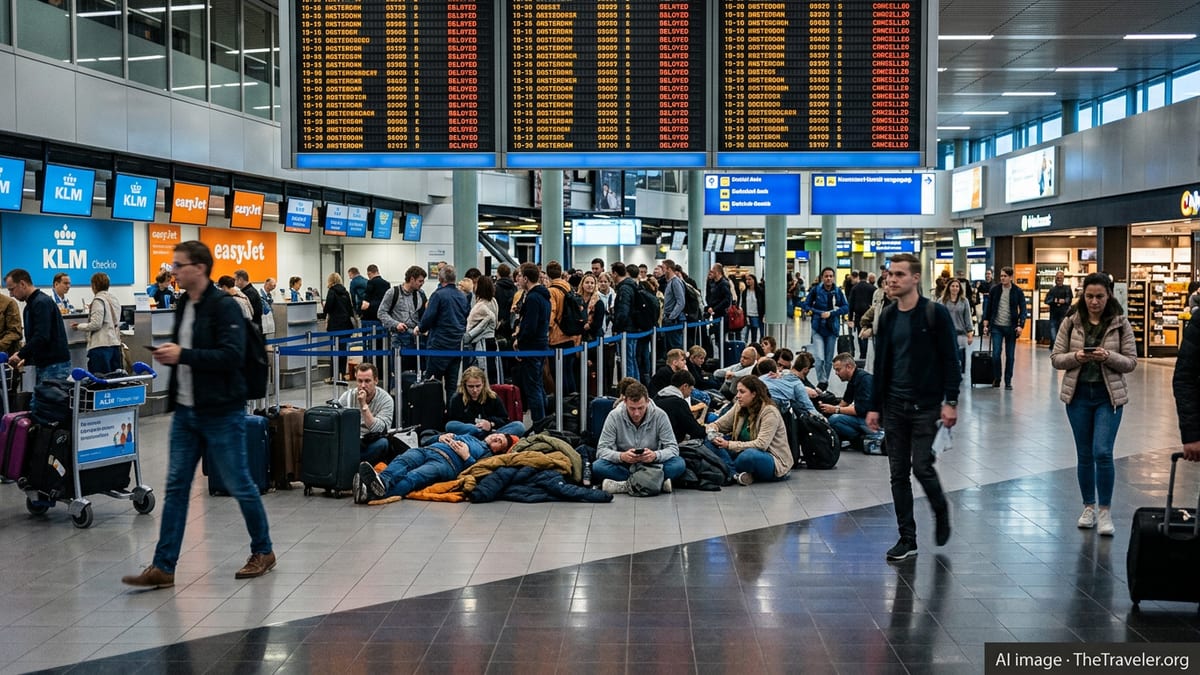
Cork Departures Hit as UK Systems Fault Spreads
Live departure boards on 8 September showed at least one Cork service to Birmingham cancelled, alongside delays on other UK-bound routes, as the impact of a technical issue in Britain’s air traffic control infrastructure rippled into Ireland’s second-busiest airport.
Publicly available data from flight-tracking and airport information platforms indicated that services linking Cork with UK cities, particularly London and regional English airports, were the first to be affected. The cancellations followed a systems problem reported in the UK that disrupted departures at multiple airports and forced carriers to adjust evening schedules.
Travel industry reports describe Cork as heavily reliant on a compact set of daily connections to the UK, meaning that the loss of even a single rotation can displace a significant share of passengers. With many services operating close to capacity in early September, rebooking options for disrupted travelers quickly became limited.
Regional coverage focusing on Munster also highlighted that Cork’s role as a gateway for both business and leisure traffic to Britain left it particularly exposed to knock-on effects from any UK-based operational fault.
Dublin and Other Irish Airports Also Affected
The disruption at Cork unfolded alongside wider issues across Irish aviation, with published coverage noting that flights into both Cork and Dublin were impacted by the UK air traffic control problem. Several services from British airports into Ireland were either cancelled or delayed, extending journey times and leaving some passengers waiting for replacement arrangements.
Reports from national outlets stated that more than 200 flights departing UK airports were cancelled during the afternoon of 8 September, with a portion of those services due to operate into Irish airports. Delays to arriving flights further compressed turnaround times and contributed to late-evening schedule changes on outbound legs from Ireland.
Airlines serving Cork and Dublin published customer updates acknowledging that a technical issue in the UK system was affecting some services across the UK and Europe. These updates directed travelers to online flight-status tools and advised passengers to monitor their bookings closely as timetables were adjusted through the day.
While Ireland’s own airspace and airport infrastructure remained operational, the close integration of schedules with British hubs meant that Irish airports were drawn into a disruption pattern originating outside their own control.
Disruption Across Europe Adds to a Difficult Summer
The events of 8 September came at the end of a summer marked by repeated operational strains in European air travel. Industry briefings from the region’s network manager show that average air traffic flow management delays per flight in early September were significantly higher than the previous week, with arrival punctuality falling below 70 percent across the continent.
In recent months, travel rights organisations and aviation data platforms have documented large spikes in same-day delays and cancellations at major hubs including London, Madrid, Amsterdam, and Rome. One late-June snapshot cited more than 1,600 flights either delayed or cancelled in a single day, underlining how quickly localised issues can cascade into system-wide congestion.
Travel analysis published earlier in September described more than 2,100 delayed flights and over 100 cancellations recorded across a sample of 12 major European airports on 3 September, affecting tens of thousands of passengers. The latest UK air traffic control problem has now added another layer of disruption, with effects felt from Ireland to Cyprus and the Netherlands as airlines reworked schedules.
For passengers at Cork, the wider European backdrop meant that spare aircraft and crews were already tightly allocated, reducing flexibility to absorb fresh disruption triggered by the UK technical fault.
Knock-on Effects Likely to Continue Beyond Initial Fault
Aviation commentators note that even once a specific technical issue is identified and resolved, recovery can take many hours, and in some cases several days, as aircraft and staff are repositioned and out-of-sequence rotations are restored. Publicly available briefings on the 8 September incident indicated that UK airports faced hundreds of cancellations and delays, creating a significant backlog.
Reports from other European countries suggested that services linking the United Kingdom with the Netherlands and Cyprus also saw dozens of cancellations and delays, highlighting how interconnected the region’s networks have become. Similar patterns are expected to play out on routes to and from Irish airports, including Cork, as carriers work through rescheduling and crew-rest requirements.
Travel-advice sites and passenger-rights organisations are encouraging affected travelers to retain documentation of cancellations and long delays, as some passengers may be entitled to care, assistance, or compensation depending on the cause of the disruption and the applicable regulations. Given the cross-border nature of the incident, rules under EU and UK frameworks may both be relevant for journeys touching Cork.
With autumn schedules due to start in the coming weeks, airlines and airports across Europe face renewed scrutiny of contingency planning, particularly in relation to air traffic control resilience and the capacity of the network to manage sudden technical shocks without cascading disruption.
What Travelers Using Cork Airport Should Do Now
For those due to fly from Cork during the aftermath of the 8 September disruption, publicly available guidance from airlines and airports stresses the importance of checking flight status online before departing for the terminal. Same-day changes, equipment swaps, or re-timings remain possible as carriers attempt to realign aircraft and crews.
Passengers whose flights are cancelled are generally being directed to manage their bookings digitally where possible, selecting alternative dates or routes if seats are available. Some carriers are also allowing limited free changes for travelers willing to move journeys away from peak recovery periods.
Travel analysts say that flexibility remains a key advantage during such disruption, with passengers who can accept routing via alternative hubs or adjusting their travel dates often rebooked more quickly. However, those with fixed plans or onward connections may continue to experience spillover delays until operational patterns at Cork and across the wider European network stabilise.
As the situation evolves, data from airport boards and independent tracking platforms is expected to provide the clearest picture of how quickly Cork’s schedule returns to normal and whether further cancellations linked to the UK systems fault emerge in the days ahead.
Cork and Dublin airports impacted by major UK flight disruption
Aer Lingus latest travel updates
UK air traffic control fault triggers delays at Cork and Dublin