


More news on this day
Long-haul air travel across the Middle East and surrounding corridors is continuing with relatively limited disruption, even after Iran launched fresh missile and drone attacks on Gulf states and again claimed to close the Strait of Hormuz in recent days.
Get the latest news straight to your inbox!
Airlines Weigh Risk as Routes Stay Open
Published coverage in recent days indicates that most major carriers serving the Gulf, including large European and Asian airlines, have maintained the bulk of their long haul schedules into hubs such as Dubai, Doha and Abu Dhabi. While some flights were briefly suspended or rerouted during peaks in the latest strikes, schedules have largely been restored with adjustments to routings and timings rather than wholesale cancellations.
Factbox-style reporting from financial and aviation outlets suggests that airlines are applying dynamic risk assessments, using real time military and airspace data to decide which services can continue and which require diversions or temporary pauses. The pattern echoes earlier phases of the 2026 Iran conflict, when operators sharply cut frequencies for several days before gradually rebuilding capacity as security conditions became clearer.
According to recent analyses of the 2026 Iran war and its impact on aviation, carriers have also become more adept at flying around higher risk zones while keeping total journey times within commercially acceptable limits. Fuel costs remain elevated compared with prewar levels, but the latest Iranian barrages have not yet triggered the kind of widespread, days long shutdowns that followed the first waves of attacks earlier in the year.
Industry observers note that, for now, demand on many trunk routes linking Europe, Asia and Africa remains strong enough that airlines are incentivized to preserve connectivity wherever safety assessments allow it. That push to keep planes in the air is helping to shield travelers from the full impact of the renewed hostilities, even as tensions in the Gulf again dominate headlines.
Gulf Hubs Balance Resilience and Precaution
The weekend attacks, which regional and international media describe as involving multiple waves of Iranian missiles and drones targeting states including Qatar, the United Arab Emirates, Bahrain, Kuwait, Jordan and Oman, have tested the resilience of the Gulf's major aviation hubs. These airports sit at the heart of global traffic flows and were heavily affected when the conflict escalated in late February.
Background reporting on the economic impact of the 2026 Iran war notes that Bahrain, Iraq, Kuwait, Qatar, Syria and the UAE previously closed their airspace entirely for periods, leading to thousands of cancellations and diversions at Dubai, Abu Dhabi and Kuwait. In the latest round of strikes, however, authorities and airport operators appear to have relied more on temporary pauses, sheltering procedures and selective restrictions rather than broad shutdowns.
Local media and international wire services describe brief disruptions on Sunday and Monday as air raid sirens sounded and civil defense protocols were activated in several Gulf states. Yet flight tracking data referenced in news coverage shows that traffic into and out of key hubs resumed relatively quickly once immediate threats had passed, with aircraft again streaming along established corridors skirting the most sensitive airspace.
Risk bulletins from regional and European aviation safety bodies issued earlier in the conflict anticipated precisely this kind of pattern, warning that missile and drone activity would continue to affect low and medium altitudes even as airlines sought to maintain higher altitude overflights where feasible. The latest events suggest that model is now playing out, with Gulf hubs operating but in a more constrained, carefully managed way.
Rerouting Around Hormuz Keeps Global Flows Moving
Iran's repeated declarations that the Strait of Hormuz is closed again raised immediate questions about the safety of nearby airspace, given that some of the heaviest U.S. strikes have targeted Iranian coastal defenses along the waterway and that Tehran has warned of further incidents involving commercial shipping. However, aviation analysts point out that the primary impact so far has been on fuel costs and scheduling, not on the continuity of most passenger flights.
Studies on the conflict's aviation impact published earlier this year noted that airlines have already redesigned many of their standard routings to avoid the highest risk sections of Iranian and adjacent airspace. The latest attacks prompted additional tactical diversions, but did not fundamentally alter these broader, conflict era patterns. Long haul services between Europe and Asia that once passed directly over Iran now more commonly skirt via alternative corridors over Turkey, the Caucasus or the eastern Mediterranean.
Industry outlook reports also highlight that, since early 2026, carriers have baked longer flight times into their schedules to account for circuitous routings around the Gulf and the Strait of Hormuz. That flexibility appears to be paying off during the present flare up. Passengers on some routes are facing modest delays and in flight holds as traffic is sequenced through constrained corridors, yet the overall volume of flights has not collapsed.
For cargo and logistics operators, the situation is more acute, with shipping restrictions through Hormuz adding to the cost pressures created by lengthened air routes. Even there, however, publicly available data on flight movements shows dedicated freighters continuing to serve Gulf and South Asian destinations, often via indirect routings that bypass the most contested skies.
Travelers Face Uncertainty but Avoid Mass Stranding
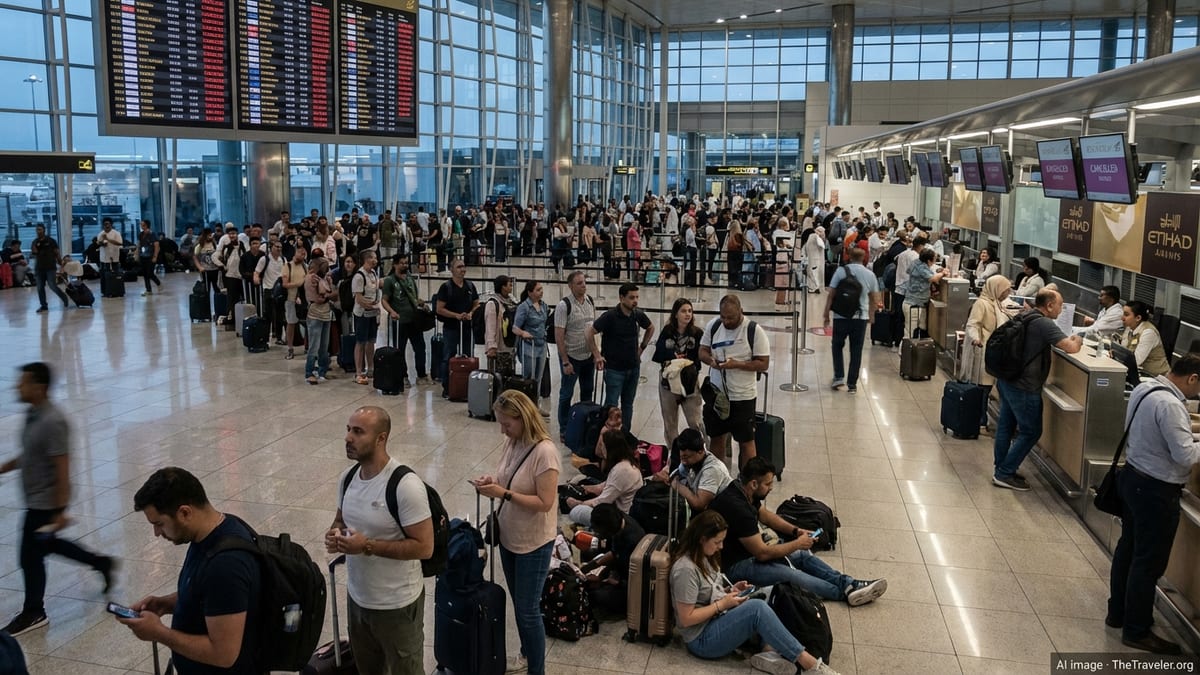
From a traveler perspective, the latest Iranian strikes have introduced a familiar degree of uncertainty without producing the mass strandings seen during the first weeks of the war. Aviation news coverage and passenger forums report isolated clusters of cancellations, particularly on routes serving secondary Gulf airports or destinations closer to known missile trajectories, but not the wholesale groundings that marked earlier phases of the conflict.
Many airlines had already built more flexible rebooking policies and remote operations procedures into their crisis playbooks after the severe disruptions of late winter and early spring. Those measures appear to be helping carriers re accommodate affected passengers more quickly during this latest escalation, reducing the number of travelers stuck for days in transit hubs while waiting for airspace to reopen.
Travel advisories published by foreign ministries and aviation regulators still urge caution for trips into conflict adjacent areas, emphasizing the possibility of short notice schedule changes and security checks. Yet governments have not, in most cases, moved to impose blanket bans on travel to major Gulf transit points. That posture aligns with the relatively modest disruption recorded on global flight tracking services since the new wave of Iranian attacks began.
For now, the main inconvenience for many passengers is logistical rather than existential: longer flight times, occasional diversions to alternative hubs and a greater risk of missed connections on tightly timed itineraries. Industry watchers caution that this could change rapidly if the conflict widens or if critical airport infrastructure suffers more serious damage, but current conditions point to a system under strain rather than in breakdown.
Outlook: Fragile Stability in a Volatile Region
Aviation risk consultancies and economic analysts tracking the 2026 Iran war consistently describe the current environment as one of fragile stability for international travel. The latest barrages against Gulf states and renewed U.S. airstrikes have underscored the volatility of the security situation, yet have not so far produced a fresh wave of regional airspace closures on the scale seen earlier this year.
Reports examining the broader economic impact of the conflict argue that governments and airlines alike are increasingly conscious of the costs of prolonged aviation shutdowns, particularly given the region's outsized role in connecting Europe, Asia, Africa and Australasia. That awareness appears to be driving a preference for calibrated, time limited restrictions that respond to specific attack windows rather than preemptive, indefinite bans on civil aviation.
Travel demand patterns may nonetheless shift if the conflict drags on. Higher fares linked to longer routings and elevated fuel prices, combined with simmering security concerns, could push some leisure travelers to opt for itineraries that avoid the Gulf altogether. At the same time, the resilience shown by major carriers and hubs in recent days reinforces their central role in global connectivity, even under the shadow of renewed Iranian attacks.
For travelers planning routes through the region in the coming weeks, the emerging lesson is to prepare for possible last minute changes, monitor airline communications closely and allow extra time for connections. Despite the serious geopolitical backdrop, the performance of the Gulf's aviation network during this latest escalation suggests that, for now, flight disruption remains manageable rather than systemic.