


Florence to Bologna is one of Italy’s easiest rail hops, yet the choice between Frecciarossa, Italo and slower Trenitalia regional trains can make a big difference to both your budget and how much of Bologna you actually see. With some advance planning, a day trip that might look expensive on first glance can become an efficient and surprisingly affordable excursion built around good food, porticoed streets and fast trains through the Apennines.
Get the latest updates straight to your inbox!
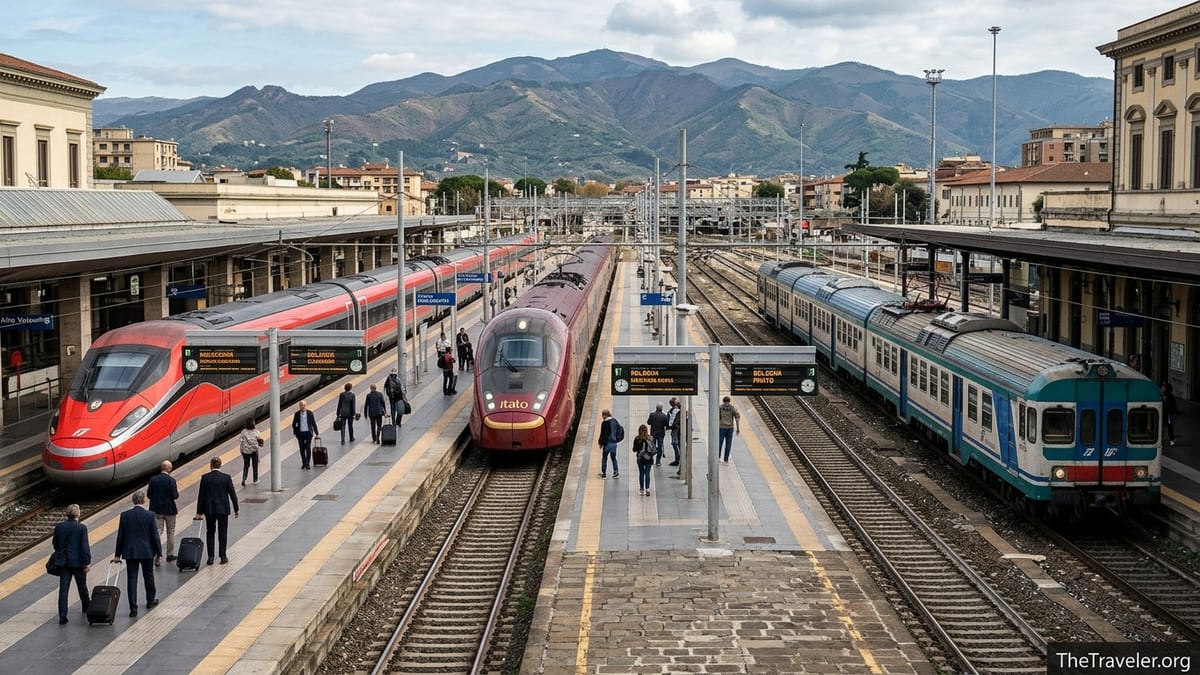
Frecciarossa, Italo or Regional: Time and Money Compared
High-speed Frecciarossa and Italo services between Firenze Santa Maria Novella and Bologna Centrale usually take about 33 to 40 minutes, running through the dedicated high-speed line under the Apennines. Typical examples in the current timetable include a Frecciarossa around 06:55 taking 33 minutes and another around 09:30 taking 37 minutes, while Italo departures around 07:25 or mid-morning show scheduled times of about 38 to 39 minutes. These trains are air conditioned, reserved-seat services with Wi-Fi and bar or snack counters, aimed at both business and leisure travelers.
Regional and intercity options on the same route are significantly slower and often less direct. A common pattern is a Trenitalia regionale or regionale veloce that requires a change at Prato Centrale or another intermediate station, resulting in total journey times of about 1 hour 10 minutes to 1 hour 45 minutes at a typical base fare of about 11 euros. There are also occasional direct intercity or EuroCity trains taking roughly 1 hour 10 to 1 hour 15 minutes, priced somewhere between regional and high-speed levels. These slower trains use the older line through the hills, with more stops and simpler on-board facilities.
The price gap between the two categories looks large if you buy at the last minute at the station. Day-of purchase examples for high-speed services between Florence and Bologna commonly sit in the 30 to 40 euro range in second class for basic economy-type fares, while the walk-up regional ticket for the same date tends to remain about 11 euros. For a solo traveler on a tight budget, that difference is enough to cover a plate of tagliatelle al ragù and a glass of wine once in Bologna.
However, both Trenitalia and Italo use dynamic pricing on their high-speed trains. If you book several weeks in advance, especially outside peak commuter hours, discounted tiers can bring one-way fares down closer to 19 to 25 euros in second class for selected departures. When those advance fares are available, the real difference versus a regional ticket narrows to roughly the cost of a coffee and a pastry, while saving more than half an hour each way.
Frequencies, Reservations and Refund Conditions
Between early morning and evening, there is usually at least two or three high-speed departures per hour on the Florence to Bologna route once you factor in both Frecciarossa and Italo, particularly in the morning peak from about 07:00 to 10:00 and in the late afternoon return window. On top of this, you will see scattered intercity and EuroCity trains that you can ride with a reserved ticket, plus regional services that require a change and run roughly once or twice per hour depending on the time of day. In practical terms, you almost never have to wait more than 30 minutes for some train heading toward Bologna.
High-speed trains require a reservation and issue tickets for a specific train and seat. The cheapest tiers on Trenitalia Frecciarossa are often semi-flexible, allowing changes for a fee up to a certain time before departure and either no refund or a partial refund if you cancel. More flexible Business or premium economy tiers cost more but give better change and refund terms. Italo uses a similar structure with names like Low Cost, Economy and Flex, where the lowest price tickets are non-refundable or charge a substantial fee to alter the booking.
Regional tickets work differently. On the Florence to Bologna corridor, a standard regionale or regionale veloce ticket bought at the official counter or machines typically has a fixed, published price and can be used within a defined time window, often on any regional train of the same route on the chosen day once validated. You do not receive a seat assignment, and the trains can be crowded in peak periods. The upside is complete flexibility on exactly which departure you take, which is useful if you prefer to keep your plans open or adjust for weather.
Because high-speed fares increase as cheaper tiers sell out, waiting until the morning of travel commonly pushes prices into the 30 to 40 euro band. In contrast, that 11 euro regional fare generally remains stable close to departure. This is why booking a Frecciarossa or Italo at least several days or weeks ahead can make them surprisingly competitive; once you factor in the extra hour or more that a slower regional journey can consume in each direction, the value of discounted high-speed fares becomes clear for almost any trip longer than a couple of hours in total.
Is High-Speed Rail Worth the Extra Cost for a Day Trip?
For a day trip from Florence, journey time is the main argument in favor of paying more for high-speed rail. Saving roughly 35 to 45 minutes each way gives you an extra hour to 90 minutes inside Bologna itself. That extra time can be the difference between a rushed loop of Piazza Maggiore and the Two Towers, and a more relaxed visit that includes a slow lunch, a look inside Santo Stefano and an espresso in the Quadrilatero before your return.
Consider a concrete example. A traveler leaves Florence on a 08:30 Frecciarossa, arriving in Bologna around 09:10, and returns on a 19:00 train arriving back in Florence around 19:40. That yields approximately nine and a half hours on the ground. If the same traveler opts for regional services with one change each way, leaving around 08:30 and 19:00, those legs might take 1 hour 20 minutes each, cutting usable time in Bologna down to roughly seven and a half hours once walking and station transfers are accounted for. Over a day, the saved time can equate to a full relaxed meal and an unhurried stroll under the porticoes.
Budget matters, but the time premium is particularly compelling for couples or families when advance high-speed fares are available. Two advance Frecciarossa tickets at 22 euros each out and 22 euros back for a couple cost around 88 euros in total, versus roughly 44 euros for two regional tickets. A family of four might pay around 176 euros on discounted high-speed fares compared with around 88 euros in regional tickets. In exchange they gain up to three more hours of sightseeing and arrive less tired after smoother, more comfortable rides, with guaranteed seats and space for bags.
Where high-speed trains are harder to justify is when you are booking very late and traveling alone on a tight budget, especially if you do not mind longer transit times or are planning an overnight stay. In that case, a regional or intercity ticket costing roughly a third of the last-minute high-speed fare makes sense, and the extra hour becomes less critical when you have more than one day to spread your activities across.
Navigating Bologna Centrale and Its Underground High-Speed Platforms
Bologna Centrale is a major junction with both surface platforms and a large underground high-speed section. The dedicated alta velocità level sits roughly 23 meters below ground and contains four high-speed tracks on deep platforms served by long escalators and elevators. To reach these underground platforms, you generally enter the main station hall, descend into the pedestrian subway, then continue to the far side of the station beyond the numbered surface platforms until you reach the high-speed hall and signage for tracks in the teens.
The vertical and horizontal distances are greater than they look on a departure board. Independent station guides and accessibility resources recommend allowing about 10 to 15 minutes to move between the street, main concourse and a high-speed platform, especially if you have luggage or are unfamiliar with the layout. Coming off a Florence train, you will spend a few minutes on escalators and walking through tunnels before emerging into the main concourse and then the exit towards the city center.
For day trippers, this means you should avoid planning very tight connections between regional and high-speed services in Bologna and allow generous buffer time returning for your evening train. If your train arrives on a high-speed platform and you plan to leave your luggage in the station deposit or grab a coffee before walking to town, add at least 15 minutes between theoretical arrival time and when you expect to be outside heading down Via dell’Indipendenza.
Accessibility is improving but still demands some planning. The station is equipped with elevators, tactile paving and assistance services for travelers with reduced mobility, yet moving from the deepest high-speed level to the street involves several changes of level even with lifts. If you use a wheelchair or have limited mobility, it is wise to request assistance in advance through the rail operator so that staff can meet you at the platform and guide the most direct step-free route.
Walking Bologna: From the Station to Santo Stefano
Once outside Bologna Centrale, the most straightforward walk into the historic center begins from Piazza delle Medaglie d’Oro in front of the station. From here you follow Via dell’Indipendenza, a broad street covered by porticoes almost throughout, heading gently downhill toward the medieval core. At a relaxed pace and without heavy bags, it usually takes around 15 to 20 minutes to reach Piazza Maggiore, assuming only brief pauses at traffic lights or for a quick coffee along the way.
Via dell’Indipendenza itself is part of the sightseeing. As you walk, you pass a mix of early twentieth-century facades, cinemas and clothing stores, all protected by Bologna’s famous arcades. Roughly halfway along, at the edge of the old center, side streets begin to open into narrower porticoed lanes leading toward the university district and the Two Towers. For a day trip, it is simplest to stay on Via dell’Indipendenza until it brings you into the vast open space of Piazza Nettuno and then Piazza Maggiore, framed by the Basilica di San Petronio and the medieval town hall.
From Piazza Maggiore, the Quadrilatero market streets begin just south and east of the basilica. Narrow lanes like Via Pescherie Vecchie and Via Drapperie are lined with traditional food shops selling fresh pasta, mortadella, Parmigiano Reggiano and seasonal produce. This compact network provides an atmospheric route towards the Two Towers, which rise beside Piazza di Porta Ravegnana a few minutes’ walk away. Even with short pauses for photos and window shopping, you can move from the station to Piazza Maggiore and then through the Quadrilatero to the foot of the towers within about 40 minutes of leaving your train.
From the Two Towers area, it is a gentle 10-minute stroll under continuous porticoes to the complex of Santo Stefano. The route follows Strada Maggiore before turning into the small square in front of the Santo Stefano churches, where quiet cloisters contrast with the busier central streets. This entire loop station to Piazza Maggiore to the Quadrilatero, the towers and Santo Stefano forms the backbone of a well-paced day trip route that can be completed on foot without using buses or taxis.
Towers and Viewpoints: Current Access and Alternatives
As of late 2026, Torre degli Asinelli remains closed to visitors due to safety and monitoring work associated with the neighboring Garisenda Tower. Municipal notices explain that the area around the towers has been partly fenced, with no confirmed reopening date published and long-term structural work under way. Ticket sales for climbing Asinelli have been suspended, and official pages now carry a closure announcement instead of a booking calendar. Travelers should not plan on climbing Asinelli for views in 2026 and should treat any unofficial claims of imminent reopening with caution.
Since Asinelli is off limits, visitors need to look elsewhere for elevated views. One option is Torre dell’Orologio near Piazza Maggiore, which periodically offers access to a rooftop terrace through the city museum system, subject to ticketed entry and stair climbing. Another is Torre Prendiparte, a privately owned medieval tower that hosts occasional visits and events, though availability and prices vary and may involve pre-booked tours or special arrangements rather than casual drop-in visits. Brief climbs inside church towers or minor viewpoints may also appear in temporary programs, but these should be checked locally once you arrive.
For many day trippers, the main reward of the Two Towers area is now ground-level atmosphere rather than a climb. Standing in Piazza di Porta Ravegnana still offers a dramatic perspective on the leaning Garisenda and the more vertical Asinelli, and the surrounding streets are lined with cafes, bakeries and small bars. If you want a panoramic sense of Bologna without tower access, a hill walk or short taxi ride to the sanctuary of San Luca outside the center can provide a broader view over the city and surrounding plains, although fitting this into a single day trip from Florence requires very efficient timing.
Given the evolving situation around the towers, travelers who place a high value on viewpoints should verify the current state of access shortly before departure and remain flexible. If weather or closures disrupt your original plan, refocusing the day on food, porticoes and museums still yields a rich experience that does not depend on climbing steep staircases.
Markets, Food Shops and Realistic Meal Costs
The Quadrilatero district beside Piazza Maggiore remains the heart of Bologna’s historic food trade. Traditional delicatessens and fresh pasta shops line streets like Via Clavature, Via Pescherie Vecchie and Via Drapperie, selling specialties such as tagliatelle al ragù, tortellini in brodo and thick slices of mortadella. Many of these shops close on Sunday afternoons or all day Sunday, and some shut for a few hours in the middle of the day, so visitors planning a Sunday trip should expect fewer open counters and aim to shop or eat earlier.
Mercato di Mezzo, a covered food market in the Quadrilatero, operates as a mix of small eateries and counters. Recent information indicates typical opening every day from late morning through the evening, with extended hours on Fridays and Saturdays and shorter schedules on Sundays. A casual plate of tagliatelle al ragù in one of the market’s sit-down areas is commonly priced in the range of 10 to 15 euros, depending on the stall and portion size, while a glass of local wine often falls between 4 and 6 euros. A simple lunch built around pasta and a drink inside the market is thus likely to cost 15 to 20 euros per person.
Mercato delle Erbe, a larger indoor market a short walk from Via Ugo Bassi, combines produce stands with several informal eateries. Many stalls open in the morning and close by early afternoon, while some of the eateries reopen in the evening for aperitivo and dinner, particularly from Tuesday to Saturday. Here, you can expect similarly priced dishes, with generous plates of tortellini or passatelli in broth typically listed around 12 to 16 euros and mixed boards of cured meats including mortadella starting from roughly 10 to 14 euros for a sharing platter.
For travelers focused on budget, self-assembled lunches from traditional shops can be very cost-effective. A 100 gram slice of good mortadella in a reputable salumeria might cost roughly 2 to 3 euros, a small wedge of Parmigiano Reggiano perhaps 4 to 6 euros, and a fresh bread roll under 2 euros. Together with a bottle of water or a takeaway soft drink for a couple of euros, this can create a satisfying picnic around Piazza Maggiore or in a quiet portico for under 10 euros per person. In contrast, a sit-down restaurant meal with antipasto, a main pasta dish, dessert and wine can easily climb to 30 to 40 euros per head in the historic center.
Sunday travel introduces additional constraints. Many independent shops close or reduce hours on Sundays, and some markets operate only partially, leaving visitors more reliant on tourist-oriented eateries near Piazza Maggiore and the university district. While these remain enjoyable, prices trend higher and menus may lean toward familiar classics. For a food-focused day trip, a weekday or Saturday generally offers better variety and value.
Building a Practical Day Trip and Optional Overnight
A realistic high-speed day trip might start with a Frecciarossa or Italo departure from Florence between 08:00 and 09:00, aiming to reach Bologna around 08:45 to 09:45. After allowing 15 minutes to navigate from the underground platform to the station exit and another 20 minutes for the walk down Via dell’Indipendenza, you could be standing in Piazza Maggiore by 10:30 at the latest. From there, a short orientation walk around the square and a look inside San Petronio could comfortably fill the next hour.
Late morning is a good time to drift into the Quadrilatero and explore traditional food shops before lunch, as stalls are open and the streets buzz without yet being overcrowded. A midday meal at Mercato di Mezzo or Mercato delle Erbe between 12:30 and 14:00 leaves time afterwards for espresso and a relaxed stroll toward the Two Towers area and Santo Stefano. Even without tower climbing, this section of the day offers clear highlights in terms of architecture and urban atmosphere.
Mid-afternoon from roughly 15:00 to 17:30 can be spent on museums or portico walks depending on weather. Options include the medieval museum near Piazza Maggiore, the Archiginnasio complex, or simply wandering under the long porticoes toward the university quarter. In poor weather, these indoor or covered alternatives prevent the day from being spoiled by heavy rain. Around 18:00, you can return via Via dell’Indipendenza to Bologna Centrale, leaving a small margin for a snack or drink at the station before boarding a 19:00 to 20:00 high-speed train back to Florence.
Travelers who choose to stay overnight open up a different rhythm. Instead of squeezing everything into a single daylight window, you could arrive on a midday train, enjoy an unhurried afternoon of markets and museums, check into a hotel near the center, then reserve a table for a longer dinner featuring multiple courses and local wines. The next morning might then be dedicated to slower activities such as visiting additional churches, a guided food tour or a visit to a less central neighborhood before heading back to Florence in the late afternoon.
Hotel prices in Bologna fluctuate sharply during trade fairs and major events held at the city’s exhibition center. On certain dates, especially in winter and early spring, even mid-range hotels can see nightly rates double or triple compared with quiet periods. When booking an overnight trip, always check for fair calendars linked to the Fiera district; if your chosen date coincides with a major event, your total budget may rise significantly, making a same-day trip or alternative date more economical.
Total Costs for Solo Travelers, Couples and Families
Putting all the elements together gives a clearer sense of likely costs. For a solo traveler using advance-booked high-speed tickets at around 22 to 25 euros each way, rail might total 44 to 50 euros. Add a casual lunch in Mercato di Mezzo at around 18 euros, an afternoon coffee and pastry for roughly 5 euros, and perhaps a simple aperitivo for around 10 euros, and your food and drink budget lands around 35 euros. With modest museum admissions or church donations added, a comfortable high-speed day trip can sit in the 80 to 100 euro band for one person.
The same day for a solo traveler using regional trains might look closer to 22 euros for return rail tickets, with the same 35 euros or so on meals and drinks and a similar amount on entry fees. That brings the total nearer to 60 euros, at the price of a longer and less comfortable ride and slightly reduced time in Bologna. For some, especially younger travelers or those repeating the route, this trade-off will feel acceptable.
For a couple, advance high-speed return tickets might total around 88 to 100 euros, while regional trains would come closer to 44 euros. Food costs scale almost directly, so a pair sharing antipasti and desserts but each ordering their own pasta and drinks might spend around 70 to 80 euros in the course of the day. Including occasional admissions, a realistic total for a couple on high-speed trains sits in the 170 to 200 euro range, while a regional-based day could be kept around 120 to 140 euros.
Families see even clearer differences, particularly if they seek restaurant meals. Two adults and two children on advance high-speed fares might pay around 176 to 200 euros for rail, depending on child discounts and the mix of operators. Add one or two sit-down meals and a few snacks and drinks, and the day can approach or exceed 280 to 320 euros when museum tickets are included. Using regional trains can cut the rail component roughly in half and encourages more picnics or food-hall lunches, potentially keeping the total under 220 to 250 euros. An overnight stay for any group will add anything from around 90 euros per night for a simple guesthouse in quiet periods to several hundred euros during busy trade fair dates.
Practicalities: Crowding, Luggage and Weather
High-speed trains between Florence and Bologna can become crowded during weekday commute times and Sunday evening returns, even with reserved seating. While you will always have a seat, overhead and luggage rack space can fill quickly. Regional trains lack reservations and are particularly busy at peak times for local commuters; travelers with large suitcases may find it difficult to store luggage comfortably, and standing is common for part of the journey in popular time slots.
Florence-based day trippers usually travel light, bringing only small backpacks or day bags, which simplifies both station navigation and time in the markets. If you are changing bases and carrying larger cases, Bologna Centrale offers left-luggage services that allow you to store bags for several hours for a per-item fee. This can make a stopover in Bologna between longer-distance trains much more pleasant, turning what could be a tedious connection into a city break.
Rain does not ruin a visit to Bologna as much as in many other cities, largely thanks to its extensive system of porticoes. Much of the walk from the station to the center can be done under shelter, and the routes through Piazza Maggiore, the Quadrilatero and toward Santo Stefano remain comfortably walkable in wet weather. On very heavy rain days, indoor markets, museums and churches step in as main attractions, with coffee bars under the porticoes providing easy warm-up stops.
Major trade fairs and events not only raise hotel prices but can increase overall crowding in the center and on trains to and from Bologna. During flagship food or design fairs, expect higher restaurant demand and busier evening trains back toward Florence and Milan. Buying rail tickets earlier, reserving dinner times where possible, and avoiding the tightest arrival and departure slots during such events all help keep the experience relaxed.
Final Verdict: When to Pay for Speed and How Long to Stay
For most visitors planning a Florence to Bologna day trip, high-speed trains represent money well spent when booked even moderately in advance. Saving around an hour to an hour and a half of travel time over the round trip, enjoying guaranteed seating and easier luggage storage, and arriving less fatigued all directly translate to more time for tagliatelle, portico walks and unhurried exploration. As long as advance fares keep the price difference to around 10 to 15 euros per leg compared with regional options, the high-speed premium is easy to justify.
On the other hand, if you find yourself booking at the last minute with only the most expensive high-speed tickets left and you are traveling alone on a limited budget, the case for slower trains strengthens. Regional and intercity services still link Florence and Bologna reliably and cheaply, especially for travelers who prioritize cost over comfort and are content with a slightly shorter window in the city.
As for how long Bologna deserves, one well-planned day is enough to experience the main squares, the Quadrilatero, Santo Stefano and a memorable meal. Yet the city’s museums, university atmosphere and evening energy reward longer stays. An overnight trip allows time for slower dinners, evening passeggiate and perhaps a side visit to less central neighborhoods or hilltop viewpoints that are hard to fit into a single-day schedule.
In practical terms, travelers with tight itineraries can confidently treat Bologna as a rewarding and feasible day trip from Florence, especially by high-speed rail. Those with greater flexibility and a strong interest in food and urban history should seriously consider giving the city at least one night, turning a quick dash under the Apennines into a richer immersion in one of Italy’s most characterful centers.