


More news on this day
Passengers flying with FlyDubai and Air Arabia are facing renewed disruption this week, as a rolling pattern of delays, cancellations and trimmed schedules continues to unsettle travel through Dubai and Sharjah.
Get the latest news straight to your inbox!
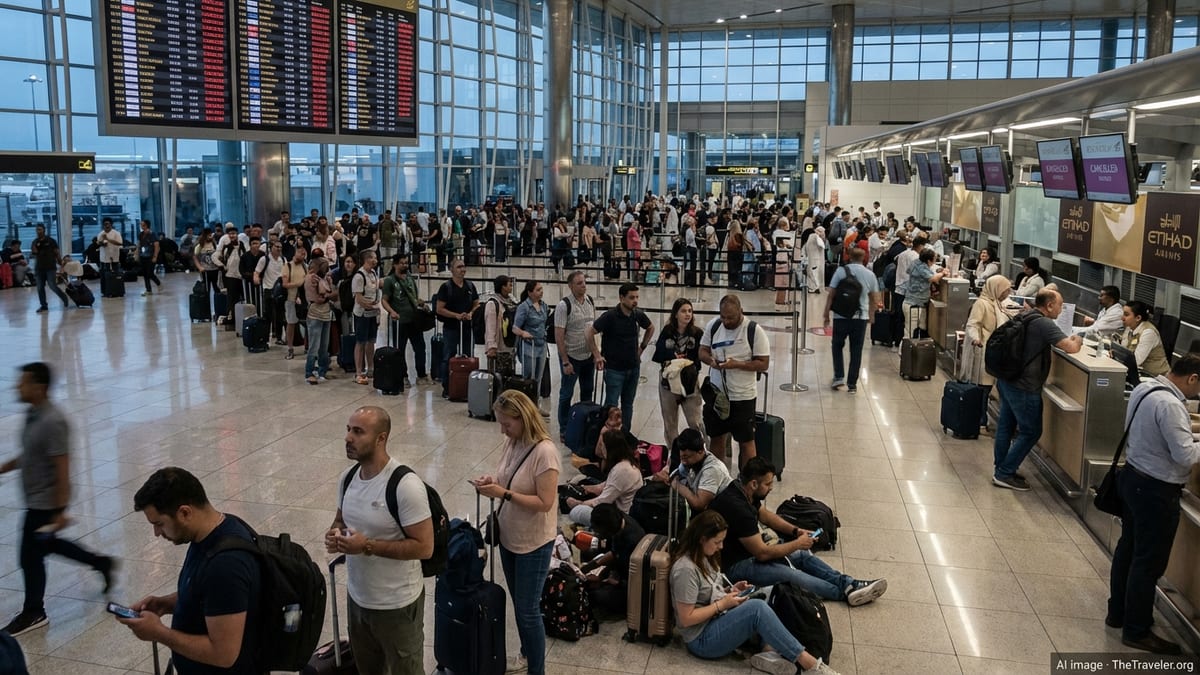
Fresh Wave of Delays Hits Dubai and Sharjah
Operational data for May 19 indicates that disruption remains elevated at the UAE’s two main low-cost hubs, with Dubai International and Sharjah International together recording more than one hundred flight delays and a cluster of cancellations across regional routes. Services operated by FlyDubai and Air Arabia are among those most affected, alongside other Gulf and South Asian carriers, according to flight-tracking dashboards and airport operations summaries.
Reports indicate that the latest disruption follows several weeks of irregular operations triggered by regional airspace constraints and shifting overflight permissions linked to the broader Middle East security situation. Although UAE authorities have recently allowed a full reopening of national airspace, network recovery remains uneven, and airlines that rely heavily on dense regional schedules continue to struggle to restore punctuality.
Travel monitoring outlets describe a pattern of knock-on delays building up through the day, especially on short-haul routes connecting Dubai and Sharjah with Pakistan, India and the wider Gulf. Late-arriving aircraft and crew rotations appear to be feeding into evening departure banks, with some services pushed back by several hours and a minority cancelled outright.
Publicly available passenger accounts on social platforms and forums reflect growing frustration with short-notice schedule changes, limited rebooking options on peak travel days and long wait times at customer service desks. Travellers report receiving cancellation emails days or even hours before departure, in some cases without immediately available alternative flights on the same route.
Route Cuts and Schedule Trimming at FlyDubai
Within this volatile environment, FlyDubai has begun to reshape parts of its network. Recent coverage from regional travel media notes that the carrier has suspended flights to several secondary cities in Pakistan, reducing connectivity between Dubai and a set of smaller South Asian gateways. The changes come on top of rolling schedule adjustments that have already lengthened block times on certain routes to account for longer routings around sensitive airspace.
Operational updates published on the airline’s own channels also show targeted suspensions for specific airports. For example, services to Basel in Switzerland are temporarily halted during a period of scheduled runway refurbishment, removing another European point from FlyDubai’s near-term schedule. While this particular suspension is tied to infrastructure work rather than geopolitics, it adds to the perception among passengers that route maps are in constant flux.
More broadly, FlyDubai’s growth model is anchored in high aircraft utilization across a dense web of regional services. Analysts following Gulf aviation trends suggest that this structure leaves limited slack in the system when flight paths must be rerouted or when turnarounds are slowed by congestion at hub airports. A delay of an hour or two on an early morning sector can cascade through an entire daily rotation, affecting multiple destinations and departure banks.
Industry commentary indicates that FlyDubai is gradually rebuilding capacity after the sharpest phase of regional disruption earlier in the spring, tracking the broader recovery of Dubai’s role as a connecting hub. However, the combination of rerouted flight paths, crew duty time constraints and infrastructure work at some outstations is still constraining the airline’s ability to offer resilient schedules on all routes.
Air Arabia Navigates Cancellations and a Partial Network Rebuild
Sharjah-based Air Arabia is facing its own set of challenges as it works to restore connections across its network. Recent aviation sector reporting describes how the low-cost group, including its Abu Dhabi unit, has been rebuilding a reduced schedule that now covers dozens of destinations, after months of cuts tied to conflict-related airspace closures and demand uncertainty.
Despite this rebuilding, publicly shared passenger complaints point to a pattern of cancellations affecting selected routes, including sectors between Sharjah and Central or Eastern Europe and services into parts of Southeast Asia. Some travellers report receiving notice of cancellations weeks ahead of departure, giving them time to seek alternatives but raising questions about how stable the schedule will be into the summer.
Commentary from travel rights platforms notes that low-cost carriers such as Air Arabia operate on tighter margins and rely on high load factors to sustain thinly priced routes. In the current climate of volatile fuel costs and disrupted routings, less profitable or more operationally complex sectors may be among the first to be trimmed or placed on hold, especially when alternative connections via other Gulf hubs are available.
At the same time, Air Arabia continues to announce selected new or resumed routes from its Abu Dhabi and Sharjah bases, signaling a cautious return to growth. The coexistence of new launches and quiet cancellations underlines how the carrier is rebalancing its network, prioritising routes where demand appears robust and operational risks are more manageable.
Regional Context: From Airspace Restrictions to Gradual Reopening
The current difficulties for FlyDubai and Air Arabia cannot be separated from the wider upheaval that has swept across Middle East aviation since late February. Conflict-related tensions led to a patchwork of airspace restrictions, forcing carriers to reroute flights around closure zones and, in some cases, to suspend services altogether. Travel industry analysis describes how key Gulf hubs experienced a near shutdown of certain corridors during the height of the crisis.
In early May, the UAE’s aviation authorities announced a full reopening of national airspace after a review of security and operational conditions, a move that has allowed carriers such as Emirates and FlyDubai to restore a large share of their pre-disruption networks. Dubai International has highlighted the scale of the challenge it faced, pointing to millions of passengers and tens of thousands of aircraft movements handled under constrained airspace conditions.
Even with the formal lifting of restrictions, operational bottlenecks have persisted. Rerouted traffic patterns across neighboring countries, displaced aircraft and crew, and a backlog of passengers from earlier cancellations have created conditions in which punctuality remains fragile. Airlines with thinner fleets and lower operational buffers, including regional low-cost carriers, are particularly exposed when a single disruption ripples across multiple rotations.
Comparative reporting from global aviation outlets places the UAE situation within a broader pattern of turbulence for the industry this year, as conflict, fuel price swings and capacity constraints interact. For passengers, that means that even as headline announcements emphasize reopening and recovery, the day-to-day experience at the gate can still involve unexpected schedule changes and prolonged waits.
What Travellers on FlyDubai and Air Arabia Should Expect Now
For passengers holding tickets with FlyDubai or Air Arabia over the coming weeks, publicly available guidance from travel advisers and passenger rights organisations converges on a few practical points. First, schedules remain subject to late adjustments, particularly on routes touching conflict-adjacent airspace or secondary regional airports. Travellers are encouraged to monitor their booking status closely in the days and hours before departure and to allow generous connection times when planning multi-leg journeys.
Second, consumer advocacy groups stress the importance of understanding applicable passenger rights regimes, which can vary significantly depending on the departure and arrival airports. On flights that originate in jurisdictions covered by strong compensation rules, some delays and cancellations may open the door to reimbursement or rebooking support, while disruptions caused by security-related airspace decisions may fall outside compensation frameworks.
Third, reports from recent weeks suggest that both FlyDubai and Air Arabia are prioritising rebooking on their own services where capacity permits, with options for vouchers or refunds when no near-term alternatives exist. In practice, however, high load factors on surviving flights can limit rebooking options on popular routes, especially around weekends and school holidays.
For now, the experience of FlyDubai and Air Arabia passengers reflects an industry still working through the aftershocks of a regional crisis. While the reopening of airspace and the gradual restoration of network capacity mark clear progress, the persistence of delays and selective cancellations at Dubai and Sharjah shows that a full return to predictable, pre-crisis operations has yet to be achieved.