


Fort Lauderdale’s beachfront is packed with options, but two spots come up again and again when visitors weigh convenience against calm: Fort Lauderdale Beach Park at the south end of the main strip, and Hugh Taylor Birch State Park just north along A1A. Both offer sand, water and sunshine, yet they deliver very different days out. This guide compares them side by side, with real examples of costs, facilities and on-the-ground experiences, to help you decide which one fits your style, your budget and the Florida heat.
Get the latest updates straight to your inbox!
Setting and Overall Vibe
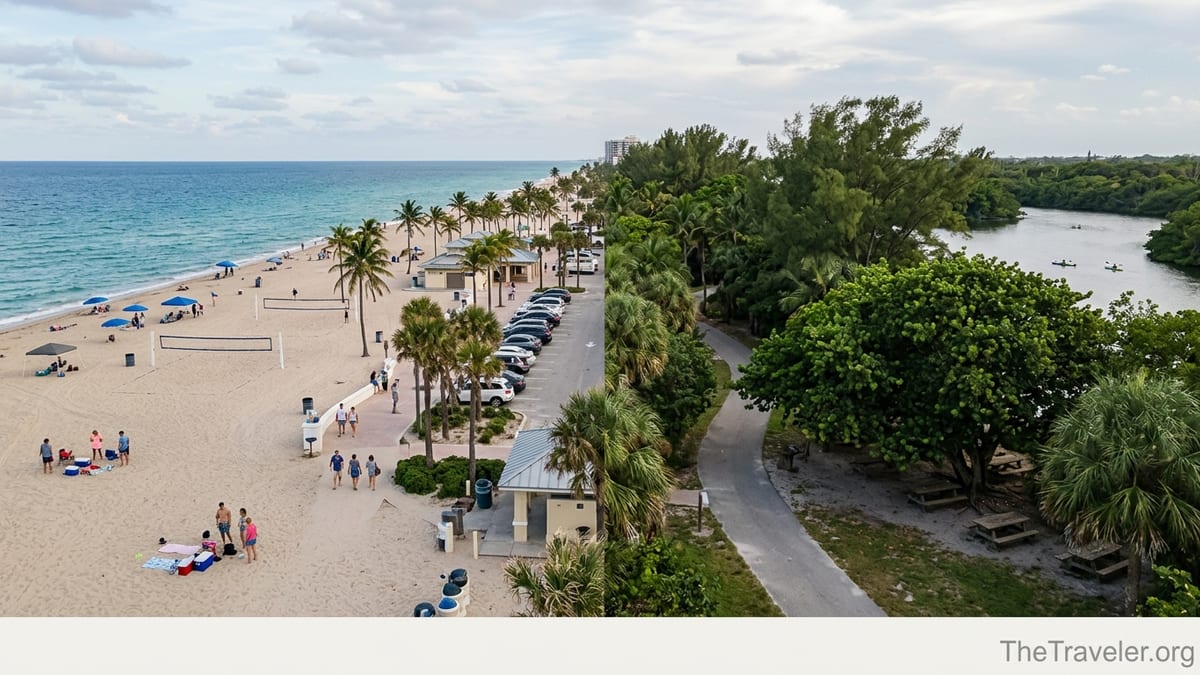
Fort Lauderdale Beach Park sits at the southern end of the city’s main beachfront, near Seabreeze Boulevard and the B Ocean Resort. It feels like a classic urban beach park: wide open sand, high-rise hotels in the background, and a cluster of courts, showers and playgrounds just steps from the Atlantic. You are firmly in the action here, with jet ski rentals, bars and casual restaurants within a short walk along A1A and the beachfront promenade.
Hugh Taylor Birch State Park, by contrast, feels like a pocket of Old Florida wedged between the Intracoastal Waterway and the ocean. Described by park managers as Fort Lauderdale’s “Central Park,” it is a tangle of coastal hammock, oak and sea grape canopy, with a freshwater lagoon running through the middle. Once you drive through the gate, the soundscape shifts from traffic and bar music to cicadas, birds and the slap of paddles on the water.
In practical terms, that means Fort Lauderdale Beach Park works best if you want a high-energy beach day with easy access to the strip, while Hugh Taylor Birch State Park suits travelers looking for shade, quieter walks, and a break from the built-up feel of the resort corridor.
Many locals actually use both differently. They might head to Fort Lauderdale Beach Park for an early morning volleyball session or quick ocean dip, and reserve Hugh Taylor Birch for a lazy Sunday picnic, a bike ride under the trees, or a kayak outing on the lagoon.
Beach Access and Water Experience
At Fort Lauderdale Beach Park, the beach is the star. You park, cross a short stretch of pavement, and you are on the sand. The slope from the lot to the beach is gentle and there are paved paths, which is a big plus for families hauling coolers and beach carts or visitors using wheelchairs or strollers. Locals often recommend this lot as one of the closest options to get from car to shoreline with minimal effort.
The water here reflects the open Atlantic: typically small to moderate waves, bright turquoise on clear days, with trained lifeguards stationed along this section of Fort Lauderdale Beach. It is an easy place to combine swimming with people-watching, as joggers, cyclists and rollerbladers move along the promenade and parasailers and jet skiers buzz just offshore.
Hugh Taylor Birch State Park does not put the sand at your bumper in quite the same way. Inside the park, you are separated from the ocean by A1A. To reach the beach, you either exit through the beach gate near the Park & Ocean concession and use a marked crosswalk, or you park along A1A itself if you prefer city meters to the state park entry fee. Once you cross, you get a more natural-feeling strand with fewer hotel towers directly behind you than at the busier central strip.
On the park side, the freshwater lagoon offers a very different water experience. You can rent kayaks or canoes from the concession near the beach gate and paddle shaded channels lined with mangroves and palms. It is a calmer, more introspective way to be around water: think gliding past turtles and wading birds rather than bobbing in beach crowds. For travelers who want both lagoon paddling and a quick saltwater dip, Hugh Taylor Birch is one of the few places in the city where you can realistically do both in the same morning without moving your car.
Facilities, Sports and Picnic Space
Fort Lauderdale Beach Park is set up for classic beach park activities. According to local tourism information, you will find basketball courts, a volleyball court on or near the sand, a children’s playground, outdoor showers, restrooms, and picnic tables with grills close to the parking area. This is the kind of place where a group might set up a grill near the car, play pickup hoops while the coals heat, then walk a minute or two to the water for a swim between burgers.
The open grassy areas are limited, and there is very little natural shade. Most people bring pop-up tents, umbrellas or rent beach chairs and umbrellas from nearby vendors. The trade-off is that all the core facilities for a beach day are concentrated in a compact zone, ideal if you are juggling kids’ nap times, bathroom breaks and snack runs.
Hugh Taylor Birch State Park spreads its facilities over hundreds of acres. Picnic tables and grills are tucked into shady groves overlooking the Intracoastal. Covered pavilions with water and electricity can be reserved for gatherings like birthday parties and family reunions, which makes the park popular for locals planning events during the hotter months. Even on a muggy July afternoon, you can usually find a table under mature trees where a breeze funnels off the water.
Instead of basketball courts hard against the sand, Birch offers multi-use trails for walking, jogging and cycling, along with interpretive signs about local plants and wildlife. The lagoon shoreline has designated spots where you can launch rental canoes and kayaks. There is also a park road that cyclists and inline skaters sometimes lap like a loop, using the canopy for shade that is hard to come by along the more exposed beachfront promenade.
Shade, Comfort and Beating the Heat
In summer, shade is not a luxury in South Florida, it is a survival tactic. At Fort Lauderdale Beach Park, the lack of natural tree cover means most shade is man-made. Beachgoers set up 10 x 10 canopies or line up rental umbrellas in neat rows facing the surf. If you arrive midday without your own sun protection, you may end up either paying beach vendors for chairs and umbrellas or retreating to a bar or cafe across A1A to cool off between swims.
For families with infants or visitors sensitive to heat, a day here often means planning around the sun: early mornings before 11 a.m. or late afternoons from 4 p.m. onward, when the angle of the light softens. During peak midday hours, people cluster under the small patches of shade cast by the courts or playground structures, but these spots are limited and go quickly.
Hugh Taylor Birch State Park, on the other hand, is practically defined by shade. The coastal hammock canopy filters the light into mottled greens, making the picnic areas and trails noticeably cooler than the open beachfront a few hundred meters away. It is common to see families set up birthday parties with balloons and tablecloths under the tall oaks, kids darting in and out of sun patches while adults linger at the grills.
If you are the type of traveler who loves nature but wilts under direct sun, Birch is the better fit. You can spend hours walking the trails, stopping at overlooks along the lagoon, or simply reading in a camp chair under the trees. When you are ready for full sun and surf, you can still stroll out the beach gate and cross to the ocean, but you are never locked into the all-day sun exposure that defines Fort Lauderdale Beach Park.
Parking, Fees and Value for Money
Parking and fees are often what tip the decision for budget-conscious travelers. Fort Lauderdale Beach Park uses paid city parking. Rates change periodically, but visitors can expect to pay hourly through pay stations or mobile apps, and spaces near the sand tend to fill quickly on sunny weekends and during events. Locals often mention circling the lot to compete for spots, especially in winter high season and on holiday weekends.
Compared with other beachfront lots and garages along A1A, the park is still considered relatively convenient because of its proximity to the sand and facilities. For example, a family arriving at 9 a.m. might pay for 4 or 5 hours of parking to cover a morning of beach time and a picnic lunch. If hourly rates are in the common coastal range of a few dollars per hour, that can quickly add up, particularly if you come several times during a week-long stay.
Hugh Taylor Birch State Park uses a state park fee model. As of mid-2026, the standard posted admission for most Florida state parks in this category is typically per vehicle rather than per hour, with a separate rate for pedestrians and cyclists. Once you have paid at the entrance, you and your group can stay until sunset without watching the clock or topping up a meter. For a car with several people planning to linger all day, that flat fee structure often works out cheaper than city beach parking.
Some Fort Lauderdale residents even buy annual Florida State Parks passes and then routinely park at Hugh Taylor Birch for beach days, using the park gate and crosswalk to access the ocean. They accept the slightly longer walk in exchange for predictable costs, easier parking in one of the park’s roughly 250 spaces, and the bonus of being able to retreat into the shade for part of the day.
Crowds, Atmosphere and Who Each Park Suits Best
Fort Lauderdale Beach Park naturally draws more tourist traffic than Hugh Taylor Birch. Its location at the south end of the main strip, with the boardwalk, hotels and beach bars close at hand, makes it a magnet for groups on vacation. Weekends can feel like a festival: music spilling from portable speakers, pickup games on the basketball courts, and coolers rolling across the pavement toward the sand.
If your ideal day includes new people to meet at the volleyball court, a quick detour to a waterfront bar for happy hour, and the hum of conversation around you, this energy will feel like a plus. It is also a strong choice for friends who want to pair beach time with nightlife later, since you are within walking distance of bars and restaurants stretching up toward Las Olas Boulevard.
Hugh Taylor Birch State Park tends to draw a different mix: local walkers, birders with binoculars, cyclists, families hosting low-key gatherings, and couples out for a quiet paddle on the lagoon. The Park & Ocean concession provides food, drinks and a relaxed outdoor seating area, but the overall soundscape remains far more subdued than the main beachfront. You are more likely to hear wind ruffling the canopy than club music.
For visitors seeking a “nature break” without leaving the city, that atmosphere is the key advantage. You can still access the beach when you want salt spray and surf, but your base camp during the day can be a shady picnic table instead of a towel in the open sand. Many repeat visitors build a routine around this: morning coffee under the trees, a midmorning walk, then a swim across A1A before returning to the park for an afternoon nap in the hammock.
Practical Itineraries: When to Choose Which
To make the choice tangible, it helps to imagine real itineraries. Suppose you are traveling with two teenagers who care most about volleyball, Instagram-worthy beach shots and easy access to snacks. In that case, Fort Lauderdale Beach Park is the straightforward pick. You could arrive midmorning, stake out a spot on the sand in front of the courts, let them bounce between the water and games, then walk together to a beachfront taco spot or ice cream shop along A1A in the afternoon.
Now imagine you are a couple visiting in August who burn easily and want a quieter setting to read and walk, but still hope to swim in the ocean once or twice. Hugh Taylor Birch State Park becomes the smarter bet. You could drive in around 10 a.m., pay the flat vehicle fee, claim a shady table near the lagoon, rent a double kayak for an hour, then retreat to the picnic area for lunch. Later, you might cross to the beach gate for a late-afternoon swim, returning to the park just before sunset.
For multigenerational groups, mixing both parks over several days can work well. One morning could be reserved for the classic “Fort Lauderdale beach day” at the city park: umbrellas, busy sand, and plenty of people-watching. Another could focus on a birthday cookout at Hugh Taylor Birch, where grandparents can sit comfortably in the shade while kids explore the nearby trail loop. Because both parks are a short drive apart along A1A, there is no real penalty for sampling each and seeing which one your group prefers.
If you are staying in a nearby hotel along the beach, ask the front desk which location their staff uses on their days off. Many will tell you they go to Hugh Taylor Birch when they want to decompress in nature and Fort Lauderdale Beach Park when they want to be around friends, food trucks and the livelier side of the shoreline.
The Takeaway
Choosing between Fort Lauderdale Beach Park and Hugh Taylor Birch State Park is less about which is “better” and more about what kind of day you want. One gives you direct, effortless access to one of South Florida’s most famous urban beaches, with courts, playgrounds and a lively social scene pressed right up against the sand. The other offers shaded trails, quiet water to paddle, and the option to step into the surf when you are ready, without committing to hours of full sun.
If your priorities are classic beach facilities, minimal walking from car to waves, and an energetic atmosphere, Fort Lauderdale Beach Park will probably feel like home base. Budget extra for hourly parking, bring your own shade if you can, and lean into the buzz of the main strip. It is particularly well suited to active groups, short visits, and anyone who wants a beach day that flows easily into drinks or dinner on A1A.
If, instead, you value shade, birdsong, picnic space and the sense of being in a green refuge, Hugh Taylor Birch State Park is hard to beat. A flat vehicle admission opens up a full day of lagoon paddling, trail wandering and relaxed meals under the trees, with ocean access available whenever you crave the salt air. For many visitors, combining a day at each park delivers the best of both worlds: one built around beach facilities, the other around nature and comfort.
Whichever you choose, plan around the heat, arrive early on busy weekends to secure parking, and think in advance about how you want to balance sun and shade. Fort Lauderdale’s coastline offers more variety than it might appear from a single postcard shot, and these two parks are prime examples of how a few minutes’ drive can completely change the character of your day.
FAQ
Q1. Which park is better if I want to be as close to the beach as possible?
Fort Lauderdale Beach Park puts you closest to the sand, with parking directly behind the beach and only a short walk from your car to the water.
Q2. Does Hugh Taylor Birch State Park have direct beach access?
Hugh Taylor Birch does not have parking right on the sand. You park inside the park, then walk to the beach gate and cross A1A at a marked crosswalk to reach the ocean.
Q3. Which park offers more shade for picnics and hot summer days?
Hugh Taylor Birch State Park offers far more natural shade, with large trees over most picnic areas and trails, making it more comfortable in midday heat.
Q4. Where will I find better sports facilities like basketball and volleyball courts?
Fort Lauderdale Beach Park is better for classic sports facilities, with basketball courts, a volleyball court and a playground clustered close to the beach.
Q5. Which option is usually better value for parking and entry fees?
Hugh Taylor Birch State Park typically offers better value for long stays, with a flat per-vehicle entry fee, while Fort Lauderdale Beach Park uses hourly city parking rates.
Q6. Is one park less crowded than the other on weekends?
Hugh Taylor Birch State Park generally feels less crowded and more relaxed, while Fort Lauderdale Beach Park can be very busy on sunny weekends and during events.
Q7. Can I have a large family barbecue or birthday party at either park?
Both allow picnics, but Hugh Taylor Birch is better suited to larger gatherings thanks to reservable pavilions, shaded grills and spread-out picnic areas.
Q8. Which park is better if I want to paddle a kayak or canoe?
Hugh Taylor Birch State Park is the stronger choice, with a freshwater lagoon, launch areas and on-site rentals for kayaks and canoes.
Q9. I do not have a car. Which park is easier to reach without driving?
Fort Lauderdale Beach Park is generally easier to reach without a car, since it sits along the main beachfront corridor served by rideshares, taxis and local buses.
Q10. If I only have one day in Fort Lauderdale, which park should I choose?
Choose Fort Lauderdale Beach Park if you want a classic, busy beach day with easy facilities; choose Hugh Taylor Birch if you prefer shade, nature and a calmer atmosphere.