


More news on this day
The Port of Galveston is laying the groundwork for a potential fifth cruise terminal, with planning documents and recent project updates indicating that Royal Caribbean’s rapid expansion at the Texas Gulf port is a major factor behind the new capacity push.
Get the latest news straight to your inbox!
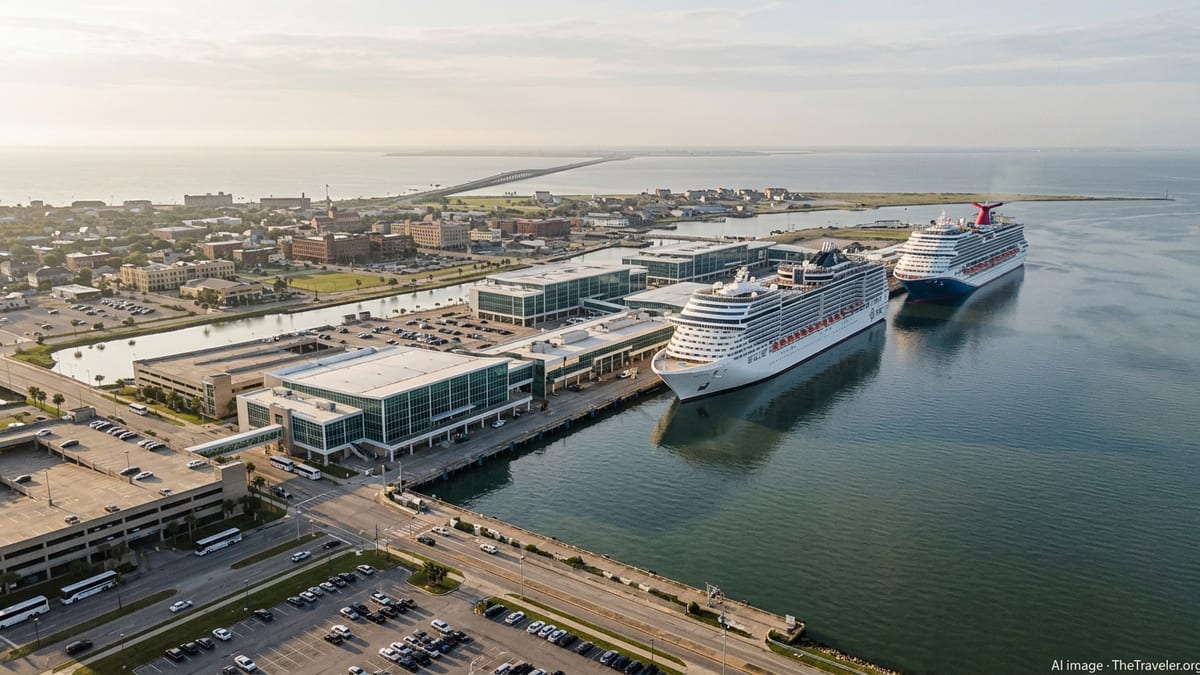
Galveston Emerges as a High-Volume Cruise Gateway
Publicly available information shows that Galveston has transformed from a regional departure point into one of North America’s busiest cruise homeports. The port currently handles multiple major cruise brands from several terminals, with Royal Caribbean operating from the dedicated Cruise Terminal 10 at Pier 10 and other lines using Terminals 25 and 28 on the west side of the harbor.
Port updates indicate that a fourth facility, Cruise Terminal 16, is in advanced development, with new berthing and parking infrastructure designed to handle larger ships and growing passenger volumes. With that project progressing, port planners have turned their attention to what would effectively be a fifth cruise terminal, aimed at safeguarding long-term capacity as ship sizes increase and itineraries from Texas proliferate.
Strategic planning materials and recent port communications frame this expansion as part of a broader effort to cement Galveston’s role as a primary gateway to the Western Caribbean and beyond, particularly for drive-to cruise passengers from Texas and surrounding states.
Royal Caribbean’s Growth Puts Pressure on Capacity
Royal Caribbean’s presence is central to Galveston’s current and future cruise strategy. The line invested heavily in Cruise Terminal 10, a next-generation facility tailored for large vessels and equipped with modern technology and energy-efficient systems. Published coverage notes that the terminal has enabled Royal Caribbean to deploy some of its largest ships from the port, significantly increasing passenger throughput.
Industry analysis and port planning documents suggest that Royal Caribbean is interested in further growth from the Texas Gulf Coast, including additional year-round deployments and the possibility of newer or larger vessels. As ship classes evolve and passenger counts per sailing climb, a single dedicated facility is increasingly viewed as insufficient for long-term ambitions.
Reports indicate that this demand profile is a major factor behind discussions of a fifth terminal. A new facility on or near existing cruise berths would create redundancy for Royal Caribbean operations, provide flexibility for seasonal ship rotations, and offer additional options for staging, baggage handling, and security screening during peak periods.
Strategic Planning Points Toward a Fifth Cruise Facility
Recent updates to the Port of Galveston’s strategic master planning efforts outline scenarios for expanded cruise infrastructure, including additional berths and reconfigured pier space between existing terminals. These materials describe a phased approach in which Cruise Terminal 16 comes online and, in later stages, a further terminal is added as market demand and financing align.
The prospective fifth terminal is positioned not as a short-term construction project, but as a medium- to long-range option that can be activated as cruise volume continues to climb. The planning concepts emphasize improved traffic circulation, expanded parking, and integrated pedestrian corridors between terminals to manage surging passenger flows during simultaneous turnarounds.
Publicly discussed concepts also reference opportunities to pair cruise facilities with adjacent attractions and historic assets along the Galveston waterfront, signaling interest in tying new terminal development to a broader visitor experience. This integrated view is presented as a way to boost both cruise revenue and onshore spending in the local economy.
Economic Stakes for Galveston and the Region
Port financial documents and prior economic impact analyses highlight the outsized role cruise operations play in Galveston’s revenue base. Each additional homeported ship represents recurring passenger spending on hotels, dining, retail, and transportation, along with fees and charges that flow to the port and local government entities.
Planning around a fifth cruise terminal is therefore framed within a regional economic context. By adding future capacity oriented toward partners such as Royal Caribbean, the port aims to remain competitive with other Gulf and East Coast cruise hubs that are also expanding their facilities to attract the newest, highest-capacity ships.
At the same time, the port’s published materials underscore the need to balance growth with infrastructure investment, roadway improvements, and environmental commitments. Any additional terminal is expected to incorporate energy-efficient design, advanced stormwater controls, and modern passenger handling systems, following recent trends in cruise-port development.
Timelines, Approvals and What Comes Next
While the concept of a fifth cruise terminal is increasingly visible in port planning, detailed timelines for design, funding, and construction have not yet been finalized in the public record. The immediate focus remains on completing Cruise Terminal 16 and associated projects, which will add near-term capacity and operational flexibility.
Subsequent steps toward a fifth terminal would likely involve additional feasibility work, environmental reviews, and formal agreements with cruise partners. Observers expect Royal Caribbean to be a prominent stakeholder in those discussions, given the company’s existing long-term commitments at Galveston and its history of investing directly in terminal infrastructure at key homeports.
For now, the inclusion of a potential fifth terminal in planning documents signals that Galveston is preparing for a future in which cruise demand, driven in large part by Royal Caribbean’s ambitions, continues to grow. How quickly that future arrives will depend on market conditions, ship deployment decisions, and the port’s ability to align new infrastructure with the evolving needs of the global cruise industry.