


More news on this day
Germany’s busiest airports are experiencing cascading disruption as summer thunderstorms collide with tighter border checks and new biometric procedures, creating hours-long queues and widespread flight delays at the height of the holiday season.
Get the latest news straight to your inbox!
Stormy Skies Expose Fragility of Airport Operations
Recent storms sweeping across central Europe have sharply disrupted German air traffic, exposing the limited resilience of airport operations during peak travel weeks. Weather-related restrictions have become the leading cause of air traffic flow delays in the region, particularly in Germany and neighboring states, according to recent European aviation data. Severe thunderstorms and heavy rainfall have repeatedly forced temporary suspensions of ground handling, runway closures and go-around procedures.
At Munich Airport, one of Germany’s key hubs, a recent severe weather warning led to a temporary stop in aircraft handling, leaving aircraft waiting on stands and passengers confined to terminals as the storm front passed. Regional coverage indicates that such safety-driven pauses, while routine during lightning or hail risk, can quickly ripple through the tightly timed network of slot allocations, crew schedules and onward connections.
Aviation reports show that when convective weather disrupts several central European hubs simultaneously, delays compound quickly as aircraft and crews are left out of position. Germany’s central role in European air traffic means that knock-on effects are often felt far beyond the country’s borders, with missed connections and diverted flights reported across the continent.
For travelers, the impact is visible in crowded departure halls, rolling delay announcements and long waits on the tarmac. Even when storms pass within an hour, the resulting backlog can stretch into the evening, particularly when aircraft require additional safety inspections after severe turbulence or lightning risk.
Border Checks and Biometric Systems Add to the Gridlock
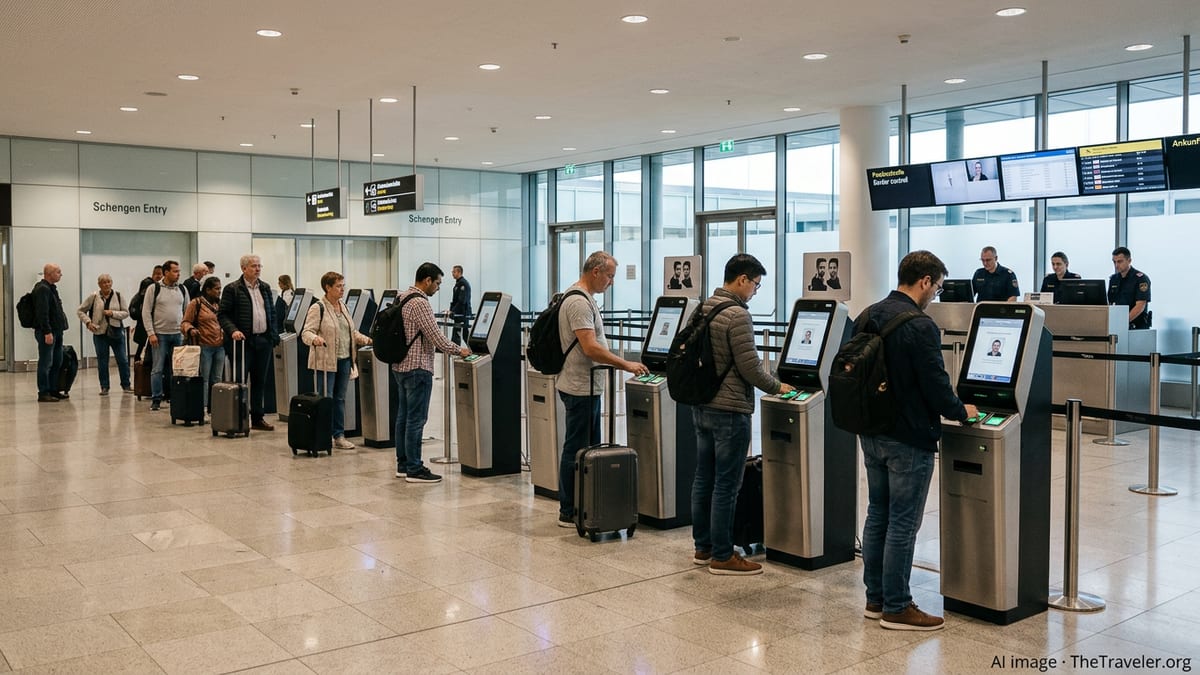
While storms have been the immediate trigger for many recent delays, parallel changes at Schengen borders are intensifying pressure at airport checkpoints. The European Union’s entry and exit system, fully activated at external borders in April 2026, records fingerprints and facial images of non-EU nationals entering or leaving the Schengen area. Industry associations and airport groups have repeatedly warned that biometric registration can significantly increase processing times at busy passport control points.
Publicly available information from airlines and airport bodies indicates that queues of more than two hours have already been observed at some European border-control zones during the system’s rollout. Ahead of the peak summer months, aviation and travel industry groups issued open letters urging greater flexibility in the implementation of biometric checks, cautioning that waiting times could reach four hours where staffing and infrastructure are insufficient.
German airports, already contending with constrained terminal layouts and legacy border-control booths, are particularly exposed when large numbers of long-haul arrivals land within a short window. Travelers transiting Frankfurt and Munich have reported extensive lines at non-EU passport control, with limited counters open at certain times and additional steps required for biometric data capture. As thunderstorms force aircraft into holding patterns or diversions, simultaneous surges of arriving passengers can quickly exceed the capacity of border checkpoints.
For residents of Schengen states and passengers on intra-Schengen routes, passport checks are typically lighter. However, the reconfiguration of border facilities and staff to accommodate biometric systems can indirectly slow flows across entire terminals, especially when lanes are reassigned at short notice to deal with unexpected long-haul arrivals.
Temporary Border Controls Strain Schengen-Era Assumptions
Operational challenges at German airports are further complicated by the partial return of internal border checks within the Schengen area. In recent years, Germany and several neighboring states have reintroduced targeted controls at selected land borders, citing security concerns and irregular migration pressures. The European Commission has formally asked a group of member states, including Germany, to wind down such internal controls more rapidly, arguing that they should remain a last-resort measure.
Although aviation flows are not the primary target of these internal controls, the broader trend has eroded the expectation of frictionless travel that once defined the Schengen zone. Travelers increasingly encounter document checks on cross-border journeys that were previously treated as purely domestic. Reports from travel organizations suggest that some passengers now build in more time for potential checks at airports, particularly when connecting to or from flights involving states that have reintroduced border measures.
Neighboring countries have also tightened their own regimes in response to migration debates and bilateral tensions. Poland has prolonged its controls at the German land border, while other states bordering Germany have taken similar steps in recent years. The overall effect is a patchwork of national approaches within a legal framework that was originally designed for free movement, creating new complexity for carriers planning schedules and crew rotations.
In practice, any increase in document checks, even when limited or sporadic, can feed into wider congestion when combined with weather-related disruption. Vehicles bringing passengers and crew to airports may encounter delays at road crossings, while additional screening obligations can slow transfers between different modes of transport on multi-leg journeys.
Passenger Experience: Long Queues, Missed Connections and Confusion
For passengers on the ground, the interplay of storms, biometric registration and selective border checks often translates into a single, frustrating reality: long waits. Social media posts and travel forums over recent weeks describe border control lines stretching hundreds of meters at major German hubs, with some passengers missing onward flights despite arriving several hours before departure. In several documented cases, the border queue for non-EU nationals was identified as the primary bottleneck, rather than security screening or check-in.
The uneven impact of these disruptions has also been highlighted. Travelers on point-to-point routes, particularly within the Schengen area, may experience relatively smooth journeys even on stormy days, while transit passengers connecting between continents face the brunt of combined delays. This is especially true at hub airports such as Frankfurt, where a missed 60-minute connection can cascade into lengthy rebooking processes and overnight stays.
Publicly accessible guidance from consumer groups and aviation regulators underscores that compensation rules in the European Union distinguish between airline-responsible delays and those caused by extraordinary circumstances. Severe weather and certain air traffic control restrictions often fall into the latter category, meaning that passengers may be entitled only to care, such as meals and accommodation, rather than financial compensation. Border-control delays that are outside an airline’s direct control can similarly limit financial redress, even when they result in missed flights.
Travel advisers now recommend that passengers build in wider buffers when planning trips through Germany’s largest airports, particularly for intercontinental connections requiring a change of terminal and a fresh border check. Some specialists suggest allowing four to five hours between flights where possible, rather than relying on the minimum connecting times historically used in booking engines.
Industry Calls for Coordinated Fixes Before Late-Summer Peak
The strain on German airports has prompted renewed calls from across the aviation sector for more closely coordinated planning between airport operators, border agencies and European institutions. Industry associations have urged the European Commission and national governments to allow temporary flexibility in biometric registration rules during the busiest weeks, including the option to suspend some data-collection steps when queues reach critical lengths.
Airports in Germany and elsewhere in Europe are also accelerating investments in automated border-control technology, such as e-gates compatible with the entry and exit system. However, publicly available assessments highlight that technology alone is unlikely to resolve current pressures in the short term, given the need for additional staffing, training and passenger communication. Several analyses point to persistent shortages of specialized border-control staff, even as air traffic has largely returned to or exceeded pre-pandemic levels.
Beyond immediate staffing and process fixes, European policy documents on the state of Schengen emphasize the importance of longer-term resource planning for border management. These reports highlight that sustained internal checks and frequent reconfigurations of border regimes can undermine the predictability on which airlines and airports rely. For Germany, a key transit country, maintaining a balance between security, migration control and efficient passenger flows has become a central challenge of the 2026 summer season.
With school holidays in multiple European countries just underway, passenger numbers through German hubs are expected to climb further in the coming weeks. Unless storms ease and bottlenecks at border control are reduced, travelers are likely to face continued disruption, reinforcing a central lesson of this summer: in an interconnected aviation system, weather and border policy are increasingly inseparable drivers of delay.