


More news on this day
Air travel across Asia faced fresh turbulence as major hubs in Saudi Arabia, the United Arab Emirates, China, India and Thailand logged 6,951 delays and 472 cancellations in a single day, disrupting schedules at airports in Riyadh, Dubai, Shanghai, Delhi, Bangkok and several secondary cities and creating a cascade of missed connections for carriers including Saudia, Akasa Air, Garuda Indonesia, Qatar Airways and other regional and long haul airlines.
Get the latest news straight to your inbox!
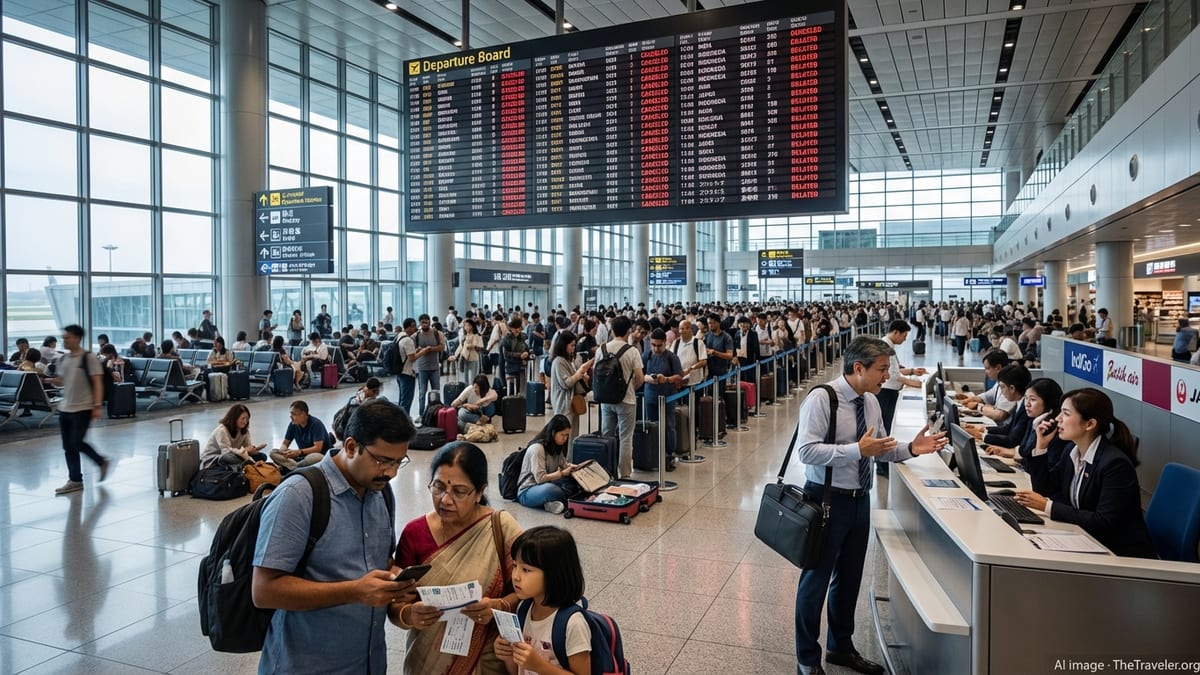
Major Asian Hubs Struggle With Knock On Disruptions
Operational data compiled from airport trackers and aviation analytics platforms shows that the worst congestion has concentrated around a handful of high volume gateways, with Riyadh, Dubai, Shanghai, Delhi and Bangkok all reporting heavy backlogs as aircraft and crew struggle to return to regular rotations. Publicly available figures indicate that together these and other regional hubs accounted for 6,951 delayed departures and arrivals over a 24 hour period, alongside 472 outright cancellations, affecting tens of thousands of passengers across Asia, the Middle East and intercontinental routes.
In the Gulf, Dubai International and Riyadh’s King Khalid International have again emerged as pressure points as airlines navigate constrained airspace, weather related reroutings and rolling schedule adjustments. Reports from regional media and airport operation summaries point to dense banks of delayed departures spreading through peak morning and evening waves, with knock on impacts for connecting traffic headed to Europe, Africa and East Asia.
Further east, Shanghai’s major airports and Bangkok’s main gateway have seen similar patterns of disruption. Congested arrival banks, aircraft holding patterns and crew duty limitations have combined to force last minute rescheduling, particularly on routes linking China and Southeast Asia with the Middle East and South Asia. In India, Delhi’s Indira Gandhi International has registered elevated delay levels on international departures alongside ripple effects on domestic rotations.
Aviation analysts note that while the absolute number of cancellations remains significantly lower than the volume of delays, each cancellation can strand large numbers of passengers, especially on widebody services. With many flights operating near full capacity during the busy summer period, rebooking options are limited, extending disruption well beyond the original day of irregular operations.
Saudia, Akasa, Garuda, Qatar Airways and Others Adjust Schedules
Publicly available schedule data and airline bulletins show that the wave of disruption has not been limited to any single carrier or country. Saudia, the Saudi flag carrier, has faced rolling adjustments on services linking Riyadh and Jeddah to Asian destinations including Delhi, Bangkok and Shanghai, as well as regional routes within the Gulf. Some flights have been consolidated, while others have been retimed to work around congestion at key hubs.
In India, low cost operator Akasa Air, which has been expanding rapidly on domestic and short haul international routes, has seen select departures from Delhi pushed back or rescheduled, particularly where aircraft and crew are held up at congested regional airports. Industry tracking platforms suggest that even modest schedule changes at major nodes such as Delhi can reverberate through a point to point network, increasing the likelihood of rolling delays across the day.
Garuda Indonesia has also been drawn into the turbulence on its services linking Southeast Asia with the broader region. Flights transiting Bangkok and other overburdened hubs have recorded increased turnaround times and, in some cases, day of departure schedule changes as the airline attempts to keep widebody aircraft in rotation while working around slot and air traffic control constraints.
Qatar Airways and other Gulf based carriers operating dense banks of flights through the Middle East have had to balance rerouting and retiming with the need to preserve long haul connectivity. Publicly available information on departures from Doha and Dubai indicates that some services to Asian cities including Shanghai, Bangkok and Delhi have departed significantly behind schedule as aircraft inbound from Europe and North America arrive late, compressing already tight turnaround windows.
Underlying Pressures: Airspace Limits, Weather and Capacity
Aviation agencies and industry observers cite a combination of factors behind the current spike in delays and cancellations. Intermittent airspace restrictions over parts of the Middle East and adjacent regions have forced airlines to reroute aircraft along longer tracks, increasing block times and pushing crews toward duty time limits. Longer flights can create cascading schedule pressure, especially when airlines are already operating near peak fleet utilization.
Seasonal weather has added further complexity, with summer thunderstorms around key Asian hubs periodically suspending arrivals and departures. When several major airports, such as Bangkok and Delhi, encounter weather related flow control measures at the same time that Gulf hubs are operating under airspace constraints, system wide buffers quickly evaporate, leaving little margin to absorb further shocks.
Capacity constraints on the ground also play a role. Ground handling teams, air traffic control and airport infrastructure were already operating at or near full stretch as travel demand continued to recover and grow. When multiple widebody flights arrive late into the same bank, limited gates, stands and personnel slow the process of turning aircraft around, in turn delaying subsequent departures and tightening connection windows for transit passengers.
Industry analysts have previously highlighted that airlines in Asia and the Middle East have been rebuilding networks amid pilot and technician shortages, as well as sharply higher operating costs. The current wave of disruption underscores how quickly these systems can become stressed when confronted with simultaneous airspace, weather and capacity challenges.
Impact on Passengers Across Asia and Beyond
The immediate effects for travelers have included missed connections, unexpected overnight stays and extended waits at departure gates. Social media posts and local news coverage from affected airports describe long queues at transfer and service desks as passengers seek rebooking and accommodation, while some travelers have reported being rerouted through secondary hubs in order to reach final destinations in Europe, East Asia or North America.
Travel industry reports suggest that routes connecting South Asia with the Gulf and onward to Europe have been particularly sensitive, as many rely on tight connecting times in hubs such as Dubai, Doha and Riyadh. Delayed inbound flights from cities including Delhi, Mumbai, Bangkok and Jakarta make it more difficult for airlines to hold onward connections without causing further disruption later in the day.
Business travelers and migrant workers transiting via Gulf and Asian hubs have faced some of the longest journey extensions, as full flights limit the availability of same day alternatives. With load factors remaining high during the summer period, passengers whose flights are cancelled can find themselves rebooked one or more days later, especially on popular evening and overnight departures.
Travel insurance providers and consumer groups have reiterated guidance that passengers should monitor flight status closely, arrive early at airports and maintain flexible itineraries where possible. Many airlines have introduced short term waiver policies for affected routes, allowing itinerary changes without standard penalties, though such measures vary widely by carrier and booking class.
Outlook for Operations in Coming Days
Operational planners at major airlines and airports are working to gradually clear the accumulated backlog and restore more predictable schedules. Historical data from previous disruption events suggests that while headline cancellation numbers can drop relatively quickly once key constraints ease, elevated levels of delay often persist for several days as aircraft and crews are repositioned and maintenance windows are resynchronized.
In the near term, travelers using the most affected hubs, including Riyadh, Dubai, Shanghai, Delhi and Bangkok, are likely to continue encountering longer than usual journey times and occasional last minute schedule changes. Aviation analysts point out that even as airlines deploy spare aircraft and crews where available, tight global capacity and ongoing regional uncertainties leave the system vulnerable to further shocks.
Some carriers have already trimmed near term schedules on select routes, particularly overnight services that are more exposed to airspace and curfew constraints at destination airports. By slightly reducing frequency on heavily disrupted city pairs and consolidating lightly booked flights, airlines hope to build additional resilience into daily operations and reduce the risk of large scale cancellation waves.
For now, publicly available operational data and aviation industry commentary indicate that while the current situation represents one of the more severe recent spikes in Asia linked disruption, it remains a manageable challenge rather than a systemic breakdown. The extent to which airlines can stabilize operations will depend on how quickly airspace and weather conditions normalize and whether additional capacity, particularly in the Gulf to Asia corridor, can be brought online in the weeks ahead.