


More news on this day
Germany has joined the United Kingdom, France, Italy and several other European states in tightening restrictions on flights across the Middle East, compounding disruption already triggered by Kuwait’s prolonged airspace closure and leaving thousands of European tourists stranded or facing complex rerouting and visa dilemmas.
Get the latest news straight to your inbox!
Expanding Airspace Bans Collide With Kuwait’s Closure
Publicly available aviation notices and travel advisories show that Germany has aligned with other major European countries in responding to the volatile security situation across the Gulf and wider Middle East by advising airlines to avoid large swaths of regional airspace, including Kuwait, Jordan, Saudi Arabia, Qatar and the United Arab Emirates. These actions follow earlier steps by the United Kingdom, France, Italy, Switzerland and others to curtail overflights and direct services on key Europe to Asia corridors.
The European Union Aviation Safety Agency has revised and repeatedly extended its conflict zone guidance for the Middle East, urging carriers to steer clear of specified flight information regions covering Bahrain, Iran, Iraq, Israel, Jordan, Kuwait, Lebanon, Oman, Qatar, Saudi Arabia and the UAE. The latest bulletins recommend avoiding these areas at all altitudes or, in limited corridors, remaining above certain flight levels, reflecting a heightened assessment of risks from missiles, drones and air defense activity.
At the same time, Kuwait’s decision earlier this year to suspend civilian air traffic after drone strikes damaged facilities at Kuwait International Airport has removed a crucial node from the regional network. Travel industry advisories and airport reports indicate that the shutdown, introduced at the end of February, halted regular commercial flights for months and forced airlines to cancel or divert services across an already congested region.
Even as partial operations begin to return in Kuwait following emergency repairs, capacity remains constrained and schedules unstable. Combined with the wider pattern of airspace avoidance across neighboring states, the result is a patchwork of closures, bottlenecks and narrow routing corridors that is catching large numbers of European travelers in the middle of multi leg journeys.
European Tourists Face Cancellations, Diversions and Long Detours
The immediate consequence for tourists has been a wave of cancellations and last minute diversions affecting flights from Europe to popular winter and spring destinations in the Gulf, the Red Sea and onward into South and East Asia. Coverage by European and regional media describes flights that once took six or seven hours now requiring extended detours via Egypt, the eastern Mediterranean or the Caucasus, with added fuel stops and complex crew planning.
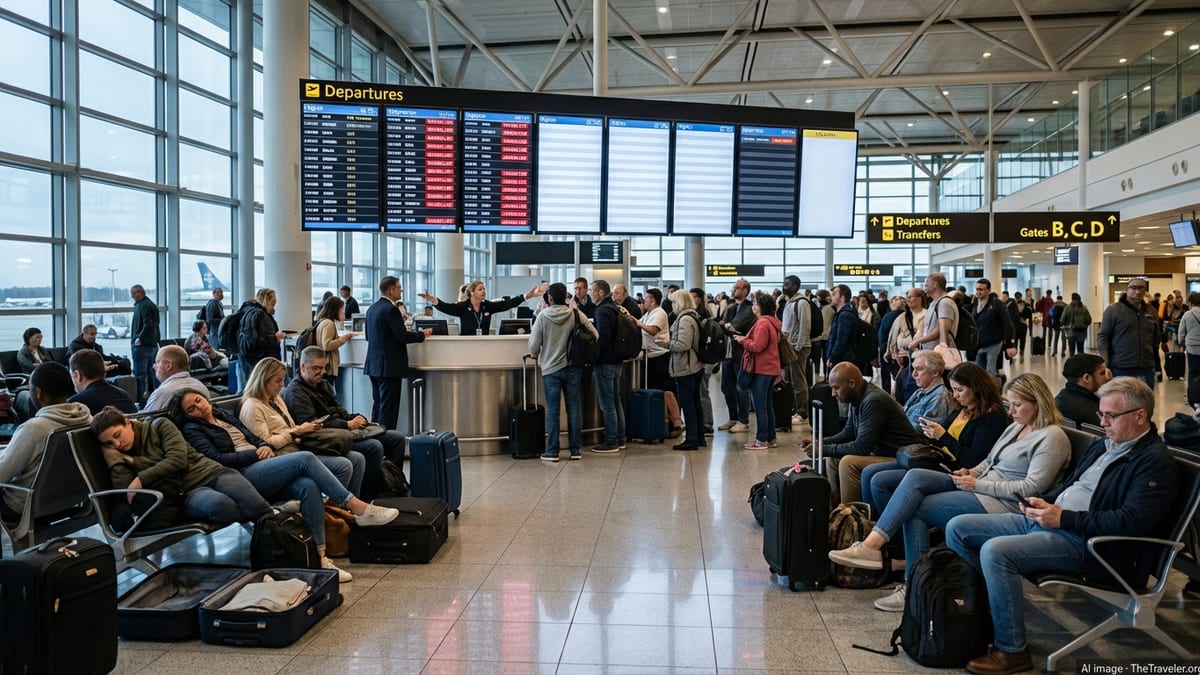
For travelers who were already in transit when Kuwait and several neighboring countries closed or restricted their airspace, disruptions have been especially severe. Reports from major Gulf hubs describe scenes of overcrowded terminals, ad hoc information desks and passengers queueing for rebooking as airlines struggle to design safe and commercially viable routings that comply with changing advisories from European regulators and local authorities.
According to published estimates, more than 100,000 British travelers alone were left stranded or delayed across Gulf states when widespread airspace closures first took effect earlier in the conflict. Germany, France, Italy and Spain have all reported significant numbers of their citizens requiring assistance or alternative travel arrangements as routes via Kuwait, Qatar, the UAE and Saudi Arabia either shut down or operated at sharply reduced capacity.
Some airlines have temporarily suspended direct services to multiple Gulf destinations, while others are operating limited relief or repatriation flights, often at short notice. Tour operators and travel agents in Europe are fielding a surge in calls from customers whose itineraries relied on now disrupted connections through Kuwait City, Doha, Dubai, Abu Dhabi or Riyadh.
Overstay Visa Risks and Legal Grey Areas
As flight options narrow and delays stretch from days into weeks for some travelers, visa status has emerged as a critical concern. Many tourists entered Gulf countries or nearby transit hubs on short stay visas or visa on arrival schemes that assumed smooth onward connections. With Kuwait’s closure eliminating one of the region’s transfer points and alternative routes oversubscribed, some visitors now risk exceeding authorized stays.
Government travel notices and consular updates reviewed by travel industry analysts warn that overstaying a visa, even in exceptional circumstances, can carry penalties ranging from fines to entry bans in the future. While some regional states have previously shown flexibility during large scale disruptions, such as the pandemic, there is currently no uniform policy across the Gulf on how to handle tourists stranded by the latest airspace restrictions.
Legal experts quoted in European media note that responsibility for avoiding overstays typically lies with the traveler, even when cancellations are beyond their control. However, a growing number of advisory notes from travel associations recommend that stranded visitors keep written evidence of flight cancellations and rebooking attempts, and, where possible, seek written clarification from immigration desks or airport authorities on any grace periods being applied.
For those stuck in Kuwait during the peak of the closure, additional complications have arisen from the country’s strict residency and sponsorship rules. Some visitors who arrived on short term visas to visit family or attend events found themselves unable to depart as planned yet unsure whether prolonged stays in hotels would be treated differently from overstays by residents or workers. Similar uncertainties are being reported in neighboring transit hubs as tourists wait out the crisis.
Financial Strain and Insurance Gaps for Stranded Travelers
The prolonged nature of the disruption is also exposing gaps in consumer protection and travel insurance coverage for conflict related events. Advisory notes from global logistics firms and risk consultancies point out that many standard travel policies exclude claims arising from war, armed conflict or acts of terrorism, leaving travelers to shoulder additional accommodation, rebooking and living costs when airspace closures are driven by security incidents.
In practice, airlines have offered a mix of refunds, future travel vouchers and free date changes, but these gestures often fall short of covering the full cost of an enforced stay in expensive Gulf cities or alternative long haul routings via distant hubs. Reports indicate that some carriers are prioritizing rebookings for passengers with through tickets purchased directly from the airline, while those who cobbled together separate legs or booked via low cost intermediaries may face longer waits and higher out of pocket expenses.
European consumer groups are starting to highlight cases in which tourists paid significantly higher fares for rerouted journeys home, sometimes via multiple continents, after their original flights through Kuwait or neighboring states were canceled. Questions are being raised about the extent to which existing passenger rights frameworks, such as those in the European Union, apply when disruptions are attributed to extraordinary circumstances linked to armed conflict.
Travel law specialists are urging prospective visitors to scrutinize policy wordings and booking conditions before committing to itineraries that transit the region. Some are advising that travelers consider comprehensive policies that explicitly include coverage for political instability or airspace closure, although premiums for such products are typically higher and availability varies between markets.
Growing Uncertainty Ahead of the Peak Summer Season
Looking ahead, the combination of Germany’s alignment with wider European airspace avoidance measures and the still fragile recovery of operations at Kuwait International Airport is casting a shadow over the upcoming peak summer season. Airlines are beginning to publish revised schedules that build in longer routings and reduced frequencies on Asia bound flights, but industry observers note that these plans remain contingent on day to day security developments.
Regional aviation analysts say that even limited reopening of Kuwait’s airspace cannot immediately restore pre conflict connectivity. Damage to airport infrastructure, higher insurance premiums for flying near conflict zones and the need for more circuitous routings all limit the number of flights that can be offered profitably. In addition, the heavy use of alternative corridors over Egypt, the eastern Mediterranean and parts of Central Asia is creating new congestion points and air traffic control challenges.
For travelers, this means that uncertainty is likely to persist. Tour operators are advising customers to build in greater flexibility, consider itineraries that avoid the most affected hubs entirely and allow extra time for connections where Middle East overflights remain necessary. Some European tourism boards are also quietly recalibrating their expectations for inbound and outbound demand linked to Gulf stopover packages, anticipating that nervousness about the region could dampen bookings.
Until there is a sustained easing of tensions and a clear, coordinated approach to reopening and securing Middle East airspace, Germany’s decision to join its European partners in avoiding the most affected corridors is expected to reinforce a new, more fragmented era for long haul travel between Europe and Asia. For many stranded tourists still waiting for replacement flights or visa clarifications, the immediate priority remains simply finding a route home.