


More news on this day
Rail passengers across the UK faced severe disruption on Sunday 23 August 2026 after a major power failure at CrossCountry’s Birmingham control centre forced the cancellation of most services, causing particular chaos for long-distance travellers to and from Glasgow.
Get the latest news straight to your inbox!
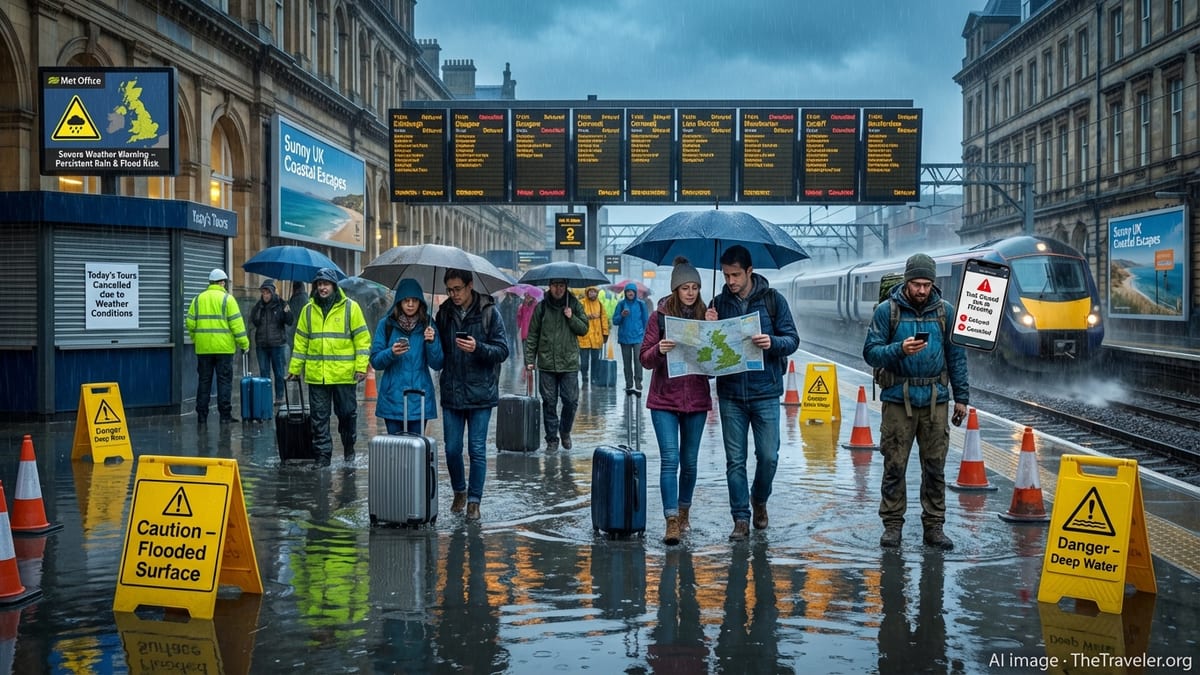
Power failure in Birmingham triggers network-wide cancellations
According to published coverage, the disruption began after an electrical failure hit CrossCountry’s main control base in Birmingham, disabling key systems used to monitor and route trains across its long-distance network. Reports indicate that the outage left staff unable to safely operate signalling and control functions for many intercity services.
CrossCountry operates a web of routes linking Scotland, northern England, the Midlands and the south-west of England. With the control centre offline, the operator announced that most services would be cancelled for the rest of Sunday, describing a near-total suspension across its timetable. Only a small number of trains on selected corridors, including Peterborough to Stansted Airport, continued to run.
National disruption maps and journey planners showed widespread cancellations across England and Scotland, with CrossCountry services marked as “cancelled” or “not running” on the majority of its core routes. The failure came at the peak of the late-summer travel period, when leisure travellers, tourists and event-goers rely heavily on long-distance rail.
Publicly available information from journey planners and rail alerts characterised the issue as a technical systems failure rather than a problem on the tracks themselves, but the knock-on effect on the network was similar to that of a major infrastructure incident, with few alternative direct services available on CrossCountry’s usual intercity links.
Glasgow and Scottish links among the hardest hit
Glasgow, one of CrossCountry’s northern endpoints, experienced especially sharp disruption as trains connecting the city to the Midlands and south-west were removed from the timetable. Published reports highlight the Glasgow to Edinburgh and Glasgow to southbound CrossCountry flows among the routes affected by the widespread shutdown.
Long-distance journeys from Glasgow Central typically rely on CrossCountry services for direct trains to destinations including Birmingham, the south-west of England and parts of northern England. With those trains largely cancelled, travellers attempting to reach English cities faced complex diversions, involving multiple changes via alternative operators such as Avanti West Coast or TransPennine-style connections where available.
While local ScotRail services around Glasgow remained comparatively stable according to live journey-check tools, the loss of CrossCountry’s through-trains effectively severed many cross-border leisure and business links for the day. Passengers who had planned to make end-to-end journeys, for example between Glasgow and destinations in Devon or Cornwall, found there was no like-for-like replacement available.
The timing was particularly difficult for visitors heading home from summer breaks in Scotland, as well as for domestic travellers using Glasgow as a hub for events and festivals across the Central Belt. Social media and rail forums reflected frustration from passengers who arrived at Glasgow stations to find blank departure boards where CrossCountry services would normally appear.
Impact across UK routes and passenger options
The power failure did not only affect Scottish connections. Published news coverage notes that key CrossCountry corridors such as Manchester to Birmingham, Cheltenham to Cardiff, and Leeds to York also saw services withdrawn. In many cases, journey planners indicated “no services available” for large portions of the day on what are usually busy cross-country routes.
National Rail information suggested that, where possible, passengers could re-route using other operators’ services, but capacity constraints made this a limited option. Many travellers found that alternative trains were already busy or required lengthy detours via London or other major hubs, substantially increasing journey times.
Some pre-planned rail replacement buses were in operation for separate engineering works, but these were designed to support localised projects rather than substitute for a network-wide loss of CrossCountry trains. As a result, passengers needing to travel between intermediate stations served primarily by CrossCountry often had no straightforward way to complete their journeys.
Under standard UK rail compensation rules, travellers whose trains are cancelled or significantly delayed are usually eligible to claim refunds or delay-repay compensation. Reports indicate that customers were being advised to check the latest guidance from CrossCountry and National Rail before travelling, and to retain tickets and booking confirmations for any future claims.
Confusion over timetables and advice to travellers
The scale and suddenness of the outage created confusion throughout the morning as passengers attempted to determine whether individual services were running. Some journey-planning apps and operator websites initially showed trains as scheduled before updates filtered through to mark them as cancelled, leaving many travellers unsure whether to set off for stations.
Rail-focused travel tools and news bulletins gradually aligned on advice that passengers should avoid attempting CrossCountry journeys unless absolutely essential, and should check real-time updates immediately before departure. Across the UK, station information screens displayed repeated warnings of cancellations and severe disruption on CrossCountry routes.
For visitors in Glasgow and Scotland who were planning intercity trips, the most practical short-term advice was to consider postponing non-essential travel, seeking refunds from retailers or operators, or exploring alternative modes such as domestic flights or long-distance coaches where available. However, last-minute availability and pricing on these options varied widely.
Travel organisations and rail commentators highlighted the importance of checking multiple information sources, including operator websites, National Rail Enquiries, and regional journey planners, to obtain the most accurate picture of which services were still operating. For many travellers, the day became an exercise in constant monitoring and contingency planning rather than straightforward rail journeys.
Broader questions over resilience and summer rail reliability
The Birmingham power failure follows a series of recent incidents and planned works that have already created a challenging summer on the UK rail network. Network bulletins in recent weeks have highlighted engineering projects and infrastructure issues affecting key main lines, compounding the impact of any operator-specific disruption.
CrossCountry’s extensive cross-border role means that any large-scale problem quickly has nationwide consequences. Today’s cancellations again raise questions over the resilience of critical control infrastructure and the ability of operators to maintain at least a skeleton service when central systems fail.
Customer reports and performance documents published over the past year have drawn attention to high levels of cancellations on some CrossCountry routes even under normal conditions, driven by a mixture of staff shortages, rolling stock issues and external factors. The events of Sunday 23 August add a further layer to ongoing concerns about reliability on long-distance services that many regions depend on.
For travellers, the latest disruption underscores the importance of building flexibility into summer rail plans, particularly for those using Glasgow and other Scottish cities as gateways to the rest of the UK. While investigations into the precise cause and duration of the Birmingham power failure continue, many passengers will be looking for clearer assurances that such a widespread shutdown is unlikely to be repeated.
CrossCountry train chaos as power cut cancels most services across UK - The Independent
CrossCountry cancels most services until further notice - The Independent bulletin
Trains cancelled across UK after power cut at CrossCountry control centre - Yahoo News
CrossCountry rail cancels trains due to power outage - YorkMix