


Touching down at Velana International Airport is the start of most Maldives holidays, but your trip does not properly begin until you have cleared passport control, immigration formalities and customs. This guide walks you through the real, on-the-ground arrival process at Velana, from the IMUGA Traveller Declaration and visa rules to alcohol restrictions, baggage checks and the common mistakes that delay tired travelers on arrival in Malé.
Get the latest updates straight to your inbox!
Understanding Maldives Entry & Visa on Arrival
Velana International Airport, serving the capital Malé, is the main international gateway to the Maldives and where most visitors receive their visa on arrival. For tourism stays, almost all nationalities receive a free 30-day tourist visa at the immigration desk, provided basic entry conditions are met. These include a passport with at least one month of validity remaining, a confirmed outbound ticket, and proof of accommodation such as a resort, hotel, guesthouse or liveaboard booking. Immigration officers will usually ask where you are staying on the first night and may request to see a printed or digital confirmation.
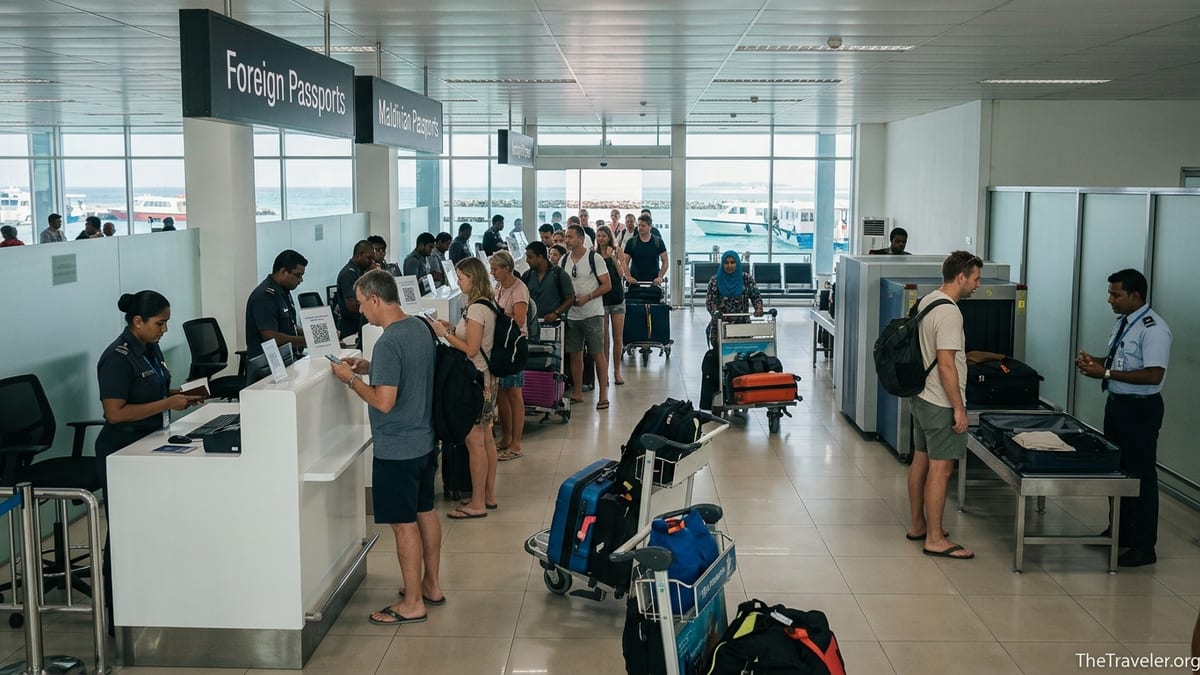
In practice, tourists arriving on major carriers such as Emirates, Qatar Airways, Singapore Airlines, Turkish Airlines or IndiGo are funneled from the jet bridge along a short corridor into the immigration hall. Overhead signs clearly separate “Foreign Passports” from “Maldivian Passports.” Lines often move reasonably quickly in the morning and late evening bank of flights, but can lengthen to 30–45 minutes when several widebody aircraft land close together. Having your documents ready, including the QR code from your IMUGA Traveller Declaration, usually makes the difference between walking straight through or being pulled aside for extra questions.
Immigration decisions are discretionary, and a confirmed resort booking does not guarantee entry. Officers will sometimes ask solo travelers about their itinerary, or couples about how long they plan to stay and how they will pay for their holiday. While they rarely count cash, they may ask about access to funds via card. If your passport is almost expired, or if your accommodation details are vague, expect a longer conversation at the counter, and possibly a referral to a supervisor’s desk just behind the main line.
One key change visitors should be aware of is that, as of mid-2025, entry to the Maldives is not granted on Israeli passports. This is clearly stated in the official tourist visa information and has been enforced at the border. Dual nationals traveling on another passport generally present only that document, but anyone carrying an Israeli passport or travel document could be refused boarding by the airline or denied entry on arrival, so it is important to check your individual situation with your carrier well before departure.
IMUGA Traveller Declaration: What You Must Do Before You Land
All foreign visitors arriving in the Maldives must complete an online Traveller Declaration, commonly referred to as the IMUGA form, before reaching Velana. The declaration is submitted through the official IMUGA portal and remains free of charge. You can complete it within 96 hours of your scheduled arrival time, and many resorts and liveaboard operators now send guests a reminder email with a checklist that includes “complete IMUGA” alongside “print transfer vouchers” and “pack reef-safe sunscreen.”
The form asks for passport details, your flight number and times, recent travel history, basic health information and at least one confirmed place of stay. If you are spending your first night at a Malé city hotel such as Jen Malé by Shangri-La or a guesthouse in Hulhumalé before transferring to a resort, list that as your initial accommodation and then add your resort in the subsequent sections. Families must submit a separate declaration for each traveler, including children and infants, but parents commonly fill them on behalf of minors.
Once submitted, IMUGA generates a QR code that you should screenshot or save to your phone. Airlines at origin airports sometimes check this at check-in or during boarding. At Velana, immigration officers frequently scan the QR code at their desk instead of manually retyping your details. If your flight schedule changes significantly, for example if your original Friday flight is canceled and you are rebooked on Saturday, you should submit a new declaration reflecting the updated flight number and date; this avoids awkward questions about why your electronic form does not match the arrival manifest.
A growing problem is third-party websites that mimic the official IMUGA page and charge “processing fees” of 20 to 50 US dollars per person for what is a simple, free self-declaration. Several travelers have reported paying such fees through agencies and then discovering at the airport that they must still complete the genuine IMUGA declaration themselves. To avoid this, only use the official government portal and be cautious of any site that asks for payment. Maldives Immigration has publicly reminded travelers that the declaration is free and warned about misleading commercial sites using similar names.
Passport Control at Velana: What Actually Happens
After exiting the aircraft and walking to the arrivals level, you will enter the immigration hall where multiple counters line the far wall. Overhead screens indicate which counters are open. Queue management is basic but efficient: airport staff direct passengers into serpentine lines for foreign visitors, while Maldivians and work permit holders have a separate lane. During busy waves, you may see temporary desks opened along the sides to clear the backlog of passengers, especially after late-night flights from the Middle East and Europe.
When it is your turn, step to the counter and present your passport, boarding pass and your IMUGA QR code on paper or phone. The officer will typically confirm your purpose of visit as “tourist” and may ask where you will stay, for how long, and whether you have visited the Maldives before. Many visitors are stamped in without further questions, but if you arrive with only a one-way ticket or no clear proof of accommodation, you can be asked to show onward travel or booking confirmations on your phone. Some officers prefer printed hotel vouchers, so having a printout from your resort or booking platform can speed things up.
Photos and fingerprints are not routinely taken for short-term tourists at Velana, but your face will be checked against your passport photo under the camera above the officer’s desk. If there is a concern about your documentation, such as a damaged passport or missing visa for your next destination, you might be asked to step aside to a secondary interview table behind the line. In a real example, a backpacker arriving from Sri Lanka with a passport expiring in three weeks was questioned for about 20 minutes before being refused entry, as the minimum validity requirement was not met.
Once your entry is approved, the officer stamps your passport with a standard 30-day stay endorsement. If you intend to stay longer, up to 90 days in total, you can request an extension later through Maldives Immigration after you have checked in to your accommodation, usually by showing proof you can support yourself and legitimate reasons for staying on. This does not happen at the arrivals counter, so focus on passing smoothly through the initial control before thinking about any extension.
Customs, Prohibited Items and Alcohol Rules
Immediately after passport control you will descend an escalator or ramp to the baggage claim hall and then pass through customs. The Maldives maintains strict rules on certain imports, particularly alcohol, religious materials and pornography. Velana’s customs area is compact but heavily monitored, with officers positioned near the exits and an X-ray scanner that all checked and hand baggage must pass through before you reach the public arrivals area.
Unlike some countries where a limited amount of alcohol is permitted for personal consumption, the Maldives prohibits passengers from bringing any alcoholic beverages into the country. This applies to duty-free spirits purchased at your departure airport or in transit. For example, if you buy a bottle of whisky at Dubai Duty Free, it will almost certainly be detected on X-ray at Velana. Customs officers will set the bottle aside, issue you a receipt, and store it in a bonded area. You can reclaim it when you depart the Maldives, usually at a small customs desk located near the check-in counters. Many tourists are surprised by this, but the process is routine, and there are no fines for honest declaration; the alcohol is simply held until you leave.
Other prohibited items include narcotics and illegal drugs, offensive religious material intended for distribution, and pornographic content, especially on physical media. The definition of “pornography” is interpreted broadly, but in practice customs tends to focus on obvious DVDs or printed material rather than private photos on your phone. Personal religious texts such as a Bible or Bhagavad Gita for private use are generally tolerated, but bringing in a suitcase of pamphlets or books for distribution can trigger serious questions and possible confiscation.
Tobacco and cigarettes are allowed within reasonable personal-use quantities, and you can freely buy international brands at the arrivals duty-free shops inside the airport. However, electronic cigarettes and vapes have come under tighter scrutiny since an amendment to the Tobacco Control Act banned their import into the country. Travelers arriving with vape kits and pods risk confiscation and fines, and several recent visitors have reported losing expensive devices at customs. If vaping is part of your daily routine, the safest choice is not to bring e-cigarettes at all, and switch to nicotine patches or gum for the duration of your trip.
Baggage Claim, Screening and Secondary Checks
Checked luggage from widebody flights is delivered onto a small number of carousels in the arrivals hall. Screens list the flight number and origin, and airport staff often announce belt changes when two flights from similar regions arrive together. During peak evening banks, bags can take 20 to 40 minutes to appear, especially on flights from Europe carrying large numbers of resort guests with dive gear and camera cases. Porters in blue vests are available and can be hired on the spot to help with multiple suitcases and sports equipment such as surfboards.
Once you have all your bags, you will push your trolley toward the customs screening area. At Velana there is typically one unified lane rather than a separate green and red channel. All bags, both checked and cabin-sized, go onto the X-ray conveyor belt. Officers watch the monitors for alcohol bottles, suspicious electronics configurations, and shapes consistent with weapons, drugs or large amounts of undeclared commercial goods. If something stands out, they will signal you to step aside to the inspection table, where you may be asked to open your suitcase.
In many real cases, the inspection is brief and polite. For instance, a couple whose bag showed several bottle-shaped outlines were asked to unzip their suitcase. Inside, officers found three duty-free wine bottles. These were calmly removed, receipts were issued, and the tourists were allowed to proceed. By contrast, a traveler attempting to bring in a large quantity of beauty products for resale was questioned more closely and ultimately had part of the shipment confiscated as undeclared commercial goods. Declaring unusual items in advance, especially if you carry professional filming equipment or boxes of samples, can prevent misunderstandings.
Random checks also happen. Even if your bags do not trigger the X-ray operator’s suspicion, a floor officer might flag you to verify that the expensive-looking drone case on your trolley contains a model permitted under local aviation guidelines and that you understand resort or atoll-specific drone restrictions. While drones are not outright banned, many resort islands prohibit them to protect guest privacy, and customs may remind you that you must obtain resort or aviation authority permission before flying. If you cannot justify why you need to bring a professional-grade drone, they may choose to hold it until departure.
Common Mistakes That Slow Tourists at Arrival
Most delays at Velana’s immigration and customs are caused not by officials being difficult but by travelers missing small but important details. One of the most frequent issues is arriving without having completed the IMUGA Traveller Declaration, or having done it incorrectly. For example, visitors sometimes confuse “arrival” and “departure” forms, or enter the wrong flight number. Airline staff may still let them board, but at Velana the mismatch between the manifest and the declaration can trigger extra questions. If the IMUGA system is down, officers typically allow manual processing, but your wait could be significantly longer.
Another common problem is relying on unofficial or paid services to handle the declaration. There have been credible reports of travelers paying an agency fee for a “visa service” and then discovering that the agency used incorrect dates or passport details, or even failed to submit anything at all. In one case, a couple who had paid an external site discovered at check-in that their QR code was invalid, had to fill new declarations on a smartphone in the departure lounge, and nearly missed boarding. Always treat the IMUGA declaration as a personal responsibility, like packing your passport, rather than something to be outsourced.
On the customs side, the biggest mistake is assuming the Maldives operates like other Indian Ocean destinations where you can bring in a couple of bottles of wine duty-free. Each day, tourists are surprised when their champagne for a private sunset on the beach is confiscated at the scanner. Even if the bottle is a special vintage for a celebration, customs will still hold it until departure. If you are planning a honeymoon or anniversary, it is wiser to coordinate with your resort, which can usually arrange comparable champagne on arrival, though at resort pricing that might be significantly higher than duty-free.
Small but avoidable issues include failing to keep luggage claim tags (which you might be asked for if a suitcase is lost), leaving valuables such as camera lenses loose in checked baggage where they can be damaged, or packing dive knives in carry-on rather than checked luggage, where they will be noticed and removed at screening. Planning how you distribute electronics, batteries and sharp objects between cabin and hold bags in line with your airline and destination rules will make the customs process quicker and less stressful.
After Customs: Transfers, ATMs and First Practical Steps
Once you exit the customs area you walk directly into the public arrivals hall, which is often crowded with resort representatives holding signs for properties such as Kurumba Maldives, Meeru Island, Lux South Ari Atoll or various liveaboard dive boats. If your stay includes a seaplane or domestic flight onward, staff from the resort or local operator will usually meet you here, help with your luggage, and guide you to the check-in desk or transfer counter across the road at the seaplane terminal.
If you have arranged your own stay in Malé or Hulhumalé, you will find local guesthouse representatives and independent taxi drivers outside the main doors. Official taxis operate on a meter or fixed airport rate to central Malé and to Hulhumalé, typically priced in Maldivian rufiyaa but often payable in US dollars as well for newly arrived tourists. It is wise to change a small amount of cash at one of the bank counters or use an ATM in the arrivals area before leaving the terminal, especially if your first night is at a budget guesthouse that prefers cash payment.
Immediately to the right after exiting customs, there are usually telecom booths for local mobile operators selling prepaid SIM cards with data packages tailored for tourists, often with names like “Holiday Pack” or “Visitor Plan.” Activating a local SIM before you board your speedboat or seaplane means you will have data coverage to receive resort messages, including changes in transfer times due to weather. Some travelers rely solely on resort Wi-Fi, but having mobile data can be invaluable if you need to reach your travel agent or airline urgently.
Remember that once you are in the arrivals hall, there is no way to go back to customs to reclaim a mistakenly surrendered item or correct a declaration, so take a moment while still inside the secure area to ensure you have all passports, phones, bags and receipts, including any paperwork for items being held until departure such as alcohol or restricted electronics.
The Takeaway
Arriving at Velana International Airport is the gateway to one of the world’s most sought-after beach destinations, and with a little preparation the process is usually quick and uneventful. Completing your IMUGA Traveller Declaration within the 96-hour window, carrying a passport with sufficient validity, and having your first-night accommodation and outbound ticket details at hand will typically see you through immigration in minutes rather than an hour.
Understanding the Maldives’ particular customs rules, especially the absolute ban on importing alcohol and the scrutiny on vapes and certain religious materials, helps you pack appropriately and avoid uncomfortable last-minute confiscations. Treat the brief customs interview and X-ray as routine, declare anything unusual and be cooperative if your bags are selected for inspection.
Finally, plan your first hour after customs: know who is meeting you, where to find transfer counters, and whether you need local cash or a SIM card before leaving the terminal. With these practical steps in mind, your first impressions of the Maldives will be of turquoise lagoons and warm air, not of queues and questions in an arrivals hall.
FAQ
Q1. Do I still need to complete the IMUGA Traveller Declaration to enter the Maldives?
The IMUGA Traveller Declaration remains mandatory for all foreign arrivals. You must submit it online within 96 hours before your flight’s scheduled arrival time.
Q2. Is there any fee to submit the IMUGA form?
No, submitting the IMUGA declaration through the official government portal is completely free. Any website charging a “processing fee” is providing a paid service on top, not an official requirement.
Q3. Can I bring duty-free alcohol into the Maldives for personal use?
No. Alcohol cannot be imported by passengers, even in small quantities. Bottles purchased duty-free abroad will be confiscated at customs and held until your departure.
Q4. What happens if my IMUGA declaration has the wrong date or flight number?
Minor errors can lead to extra questions at immigration and may slow you down. If your travel plans change significantly, it is best to submit a new, correct declaration before you fly.
Q5. How long is the tourist visa on arrival, and can it be extended?
Most visitors receive a free 30-day tourist visa on arrival. In many cases this can be extended up to a total of 90 days by applying to Maldives Immigration after arrival, subject to their approval.
Q6. Are e-cigarettes and vapes allowed through customs?
Vapes and e-cigarettes face strict restrictions and may be confiscated on arrival, with possible fines under local tobacco control regulations. To avoid problems, do not bring them at all.
Q7. Will customs inspect the photos and data on my phone or laptop?
Routine inspections focus on physical luggage and X-ray images. Devices are not usually checked, but customs can investigate if they suspect prohibited material such as pornography intended for distribution.
Q8. Do children need their own IMUGA form and passport?
Yes. Each traveler, including infants and children, needs a separate IMUGA declaration and must travel on their own passport to receive a visa on arrival.
Q9. What should I do if my alcohol is confiscated on arrival?
You will be given a receipt and the items will be held in a bonded store at the airport. Keep the receipt safe and reclaim your alcohol at the customs desk before your departure flight.
Q10. How much time should I allow to clear immigration and customs at Velana?
At quiet times you may be outside within 30 minutes of landing, but during busy evening banks it can take an hour or more. Completing IMUGA correctly and having documents ready helps reduce delays.