


Grand Cayman’s Crystal Caves are one of the island’s headline attractions, but the experience is not equally comfortable for every visitor. If you or someone in your group has limited mobility, joint pain, balance issues, or anxiety in enclosed spaces, it is worth understanding exactly what the terrain, climate, and tour pace feel like in real life before you book. This guide breaks down the experience step by step, so you can make an informed decision and ask the right accessibility questions in advance.
Get the latest updates straight to your inbox!
What to Expect From the Crystal Caves Experience
The Cayman Crystal Caves sit in Grand Cayman’s North Side, about a 30 to 40 minute drive from Seven Mile Beach in light traffic. Every visit is by guided tour only, typically lasting around 90 minutes from the moment you leave the visitor center until you return. That 90 minutes includes short shuttle rides by van or small bus, walking on forest paths, and time inside three separate caves. It is not a strenuous hike in the mountaineering sense, but it also is not a flat, air conditioned museum.
On arrival, you check in at a modern visitor center with restrooms, a shaded deck, and the Treehouse Restaurant above the forest canopy. From there, staff group visitors by time slot and drive everyone a short distance down a private access road to the trailhead. This first van ride involves one or two steps up into the vehicle and similar steps down. There are handrails, but no ramps or wheelchair lifts, and the attraction’s own information clarifies that wheelchairs, walking aids, crutches, and strollers are not allowed on the tour because the terrain is not suitable.
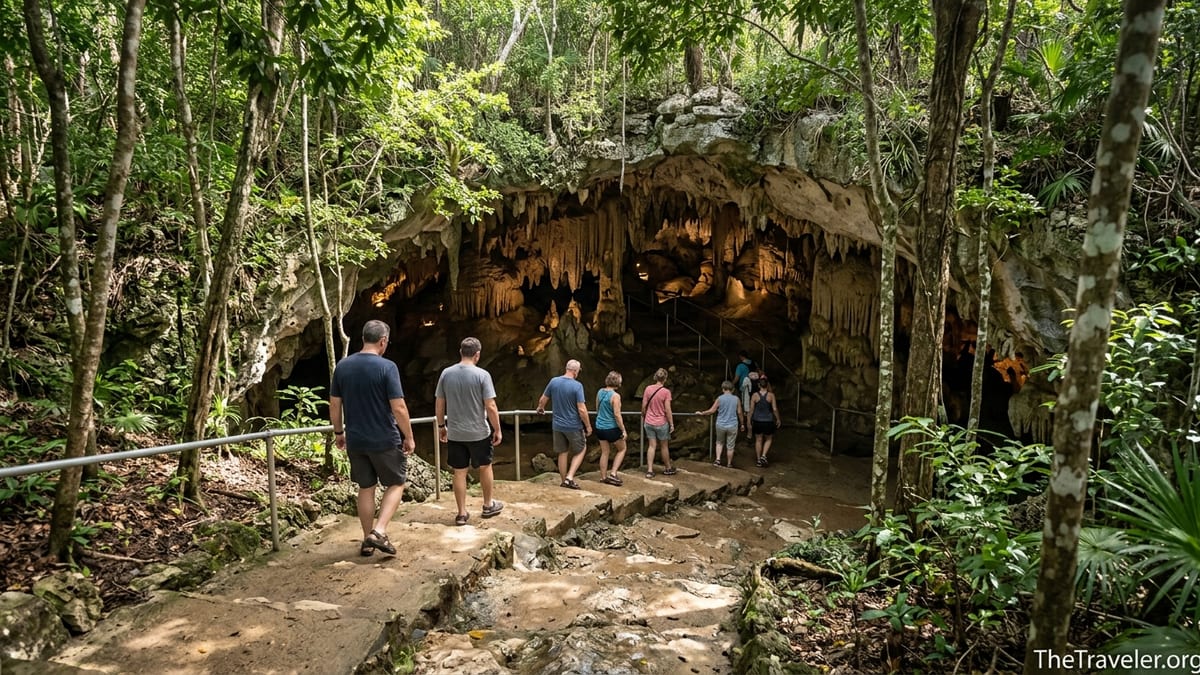
Once you reach the trailhead, the tour becomes a walking experience over compacted soil, limestone rock, and sets of steps going up and down into the cave entrances. Guides keep a moderate pace and stop for explanations and photos, but visitors are generally standing or walking for most of the 90 minutes. People who are comfortable with a city walking tour that includes some stairs usually cope well, while travelers who struggle with a single flight of stairs or prolonged standing often find this outing tiring.
Inside the caves, the environment changes abruptly from bright Caribbean sunlight to cool, dim spaces lit by spotlights. Many visitors find this refreshing and visually spectacular, but for anyone with vision challenges, balance issues, or anxiety in low light, the shifts in brightness, depth perception, and ceiling height are an important part of the decision-making process.
Steps, Slopes, and Uneven Surfaces
There is no single staircase that defines the experience, but rather many small sets of steps and sloping sections mixed throughout the tour. Expect a combination of concrete steps with simple metal handrails near entrances and more natural limestone steps or uneven carved treads as you move deeper inside. The step risers are not perfectly uniform, so you cannot rely on the regular rhythm of a hotel staircase. Visitors frequently mention needing to watch their feet closely, especially when they are looking up at stalactites or taking photos.
The forest paths leading between the three caves are generally compacted soil and crushed limestone. In dry weather they feel like a firm park trail, with some embedded rocks and roots. After heavy rain, some spots can become slick or muddy. There are modest gradients but no sustained climbs. People who manage a short walk on the Mastic Trail’s easier sections often describe the Crystal Caves paths as gentler, but they are still far from wheelchair-friendly pavements. Closed-toe shoes with decent grip are strongly recommended over flip-flops or thin sandals.
Inside the caves themselves, the floors vary from reasonably level concrete or rock pathways to sections where you step over small ridges, navigate slightly sloping rock, or walk through areas where the ceiling dips. Handrails are present on most steeper internal steps, but there are stretches where you rely on your own balance. If you use a cane on level ground, you will likely want it here, though the attraction does not permit larger walking aids that could catch on uneven rock.
For a real-world comparison, if you can comfortably manage a heritage-site visit with old stone steps, like climbing a lighthouse staircase with handrails or navigating an outdoor archaeological site with rugged paths, you will probably find this tour manageable. If even a few irregular steps with no elevator option are a concern in your daily life, Crystal Caves may present more risk or fatigue than enjoyment.
Forest Paths, Heat, and Humidity
The time outside the caves is spent on shaded tropical forest paths. Grand Cayman is hot and humid for much of the year, and North Side is no exception. Even in the shade, real-world daytime temperatures frequently sit in the upper 80s Fahrenheit with high humidity, especially from late spring through early fall. The attraction itself advises visitors to dress lightly and bring a refillable water bottle to top up at the visitor center water cooler before and after the tour.
Although the walking distance is not extreme, heat can make the experience feel more demanding, particularly for older travelers, anyone with heart or respiratory issues, or those who are sensitive to tropical climates. For example, a traveler who is perfectly comfortable walking a flat mile in an air conditioned airport might find 30 minutes of slow walking and standing in humid forest air surprisingly draining. Morning tours, particularly the first departures around 9 am, are generally the coolest and often the quietest, which can be a significant comfort advantage.
Inside the caves, the temperature drops and the air feels cooler, but it remains humid. Some visitors describe the relief of stepping into the shade and cooler cave air as one of the highlights. Others with respiratory concerns note that the heaviness of the humid air, combined with enclosed spaces, can still feel challenging. If you are affected by heat, consider planning a rest period back at your hotel or a nearby café after the tour rather than heading straight into another high-activity outing like snorkeling.
Practical measures help: wearing moisture-wicking clothing instead of heavy cotton, packing a compact handheld fan, or using a cooling towel can all reduce perceived effort. Travelers who are used to strolling shaded botanical gardens or open-air historic sites in the Caribbean will find the outdoor climate here familiar, but should still plan for frequent sips of water and sun protection on the uncovered stretches near the parking and shuttle area.
Cave Lighting, Visibility, and Enclosed Spaces
Crystal Caves are lit by fixed electric lights that highlight rock formations and guide the path. The overall feel is dim, not dark, but your eyes need time to adjust as you move from the forest into the first chamber. Guides typically pause to let everyone acclimate before proceeding, but during those first moments the contrast can challenge visitors with reduced night vision or strong glare sensitivity.
The lighting is directed onto stalactites, stalagmites, and pools, creating areas of bright reflection alongside deeper shadows. This looks beautiful in photographs but can increase visual confusion for people with depth perception issues. Edges of steps and small changes in floor level are not always marked with high-contrast strips, so it is important to move slowly and use handrails wherever they are available. Some visitors choose to bring a compact flashlight or use a phone light pointed at the ground when guides indicate it is safe and acceptable to do so, though bright beams should never be shone toward formations or other guests’ eyes.
Regarding enclosed spaces, most chambers are reasonably wide, with high ceilings in sections, especially in the so-called cathedral-like cave and the lake cave with its underground pool. However, access paths may narrow and dip, and there are points where taller visitors have to stoop slightly to avoid low rock. Anyone with significant claustrophobia should think carefully. A traveler who feels uneasy in an MRI machine or a tight elevator but is fine in small hotel rooms may be comfortable here, while someone who avoids any underground spaces might find the tour distressing.
If you are unsure, you might compare your reaction to similar attractions: guided tours in Carlsbad Caverns or large commercial caves in the United States often feel more spacious and fully paved, whereas Crystal Caves retain more of a natural, uneven character. Asking staff on site about the narrowest passages and whether guests can easily step aside or exit early can provide extra reassurance before you commit.
Seating, Resting Opportunities, and Tour Pace
Seating is one of the key considerations for visitors with mobility challenges. At Cayman Crystal Caves, there is comfortable seating at the visitor center and Treehouse Restaurant before and after the tour, including shaded outdoor tables where you can wait for your time slot. However, once you leave in the shuttle and begin the walking tour, benches or formal resting spots are limited. Some groups pause at small clearings or wider parts of the path where guests can stand off to the side, but actual places to sit down and rest along the forest trail or inside the caves are not guaranteed.
The guided format means the group generally stays together. Guides usually set a moderate pace and stop frequently to explain geology, local history, and plant life. During these commentary breaks, people lean against railings or stand with their group. Visitors who can handle 5 to 10 minute standing intervals punctuated by short walks often do well. However, travelers who require a seat every few minutes, such as those with advanced arthritis or circulation issues, may find the lack of structured seating a serious drawback.
If you have a mixed-ability party, one strategy is for the less mobile traveler to enjoy the visitor center and Treehouse Restaurant while others take the walking tour. For example, a grandparent with balance issues might choose to relax over a cold drink on the shaded deck, browse the gift shop, and watch the forest below, meeting the rest of the family when they return. This allows everyone to share the outing without pushing someone beyond their comfort zone.
Keep in mind that tours run on a schedule, so if you need to step aside frequently, the guide may encourage you to stay closer to the front or back of the group to minimize delays. If you anticipate needing extra time, discussing this at check-in and asking if a smaller or less crowded time slot is available can make the experience more manageable.
Who May Find the Tour Difficult
Given the combination of steps, uneven terrain, heat, and limited seating, certain travelers are more likely to find the Crystal Caves experience challenging. The attraction itself does not allow wheelchairs, strollers, walking aids, or crutches on the tour, which effectively excludes many visitors who rely on these devices daily. Even those who use a cane occasionally should think realistically about how they feel after 90 minutes of stop-and-go walking on irregular surfaces.
People with chronic knee, hip, or back pain often struggle most with the repeated small steps and the constant need to adjust to uneven ground. For example, a visitor who can climb one set of hotel stairs but pays for it with pain afterward may be able to complete the tour but feel significant discomfort later that day. Travelers with poor balance or a history of falls may also find the low-light, uneven environment stressful, particularly if they are used to smooth sidewalks and stable handrails.
Respiratory and cardiac conditions are another factor. While the overall exertion level is moderate, the combination of tropical humidity, short climbs, and occasional crowded moments inside the caves can feel demanding. Guests who become short of breath after a few minutes of walking on an incline should consult their doctor before planning this activity and consider whether a less physically demanding Grand Cayman experience, such as a glass-bottom boat tour or a beach day with accessible facilities at a major resort, might be a better choice.
Sensory and psychological factors matter too. People with strong claustrophobia, fear of bats, or anxiety in low-light environments sometimes underestimate their reactions until they are underground with limited immediate exit options. Those who have previously felt uncomfortable on enclosed attractions, such as submarine rides or tight historic tunnels, should approach Crystal Caves cautiously, perhaps by watching recent visitor videos in advance to get an honest sense of the space.
Key Accessibility Questions to Ask Before Booking
Because conditions and policies can evolve, contacting Cayman Crystal Caves directly before you commit is essential if mobility or accessibility are priorities. When you call or email, go beyond asking “Is it easy?” and focus on precise, practical questions that relate to how you move and what you need. The more specific you are, the better staff can advise you honestly.
For example, ask approximately how many steps you will encounter in total across the three caves, and whether any single staircase is especially steep. Clarify whether the steps are mostly concrete with railings or primarily natural rock and dirt. Request details about the narrowest sections of the path, including whether two adults can comfortably pass each other or if single-file is required. If you are taller, ask whether there are particular spots where stooping is unavoidable and how long those sections last.
It is also worth enquiring whether there are any opportunities to opt out of one of the three caves if you decide mid-tour that you have reached your limit. Some attractions allow guests to wait in a shaded outdoor area while the rest of the group completes a final chamber, then rejoin them on the return path. Policies can change, so do not assume this is available, but ask. Similarly, check whether staff can recommend a quieter tour time, such as the earliest or latest departures, which may feel less rushed and crowded for those who move more slowly.
Finally, if you are visiting on a cruise ship excursion, remember that accessibility is affected not only by the cave terrain but also by the transportation arranged by your tour operator. Ask the cruise excursion desk or local tour company whether coach steps are high, if there are handrails on both sides, how long the drive takes each way, and what happens if you decide not to enter the caves after seeing the trailhead. Having clear answers in writing on your booking confirmation or tour description can help you choose the option that best matches your comfort level.
Alternatives for Travelers With Limited Mobility
If you conclude that Crystal Caves will be too demanding, Grand Cayman still offers many ways to experience the island’s natural beauty and history without extensive walking on uneven ground. For visitors who can manage a few steps but prefer more controlled environments, popular catamaran or powerboat trips to Stingray City, combined with limited-mobility friendly island drives, may be more comfortable. Many boat operators help guests on and off using sturdy ladders and provide flotation vests, and some tours emphasize scenic viewing from the boat for those who do not wish to enter the water.
Resort day passes along Seven Mile Beach can also be a good choice, especially at properties that publish accessibility information and offer ramps, accessible restrooms, and relatively firm walkways close to the sand. This setup allows travelers with mobility challenges to enjoy the Caribbean sea and shade without committing to long walks or uneven forest trails. Checking with individual hotels or reading their accessibility guides before purchase helps set realistic expectations about beach access and pool areas.
For a more educational outing, consider indoor or mostly flat attractions such as the Cayman Turtle Centre’s accessible viewing areas, or small museums and galleries in George Town with ramps and air conditioning. While these do not replicate the underground drama of Crystal Caves, they can offer rich cultural context and wildlife encounters in spaces that better support wheelchairs, walkers, and those who tire easily.
Some travelers choose to divide activities by ability level within their group. For example, one adult and children might visit Crystal Caves while a less mobile relative spends the same morning on a shorter, low-impact tour like a drive along the North Side coast with scenic photo stops and a relaxed lunch at a seaside café. Planning in this way can preserve inclusion and shared memories without putting everyone through the most physically demanding option.
The Takeaway
Cayman Crystal Caves delivers a memorable combination of tropical forest and underground landscapes, but it is not a universally accessible attraction. The experience involves a 90 minute guided walking tour over uneven limestone, steps with inconsistent risers, humid forest paths, and dimly lit cave interiors. There are no ramps or wheelchair routes on the tour itself, and seating during the walk is minimal.
Travelers who can comfortably manage moderate walks with some stairs, are reasonably steady on their feet in low light, and tolerate tropical heat typically find the tour enjoyable and manageable. Visitors who rely on mobility aids, struggle with balance, or require frequent opportunities to sit down may find it difficult or inadvisable. Sensitivities to enclosed spaces, bats, and humidity should also be factored into the decision.
The most important step is to match the reality of the terrain and climate with your personal abilities on a good day, rather than your best-case hopes. Contacting the attraction directly with detailed questions, choosing cooler morning departure times, wearing sturdy footwear, and planning for rest before and after the tour all improve the experience for those who decide to go. For everyone else, Grand Cayman offers plenty of alternative activities that showcase the island’s natural beauty without the same physical demands.
FAQ
Q1. Are the Grand Cayman Crystal Caves wheelchair accessible?
The guided tour is not wheelchair accessible. The attraction does not permit wheelchairs, walkers, crutches, or strollers on the cave paths because of steps, uneven rock, and narrow sections. Visitors who use mobility devices may still enjoy the visitor center and Treehouse Restaurant area, but not the walking tour itself.
Q2. How difficult is the walking and how many steps are involved?
The tour lasts about 90 minutes and involves repeated small sets of steps, short slopes, and uneven limestone surfaces rather than one long staircase. Most reasonably active visitors who are comfortable with a few flights of stairs and park-style trails find it manageable, but people with significant knee, hip, or balance issues can find it tiring.
Q3. Can I bring a cane on the tour?
Certain types of canes may be allowed, but larger walking aids are not. If you rely on a cane for balance, contact the attraction in advance, describe the specific type you use, and ask whether it is acceptable on the narrow, uneven paths inside the caves.
Q4. What shoes should I wear for the Crystal Caves?
Closed-toe shoes with good grip, such as walking shoes or light hiking trainers, work best. Thin sandals and flip-flops are not advisable because the paths and steps are uneven, and sections can be slick after rain. Good footwear makes a noticeable difference in stability and comfort.
Q5. How hot does it get and is the tour suitable for people sensitive to heat?
Outside temperatures are often in the upper 80s Fahrenheit with high humidity. The forest paths are mostly shaded, and the caves themselves are cooler but still humid. People with heart, lung, or heat sensitivity issues should consider booking the earliest morning tour, carrying water, and speaking with their doctor before visiting.
Q6. Is the tour suitable for someone with claustrophobia?
Many chambers are fairly spacious, but access routes can narrow and ceilings can lower in places. Visitors who are mildly claustrophobic and comfortable in other commercial caves may cope well, while those with severe claustrophobia often find the environment stressful. Watching recent cave tour videos and discussing concerns with staff beforehand can help you decide.
Q7. Are there places to sit and rest during the tour?
There is ample seating at the visitor center and Treehouse Restaurant before and after the tour, but benches along the actual walking route are limited. Most rest breaks are standing pauses while the guide speaks. If you need to sit frequently, this tour may not be a good fit.
Q8. Can I skip one of the caves if I get tired partway through?
Policies can vary, so you should ask on the day of your visit. In some cases, guests who feel they have reached their limit can wait in a shaded outdoor spot near an entrance while the group explores a final chamber. However, you should not assume this is guaranteed and should clarify options before joining the tour.
Q9. Is the tour appropriate for young children or toddlers?
Young children who can confidently walk on uneven ground and manage stairs usually enjoy the caves, but strollers are not allowed and parents must be prepared to hold hands and supervise closely on steps and near edges. Toddlers who tire quickly or need to be carried for long periods may make the experience physically demanding for adults.
Q10. What are good alternative activities in Grand Cayman for limited mobility?
Alternatives include resort or beach club day passes on Seven Mile Beach with accessible facilities, glass-bottom boat or calm-water catamaran tours, visits to the Cayman Turtle Centre’s more accessible viewing areas, and short scenic island drives with limited walking. These options let travelers enjoy the island without navigating uneven cave terrain.