


More news on this day
A fresh Federal Aviation Administration ground stop at a major U.S. hub has collided with long‑running terminal seating and space constraints, briefly turning the airport into the world’s most delay‑affected departure point and underscoring how fragile the country’s busiest connecting nodes remain at the height of the summer travel rush.
Get the latest news straight to your inbox!
Ground Stop Ripples Through Global Flight Schedules
Publicly available FAA advisories show that a sudden ground stop at the hub forced departures bound for the airport to hold at their origin, sharply reducing arrival capacity and triggering rolling delays across the domestic network. Ground stops are the most restrictive form of traffic management, halting all departures within the scope of the order until conditions at the destination improve, and they are typically reserved for severe weather, runway blockages or short‑notice airspace constraints.
Data from live flight‑tracking dashboards on Tuesday indicated that, while the ground stop itself was relatively short in duration, its effects were amplified by the airport’s role as a primary connecting point for one of the largest U.S. carriers. Once inbound aircraft were held, the knock‑on impact rapidly spread to onward legs, with late‑running aircraft and crews cascading delays to secondary hubs and smaller spokes.
Published industry analysis on FAA delay programs notes that a single ground stop or aggressive ground delay program at a major hub such as Chicago, Dallas or Atlanta can send disruption across the national system in less than an hour, as aircraft and crews miss their scheduled turns. At this hub, those mechanics appear to have played out in full, with late‑evening departure banks particularly affected as airlines struggled to reset operations before overnight curfews and crew duty limits took hold.
By late afternoon local time, several independent trackers ranked the airport among the top global sources of departure delays, with hundreds of flights operating behind schedule and dozens more canceled outright. The spike briefly placed the hub ahead of traditionally congested gateways in Europe and Asia, a reflection of how tightly U.S. domestic schedules are currently calibrated to aircraft and crew availability.
Chronic Seating Shortages Magnify Passenger Disruption
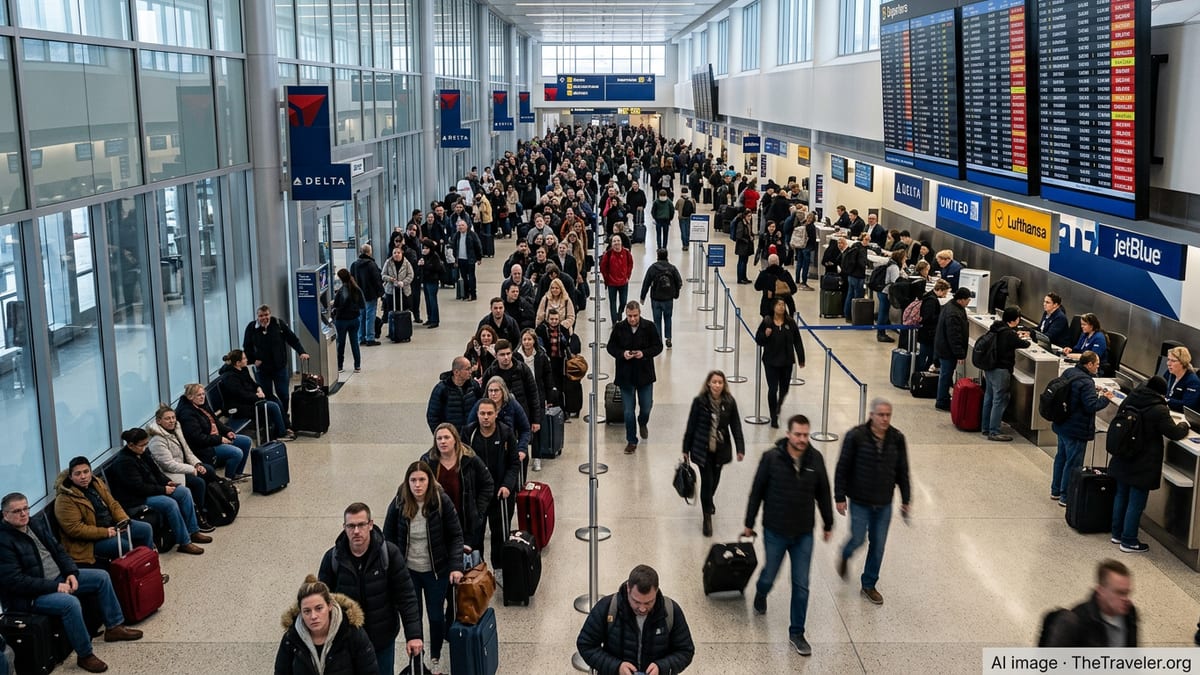
While the ground stop was the formal trigger for the operational slowdown, the experience for travelers on the concourses was shaped by issues that predate this week’s turbulence. Passenger accounts and recent online discussions have repeatedly highlighted overcrowded gate areas at the hub, with limited seating relative to the number of flights scheduled out of each concourse during peak banks.
Comments shared across aviation forums in recent days describe boarding zones where passengers routinely sit on the floor, line the hallways or stand deep into the circulation space once all fixed seats are occupied. Some travelers note that when all gates in a pier are active, there is effectively no quiet area to wait, and that basic amenities such as charging points and nearby restrooms become overwhelmed long before any formal disruption occurs.
These accounts align with broader conversations about “undersized” U.S. terminals, where gate counts and schedule growth have outpaced waiting‑area expansion. In these facilities, even routine 30‑ to 45‑minute delays can leave passengers clustered shoulder‑to‑shoulder around departure doors, with little room for those rebooked from canceled services. When multiple waves of delayed flights stack up, gate agents are left managing crowds in spaces originally designed for far fewer people.
At this week’s affected hub, the combination of a federal ground stop and already stretched concourses appears to have produced that kind of pressure cooker. With new arrivals from unaffected flights pouring into seating areas already filled with delayed passengers, wait times for food, restrooms and customer‑service desks grew rapidly, and many travelers reported moving between concourses simply in search of somewhere to sit.
Weather, Infrastructure and Staffing Collide
According to FAA operations summaries and regional weather reports, fast‑moving thunderstorms and low visibility around several key hubs in recent days have repeatedly constrained arrival and departure rates, forcing controllers to meter traffic more aggressively than airlines had planned for. In this case, adverse conditions in the terminal area and en‑route corridors combined with high seasonal demand to push the hub’s tightly scheduled operation beyond its practical limits.
Federal traffic management documents and recent analytical reports point out that the overall number of ground stops in the U.S. has risen since the pandemic period, reflecting both volatile weather patterns and persistent staffing challenges in certain air traffic control facilities. Even short ground holds can trigger long queues for departures when departure banks are already tightly packed and runway throughput is limited.
Infrastructure constraints compound those pressures. Some large hubs are currently operating with runways out of service for maintenance or using work‑around arrival procedures that reduce capacity in marginal weather. Terminal modernization has lagged in several markets, leaving carriers to add frequencies and larger aircraft into legacy concourses that were never designed for today’s passenger volumes or security requirements.
Industry forecasts published this month by federal transportation analysts project continued growth in U.S. passenger traffic over the next two decades, with domestic demand already exceeding some pre‑pandemic benchmarks. Without significant investment in both physical infrastructure and air traffic staffing, analysts warn that severe delay spikes of the kind seen this week may become more common, particularly at the handful of megahubs that underpin most national route networks.
Global Rankings Highlight Systemic Vulnerabilities
The fact that a single U.S. hub could briefly top global delay rankings underscores how concentrated airline operations have become around a few fortress airports. Data aggregators that track disruptions worldwide typically show a rotating cast of major hubs trading places at the top of the delay tables, but the latest spike stands out for the speed with which an otherwise routine day degraded into a global outlier.
According to publicly shared statistics from delay‑tracking platforms and airline performance dashboards, once the ground stop at the hub was issued, the share of on‑time departures dropped sharply, even as some international gateways elsewhere continued to operate with relatively modest disruption. That pattern suggests that the problem was less a worldwide weather event than a domestic choke point that propagated outward through tight connection windows.
Travel analysts note that this concentration risk is a structural feature of the U.S. hub‑and‑spoke model. Large carriers schedule waves of inbound aircraft to arrive within short windows, followed by timed departure banks that shuttle connecting passengers to their final destinations. Any constraint on arrivals during those banks, whether from a ground stop or slower‑than‑planned runway throughput, immediately threatens dozens of downstream flights.
Other recent cases at hubs such as Chicago O’Hare, Dallas Fort Worth, San Francisco and Houston illustrate the same pattern: a localized capacity problem, followed by a national and occasionally international ripple. This week’s episode adds to that record, offering another data point in the ongoing debate over how resilient U.S. air travel really is when one cornerstone airport suddenly falters.
Pressure Builds for Terminal Upgrades and Better Contingency Planning
The images and accounts emerging from the hub during the ground stop are likely to intensify scrutiny of how airports and airlines design passenger spaces for irregular operations. Advocates for infrastructure expansion argue that gate lounges, circulation corridors and customer‑service counters should be sized for occasional surges, not just for average loads on a normal day.
Recent federal policy documents and funding announcements have emphasized resilience, with grants targeted toward modernizing concourses, expanding hold rooms and upgrading baggage and security systems. Yet construction timelines are long, and many current projects were scoped years before today’s demand fully materialized. In the interim, airports are relying on temporary seating, flexible use of under‑utilized concourses and more extensive use of digital queuing to spread crowds.
Operational experts writing in trade publications suggest that airlines and airports can also refine their contingency playbooks for ground stops and extended ground delay programs. Strategies include pre‑identifying overflow areas for stranded passengers, deploying mobile customer‑service teams away from the busiest gates and adjusting connection rules in real time to protect the most time‑sensitive journeys.
For travelers, this week’s disruption is another reminder to build buffers into itineraries that rely on complex connections through major hubs, especially during peak summer months. While the specific ground stop that produced the latest spike in delays has now been lifted, the underlying friction between surging demand, constrained infrastructure and volatile weather patterns remains unresolved, leaving the system vulnerable to the next shock.