


More news on this day
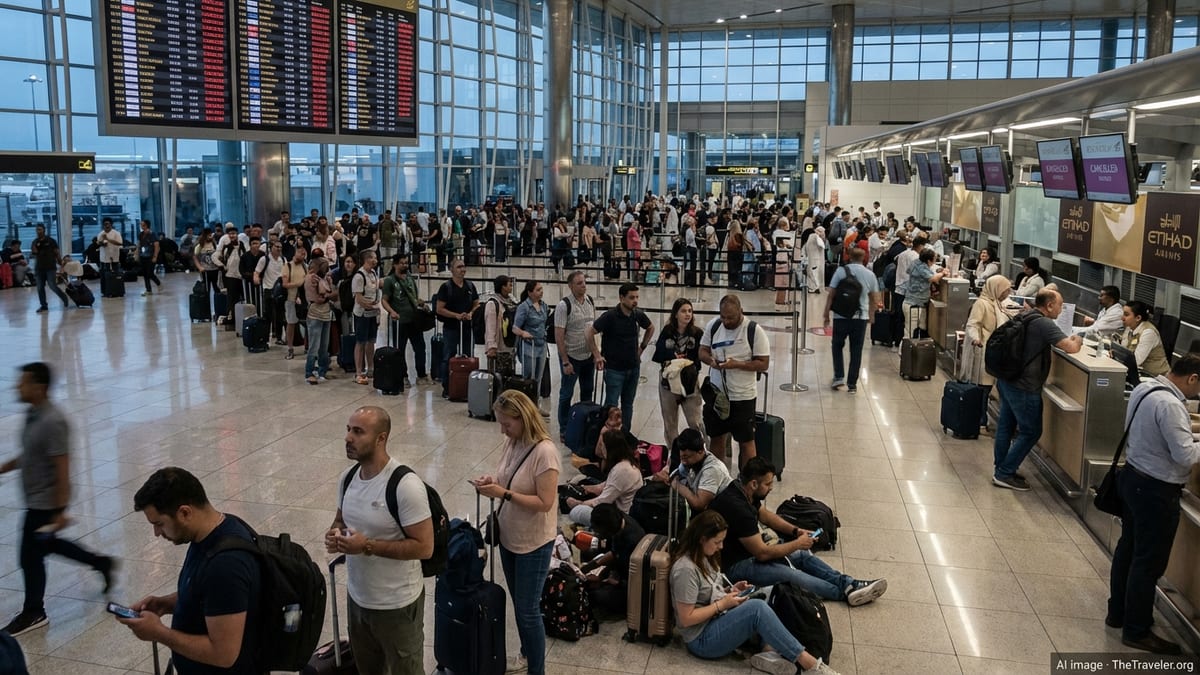
Flight-tracking snapshots for September 19, 2026 recorded 1,585 delays and 40 cancellations across major Gulf gateways, underscoring how quickly disruptions can spread through one of the world’s most connection-heavy aviation corridors.
Get the latest news straight to your inbox!
What the disruption numbers show and when they occurred
The 1,585 delays and 40 cancellations reflect a region-wide pattern rather than a single-airport outage, based on publicly available flight-status tallies circulating in published coverage. The timing is notable: it lands in a period when Gulf hubs are heavily relied on for long-haul connections between Europe, Asia, and Africa, making even modest schedule slippage more likely to cascade into missed onward flights.
Published reports tied the counts to major airports across Saudi Arabia, the United Arab Emirates, Qatar, Kuwait, and Oman, with prominent hubs including Riyadh, Jeddah, Dubai, Abu Dhabi, Doha, and Kuwait City. Because these airports operate in tightly banked “waves” of arrivals and departures designed for short connections, delays can disproportionately affect travelers attempting to connect onward within a narrow window.
While the 24-hour totals are often the headline, the traveler impact typically stretches beyond a single day. Aircraft rotations, crew assignments, and gate availability can carry the after-effects into the next schedule cycle, especially for airlines operating multi-leg patterns that re-use the same aircraft across several sectors.
Why Gulf delays cascade faster than travelers expect
Operational backlogs can build quickly at hubs where multiple long-haul banks overlap. When inbound flights arrive late, gates remain occupied, ground handling shifts to recovery mode, and departures can be pushed back even if the aircraft and passengers are ready. The result is a network-style ripple rather than an isolated set of late departures.
Crew duty-time limits add another lever that can turn a delay into a cancellation. If a flight slips late enough that a crew would exceed legal duty limits, airlines may have to delay further for a replacement crew or cancel if no viable substitution exists. That dynamic is especially relevant at hubs where flights are scheduled to depart late evening to meet early-morning arrival banks elsewhere.
Airspace routing and flow management can also contribute to longer block times. In 2026, parts of the region have seen heightened attention to airspace risk management in published aviation advisories, and route adjustments can increase flight times, tighten turnarounds, and reduce schedule resilience when buffers are thin.
Airspace advisories and route changes in 2026
In parallel with the disruption counts, publicly available aviation safety advisories have continued to flag elevated operational risk in portions of the Middle East and adjacent airspace. The European Union Aviation Safety Agency (EASA) has issued and extended conflict-zone guidance related to the Persian Gulf and Gulf of Oman during 2026, a reminder that carriers may revise routings, altitudes, or alternates on short notice when risk assessments change.
For travelers, the practical implication is that flight times can shift even when an airline does not formally change a departure slot. A longer-than-planned en-route segment can still cause missed connections at hub airports, particularly on itineraries with tight connection times and a second leg that departs in a fixed bank.
Separately, airport and air navigation publications can also indicate peak-hour delay susceptibility. For example, Qatar’s aeronautical information publications have included notices referencing traffic delays during peak hours at Hamad International Airport through the end of 2026, which can matter for travelers trying to connect during the busiest arrival-and-departure waves.
What travelers can do during a disruption wave
When disruption is widespread, the biggest constraint is often capacity, not willingness to help. As seats on later flights fill with displaced passengers, rebooking options narrow quickly. Travelers with critical connections may have better outcomes by switching to a later long-haul departure with a longer connection buffer, even if it means arriving at the final destination a few hours later than planned, because it reduces the risk of a second misconnect.
Before leaving for the airport, checking an airline’s flight-status tools and the airport’s live flight information pages can help avoid unnecessary terminal waits when a delay becomes substantial. Some carriers publish disruption-specific guidance that emphasizes monitoring email or app notifications for schedule changes, and travelers should keep boarding passes and rebooking receipts available for any follow-up claims.
For itineraries that involve multiple Gulf stops, it can also help to reassess connection times in both directions, not just the outbound. A late arrival into a hub can disrupt the return sector if the same aircraft is scheduled to operate onward, and that can matter for travelers attempting to protect hotel bookings, tours, or cruise embarkations at their destination.
Passenger rights: where rules are clearer and where they vary
Passenger protection frameworks in the Gulf are not uniform, and travelers should expect differences by country, airline, and the reason for disruption. Saudi Arabia is one of the more structured examples: the General Authority of Civil Aviation’s passenger-rights materials describe obligations that can include care such as hotel accommodation and transport in certain extended-delay scenarios, along with defined complaint channels for escalation.
However, even where rules exist, eligibility can hinge on whether the disruption is attributed to factors within the airline’s control versus weather, airspace restrictions, or other circumstances. Travelers seeking compensation or reimbursement typically need to keep documentation showing the original schedule, the revised schedule, and any out-of-pocket costs such as hotels or ground transport booked because of the disruption.
For passengers transiting Gulf hubs on tickets that originate in other jurisdictions, additional consumer rules may apply depending on itinerary structure and operating carrier. The most practical approach during a large disruption event is still immediate: secure the next viable flight option first, then address reimbursement and formal complaints afterward with complete documentation.