

More news on this day
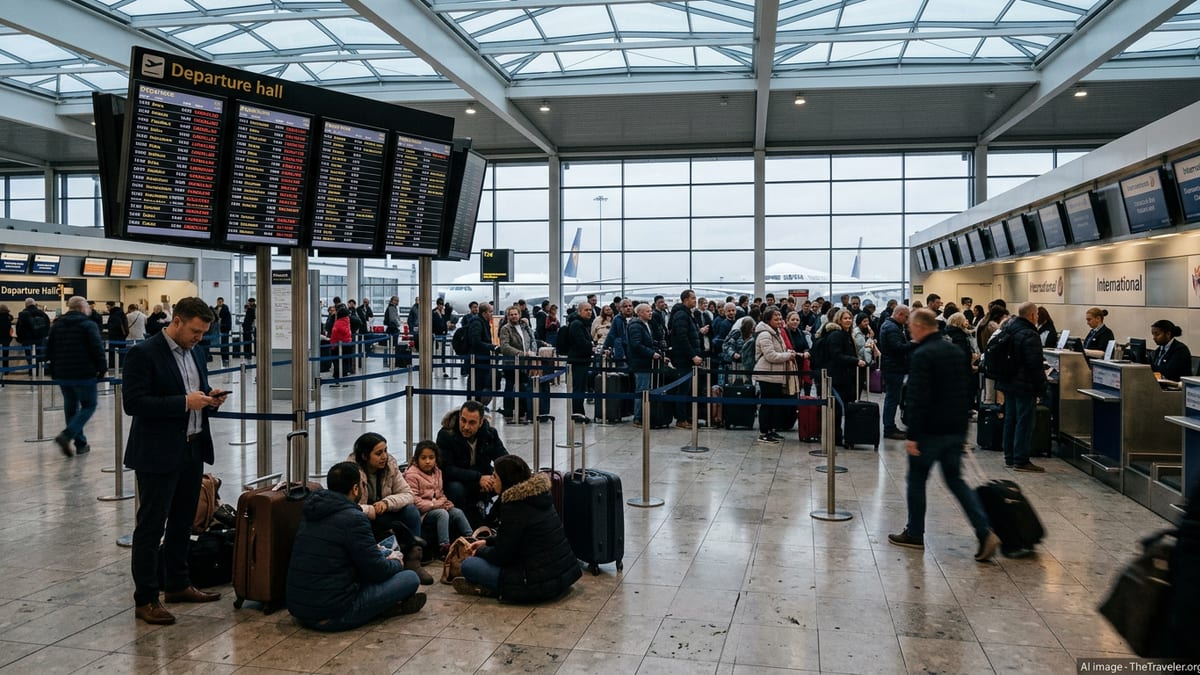
Passengers at Manchester Airport faced hours of uncertainty on Thursday as a fresh wave of cancellations and delays involving Qatar Airways, Etihad, Emirates, Gulf Air and Norse Atlantic upended long-haul travel, disrupting at least 16 flights and key connections to hubs including Doha, Frankfurt, Hamburg, Belfast and Amsterdam.
Regional Conflict Sends Shockwaves Through Manchester Schedules
The latest day of disruption at Manchester comes against the backdrop of a fast‑moving conflict in the Middle East that has triggered rolling airspace closures and wholesale schedule cuts by Gulf carriers. Authorities in Qatar, the United Arab Emirates and neighbouring states have restricted or fully closed sections of airspace following missile and drone exchanges involving Iran, Israel and the United States, prompting airlines to suspend most regular passenger services.
Qatar Airways confirmed this week that its scheduled passenger operations remain temporarily suspended while Qatari airspace is closed, extending a policy that covers travel dates from 28 February into mid‑March. Etihad and Emirates have issued similar notices, with both carriers focusing on limited cargo and repatriation services while warning customers not to travel to their hubs unless they hold confirmed seats on specifically notified flights.
The knock‑on effect for Manchester, a key UK gateway for long‑haul traffic outside London, has been severe. Multiple departures and arrivals linking the airport with Doha, Abu Dhabi and Dubai were scrubbed from departure boards on Thursday morning, while European partners struggled to absorb displaced passengers through alternative routings via Frankfurt, Amsterdam and other hubs.
Data from European air travel trackers indicated that more than a thousand flights across the continent were delayed or cancelled on 5 March, with Manchester among the worst affected British airports. Long‑haul carriers operating through the Gulf accounted for a significant share of the cancellations, compounding wider congestion at major continental hubs.
Sixteen Cancellations and a Day of Rolling Delays
Airport operations staff at Manchester reported at least 16 cancellations tied to services operated or marketed by Qatar Airways, Etihad, Emirates, Gulf Air and Norse Atlantic, in addition to a long list of delayed departures as airlines reworked routings around shuttered air corridors. Several Manchester–Doha and Manchester–Abu Dhabi rotations were removed outright, while select Dubai services alternated between severe delay and last‑minute cancellation as operational windows shifted.
Passengers booked on Gulf Air codeshares via partner airlines also found their plans unravelled. Although the Bahraini carrier does not operate its own metal to Manchester, its network feed into Frankfurt, Amsterdam and other European gateways meant that cancellations out of the Gulf left connecting legs to northern England without inbound traffic, forcing schedule cuts or equipment swaps.
Norse Atlantic, the low‑cost long‑haul specialist that has served Manchester on seasonal transatlantic routes, contributed to the disruption as it adjusted its late‑winter programme. Industry documents for the 2025–26 season show a pause in certain services through late March, and aviation sources at the airport said the carrier had withdrawn additional rotations at short notice as transatlantic demand softened and connecting flows from the Gulf dried up.
The practical impact for travellers was a departure board dominated by red “cancelled” and “delayed” notices through much of the day. Check‑in queues formed early as word of the overnight schedule changes filtered through, with many passengers learning only at the airport that their flights to the Middle East or beyond had been removed or retimed by several hours.
Major Hubs From Doha to Frankfurt and Amsterdam Clog Up
The turbulence at Manchester is part of a larger tangle stretching along some of the world’s busiest long‑haul corridors. With Doha’s Hamad International functioning on a skeleton schedule and Abu Dhabi and Dubai prioritising repatriation services, European hubs that normally funnel traffic to and from the Gulf have been forced to absorb wave after wave of stranded passengers.
In Frankfurt, where Lufthansa and partner airlines connect northern England with Asia and the Americas, terminal operators reported mounting congestion as misaligned arrival banks from the Gulf threw carefully choreographed transfer windows into disarray. Delayed Middle East arrivals left some Manchester‑bound flights departing half‑empty while others waited for reassigned passengers, creating a patchwork of late operations and missed onward connections.
Amsterdam Schiphol saw similar strains. With selected flights between the Dutch hub and the Gulf cancelled outright, passengers bound for Manchester, Belfast and other UK regional airports were rebooked onto scarce seats, often with improvised routings via Hamburg, Paris or Zurich. Each fresh delay rippled outward, forcing crew rescheduling, aircraft swaps and longer‑than‑usual turnaround times.
Hamburg and Belfast, though smaller nodes in the long‑haul ecosystem, also felt the pressure. Regional services that normally feed into Manchester’s transatlantic and Gulf departures instead became ad‑hoc lifelines for travellers repositioned from other disrupted routes, leading to full flights, tight connection windows and occasional boarding denials when aircraft reached weight or seat limits.
Passengers Face Rebookings, Overnight Stays and Uncertain Timelines
For individual travellers, the operational jargon translates into missed holidays, broken business itineraries and nights spent in airport hotels. Many passengers transiting Manchester on complex itineraries via Hamad, Abu Dhabi or Dubai reported being rebooked for dates more than a week away as airlines worked through huge backlogs created since the first wave of airspace closures in late February.
Airlines urged customers not to travel to Manchester Airport unless they had received confirmation that their specific flight was operating, and to make use of online rebooking and credit options where possible. Flexible disruption policies introduced in recent days allow some passengers to switch to alternative European gateways or accept vouchers instead of cash refunds, although reports from travel agents suggest call centres and chat services have been stretched to capacity.
Those who did reach the airport faced long waits at check‑in and transfer desks. With Qatar Airways, Etihad and Emirates still operating only a limited number of special services, seats on any flight leaving the region in the coming days are at a premium. Travel insurers have warned that standard policies may not cover all additional costs associated with the conflict‑linked disruption, increasing the financial burden on stranded travellers.
Local tourism businesses in northern England are also bracing for fallout. Hoteliers near Manchester Airport noted a spike in last‑minute bookings from passengers whose flights to the Gulf, Asia or Australia were postponed, while inbound tour operators reported cancellations from high‑spending visitors who had planned to reach the region via Middle Eastern hubs.
Outlook: Gradual Recovery but Prolonged Uncertainty
Industry analysts caution that even once key Middle Eastern airspace begins to reopen further, normal operations at Manchester and other European airports will not resume overnight. Airlines will first have to reposition aircraft and crews stranded around the world, then work through days of accumulated backlogs while monitoring the security situation along their traditional flight corridors.
Some signs of recovery are emerging, with Emirates preparing a larger programme of repatriation flights and European carriers exploring alternative routings that skirt the most sensitive zones. Yet with thousands of flights already cancelled across the region in less than a week, capacity on trunk routes between Europe, the Gulf and Asia is expected to remain tight for some time.
For Manchester, the immediate priority is managing passenger flows through its terminals while maintaining runway operations amid a patchy and fast‑changing schedule. Airport officials have encouraged travellers to arrive only with verified bookings and to remain in close contact with their airlines or travel agents for the latest information on departures and connections.
With key Gulf partners, European network carriers and leisure operators all adjusting their plans day by day, aviation watchers say the northwest hub is likely to see further timetable revisions in the coming week. For now, passengers heading through Manchester on long‑haul journeys are being advised to build in extra time, prepare for unexpected layovers and treat published schedules as provisional rather than guaranteed.