


More news on this day
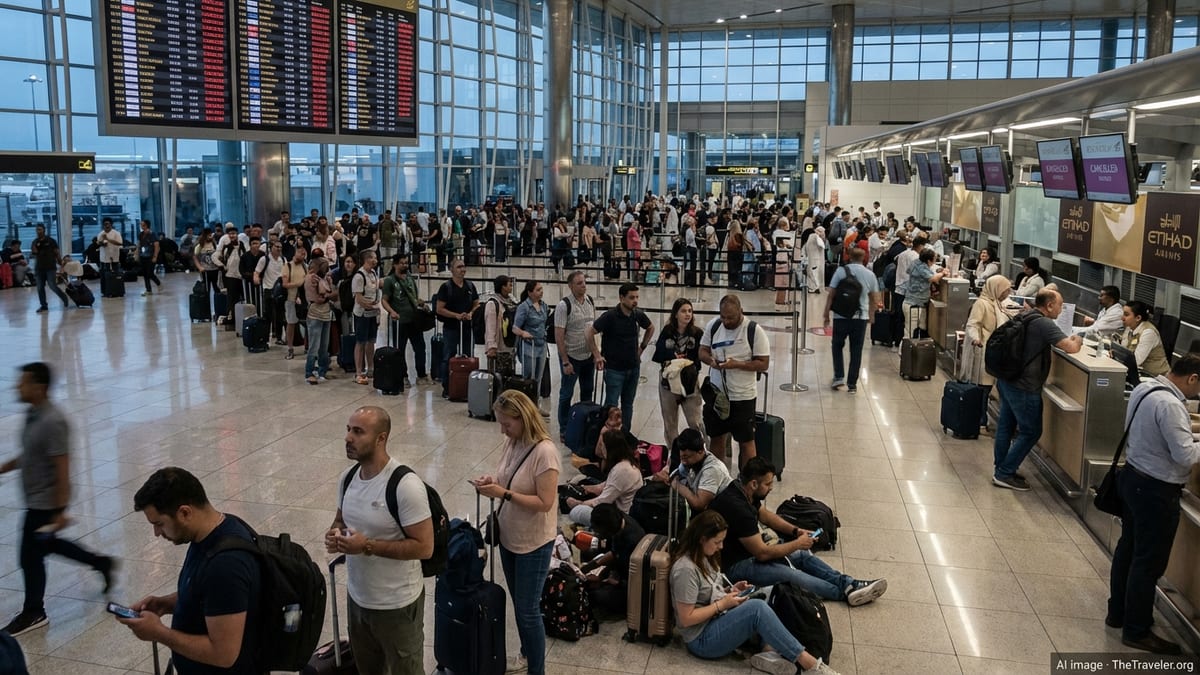
More than 60 flight cancellations and 878 delays across the Gulf over recent days are disrupting travel for thousands of passengers, with Riyadh, Cairo and eight other airports experiencing knock on impacts on regional and long haul schedules.
Get the latest news straight to your inbox!
Operational Strain Spreads Across Key Gulf Hubs
Publicly available aviation data and regional coverage indicate that a fresh wave of disruption has swept across major Gulf airports, with more than 60 cancellations and 878 delays recorded in a short period. The latest figures build on an already difficult summer for air travel in the region, where infrastructure strain, weather related challenges and airspace restrictions have combined to unsettle normally reliable hub operations.
Riyadh’s King Khalid International Airport, which handles hundreds of movements per day, has been operating under sustained pressure through August 2026, according to aggregated airport statistics. Earlier in the month, one day of operations alone saw more than 30 flights cancelled at the Saudi capital’s main gateway, illustrating how quickly cascading delays can translate into outright cancellations when turnaround buffers are exhausted.
Reports from Gulf focused outlets describe a broader pattern in which congestion at one hub forces last minute schedule adjustments at others. As airlines juggle aircraft rotations across Riyadh, Jeddah, Dubai, Doha and Kuwait City, even minor disruptions in one city can trigger rolling delays across an entire network, driving up the overall tally of late departures and arrivals.
The current spike in cancellations and delays follows several months in which Gulf carriers have been rebuilding capacity to meet strong demand. Industry analyses suggest that this rapid ramp up, combined with tight aircraft availability and heavy reliance on a small number of busy hubs, has left operations vulnerable to shocks.
Riyadh and Cairo See Knock On Cancellations
Riyadh and Cairo have emerged as two of the most visible flashpoints in the latest disruption cycle. Flight tracking records show that Riyadh has experienced repeated clusters of cancellations on peak days in August, affecting both departures and arrivals across a mix of regional and international routes. On one mid month Friday, publicly available logs recorded 32 cancellations at King Khalid International Airport, with services linking the Saudi capital to Cairo among those affected.
Cairo International Airport, one of Africa’s busiest hubs, is closely tied into Gulf traffic flows and has been feeling the downstream effects. Airline schedule trackers on routes between Riyadh and Cairo show persistent delay rates, with some data providers calculating that close to one in five flights on the corridor have operated late over the past year and that average delays can exceed an hour on bad days.
Carriers connecting Riyadh and Cairo, including regional low cost and full service airlines, have been adjusting departure times, consolidating frequencies and, in some cases, cancelling selected rotations when aircraft and crew are out of position. While many affected flights are rescheduled within 24 hours, the resulting backlog of passengers can strain check in, transfer and baggage systems at both ends of the route.
Public information from Riyadh’s airport operator highlights efforts to analyze on time performance by carrier and day of week in order to identify pressure points. Recent punctuality breakdowns by airline serving Cairo from Riyadh show fluctuating on time percentages and average delays that tend to climb on the busiest travel days, indicating that schedule resilience remains limited.
Eight Other Airports Face Ripple Effects
Beyond Riyadh and Cairo, at least eight additional airports around the Gulf and wider Middle East are experiencing related disruptions. Flight tracking snapshots and regional media coverage from recent days point to elevated delay and cancellation counts at Dubai, Doha, Jeddah, Kuwait City, Bahrain, Abu Dhabi and other secondary hubs that play key roles in regional connectivity.
One recent analysis of Middle East operations cited more than a thousand delays and over a hundred cancellations across the region on a single day in mid August, underscoring how quickly network wide disruption can build once airspace constraints or weather events disrupt planned routings. In several instances, flights have been rerouted around sensitive airspace or congested corridors, extending sector times and narrowing the margin for on time arrivals.
Airlines in the Gulf typically bank arrivals and departures to maximize connection opportunities, meaning that a late inbound can jeopardize onward links for hundreds of passengers. When multiple banks are affected, carriers have little choice but to delay subsequent departures, swap aircraft or trim frequencies, which helps explain the sharp rise in same day delays across multiple airports.
Secondary airports that rely heavily on inbound traffic from major Gulf hubs are particularly exposed. When an originating service from Riyadh, Dubai or Doha is cancelled or heavily delayed, there may be no alternative flight until the following day, leaving travelers stranded and adding to the region’s overall disruption statistics.
Causes Range from Airspace Limits to Weather and Capacity
The spike in cancellations and delays has been shaped by a combination of factors rather than a single cause. Regional news outlets and industry reports point to continuing reroutes around sensitive airspace following this year’s security tensions, which have narrowed flight corridors over parts of the Gulf and pushed more traffic into already busy pathways over Saudi Arabia and the eastern Mediterranean.
In parallel, the Gulf’s summer weather patterns have brought occasional episodes of heavy rain, dust storms and high winds that can temporarily close runways or reduce arrival rates at key airports. When weather driven restrictions coincide with peak travel waves, holding patterns and diversions can quickly cascade into missed slots and eventual cancellations.
Capacity constraints are adding to the pressure. Aircraft delivery delays reported across the global industry have limited the number of spare jets available to cover unexpected maintenance or crew availability issues. Gulf based airlines that expanded aggressively before the summer now have little slack to absorb irregular operations, so a single mechanical issue or late inbound can disrupt several subsequent sectors.
Analysts note that the region’s reliance on tight connection windows at mega hubs amplifies the impact of any disruption. Where point to point networks can sometimes recover overnight, hub and spoke models in the Gulf may require several days of schedule adjustments before on time performance metrics fully stabilize.
What Passengers Using Riyadh, Cairo and the Gulf Should Expect
For travelers with upcoming itineraries through Riyadh, Cairo and other affected airports, the current pattern of disruption suggests that additional contingency planning is advisable. Data led travel platforms tracking the Riyadh to Cairo corridor, for example, have highlighted that some days of the week see delay rates well above the route average, while early morning and late night departures can be particularly exposed when aircraft positioning is tight.
Regional travel coverage in late August has emphasized the importance of confirming flight status before heading to the airport, particularly for itineraries involving multiple Gulf transfers. Several airlines have issued travel advisories around changing schedules, urging passengers to monitor booking management tools and mobile applications for real time updates on rebookings and gate changes.
Experts who analyze on time performance trends recommend that where possible, passengers prioritize longer connection windows when routing through congested hubs such as Dubai, Doha, Riyadh or Jeddah. Historical delay data from flight search platforms suggests that itineraries built on very tight minimum connection times are more likely to misconnect during periods of elevated disruption like those seen in August 2026.
For now, publicly available statistics indicate that while the majority of flights in and out of the Gulf are still operating, the tally of more than 60 cancellations and 878 delays across Riyadh, Cairo and eight other airports in recent days reflects an air travel environment that remains fragile. Travelers using these hubs in the coming weeks are likely to benefit from conservative planning, flexible tickets where possible and close monitoring of operational updates.
Regional Gulf disruption analysis
Riyadh King Khalid cancellations log